Personal Agent Protocol
AAP 4.0 is 100% compliant with PAP 1.0. Every PAP request carries a fresh delegated Poppy-Session JWT and Poppy-Version: 1.0. Signed-out shopping needs no OAuth token. Account access, browser join, conversations, task coverage and Operations approvals are optional; when a dealer advertises one, the complete PAP 1.0 rules apply.
AAP carries the same automotive payloads through A2A, MCP and native PAP OpenAPI. The client walkthrough shows the same rules from the agent's side.
1. Target and scope
| Item | Value |
|---|---|
| Specification | PAP 1.0, published and frozen upstream on 2026-11-14 |
| Upstream pin | Commit 8c02b4282eda53468a7c09412558bc8b060d95f6, file content/versions/1.0/spec.mdx |
| Spec SHA-256 | 559a191127cb81d4e77360cd1cfae35233178a89b71b39c0534142a2bab918d6 |
| Operations extension | Version 3, at the same commit |
| Minor versions | AAP 4.0 follows 1.0. Later 1.x minors are additive: readers accept every 1.x document and ignore unknown fields, and a dealer offers a 1.x feature only to agents that send that version |
A dealer implementing this binding MUST:
- Publish
/.well-known/poppy.jsonwithprotocol_version: "1.0", anopenapiAPI entry for the native AAP API and exactly one version-"1"AAP bridge entry (withaap_version,mcp,llms_txtandagent_card), next to a matching Agent Card andllms.txt. - Answer domain protected-resource discovery truthfully (metadata or HTTP 404), so agents can derive the Company identifier.
- Verify the Session header and
Poppy-Versionbefore every skill on the native API. - Expose the same implemented skills, capabilities, consent rules and idempotency store as on A2A and MCP.
poppy-document.schema.json is the tolerant PAP 1.0 reader shape: it accepts every 1.x document and unknown fields, extensions and API types. poppy.schema.json adds the AAP publication profile: exactly 1.0, the bridge entry, and rejection of retired 0.3 fields (excluded_tasks, skill_index and feedback at the top level, object-form extensions). Do not publish an optional surface merely because this repository includes its schema.
2. Compliance matrix
One row per PAP 1.0 section. Required: every AAP 4.0 dealer. Required when advertised: applies in full once the dealer lists the surface. Client obligation: a Personal Agent requirement the dealer relies on. Not used by AAP: no AAP-specific rule; upstream text applies unchanged. Sections 2 (Terms) and 11 (References) state no requirements.
| PAP 1.0 | What it requires | AAP 4.0 status | Where |
|---|---|---|---|
| 1.1 Protocol layers | Sessions and account access are independent; an endpoint relying on Session claims verifies the header; agents send it even when ignored | Required: the native API verifies on every skill | Verification |
| 3 Discovery | HTTPS well-known document; HTTPS redirects ending at the exact path without query; host speaks for itself; issuer checked both ways; every exchanged URL HTTPS; no secrets across redirects; no private addresses | Required; Client obligation | Discovery |
| 3.1 Fields | protocol_version 1.0; organization.domain is the final host with its non-443 port; one of agent, apis, web; web.disabled, web.unscoped, tasks, list-form extensions | Required | Discovery |
| 3.2 OAuth server | Company identifier from protected-resource metadata; no domain fallback after errors; issuer metadata with protected_resources, refresh grant and revocation; one issuer per Company; auth.disabled; signed_in access hint | Required (identifier); Required when advertised (issuer) | Company identifier |
| 3.3 Extensions | One list entry per major version; domain-prefixed names; ignore unknown; extension_required HTTP 403 JSON | Required | Extensions |
| 3.4 Versions | supported_versions on the same host and Company; newest compatible version; Poppy-Version and Poppy-Extensions per Session; version_unsupported; minor-version rule | Required; Client obligation | Versions, coexistence |
| 4 OAuth | Confidential client, standard grants; Direct Sign-In preferred | Required when advertised | Account access |
| 4.1 Agent identity | CIMD client_id; same-domain jwks_uri and redirect_uris; assertion aud is the issuer; exp at most 5 minutes after iat; accept ES256 and PS384 | Required (CIMD for Sessions); Required when advertised (assertions) | Client metadata |
| 4.2 Direct Sign-In | PKCE; exact redirect_uri; iss check; prompt=consent; PAR when required; RFC 10027 §2 | Required when advertised | Account access |
| 4.3 Device Sign-In | RFC 10027 §2; link host check; show organization name and domain; opening the link approves nothing | Required when advertised | Account access |
| 4.4 Refresh tokens | Rotation per RFC 6749 §6; same DPoP key at every refresh | Required when advertised | Account access |
| 4.5 Access tokens | Bearer or DPoP; DPoP key per User ID; one sign-in covers every resource; one resource per token request; invalid_target | Required when advertised | Account access |
| 4.6 Revocation | RFC 7009 with token_type_hint=refresh_token and a client assertion | Required when advertised | Account access |
| 4.7 Scopes | scope on every sign-in; never broader than requested; at least one granted; hints carry both fields; re-request every needed scope | Required when advertised | Account access |
| 4.8 OAuth additions | Summary of 3.2 and 4.1–4.7 | Required when advertised | Account access |
| 5 Sessions | Session header on every API, protocol and extension request; the first request with a new sid starts a Session | Required | Delegated Sessions |
| 5.1 User IDs and Agent IDs | Pairwise, stable, opaque, never derived from personal data; mapping confidential; anonymous-browsing IDs never signed in | Client obligation | Session JWTs |
| 5.2 Session header | Destinations from poppy.json; ES256 JWT claims; same sub and agent_id per Session; website pages fetched without a browser | Required; Client obligation | Session JWTs, destinations |
| 5.2 Delegated keys | Accept ES256 and PS384 delegations; at most 24 hours; verification order; reject without delegation; never expect a stable key; one key per User ID | Required | Session JWTs |
| 5.3 Verifying | Checks before relying on claims; lookup by client_id, sid and User ID; invalid_session HTTP 400; no unverified attribution | Required | Verification |
| 5.3 Operator signatures | Web Bot Auth recommended, covering poppy-session and authorization; the Session JWT is still verified independently | Client obligation; Required (independent verification) | Operator signatures |
| 5.4 Signing in | Sessions need no sign-in; one account per Session; sign-in only by the User | Required when advertised; Client obligation | Account access |
| 5.5 Ending Sessions | session_ended; new sid, resend once; sign-out by revoking every refresh token | Required | Verification |
| 5.6 Sending requests | No cookies required; never omit the header; no tokens in URLs; HTTP 429 with Retry-After | Required; Client obligation | Destinations, recovery |
| 6 Web browsing | Three-step browser join; poppy:browser-sign-in; web.unscoped; web.disabled; own browser only; cookie rules | Required when advertised; Required (web flag consistency) | Browser join |
| 7 APIs | openapi and mcp (2025-06-18 or later) types; every listed API accepts the Session header and tokens; MCP resource is its url; error table | Required (openapi); Required when advertised (mcp) | Recovery, native MCP |
| 8.1 Conversation protocols | Every agent.protocols[] entry has a description | Required when advertised | Conversations |
| 8.2–8.13 Conversations | Requests and ownership, request IDs, messages, events, streaming, four-field state, human or AI, handoff, Direct Conversations, sign-in, closing, errors incl. version_mismatch | Required when advertised | Conversations |
| 9 Task coverage | One tasks.endpoint; GET with the Session header and no token; Cache-Control: private or no-store when per Session | Required when advertised | Task coverage |
| 9.1 Excluded tasks | A listed task is offered through no interface | Required when advertised | Task coverage |
| 9.2 Alternatives | Instructions or references; references name listed APIs | Required when advertised | Task coverage |
| 9.3 Feedback | task ≤ 200 and description ≤ 2000 characters; HTTP 202 or 200 with an alternative; report text is data | Required when advertised | Task coverage |
| 9.4 Agent context | Pinned Agent Skills index; digests; URLs resolved against tasks.endpoint; no script execution without permission | Required when advertised | Task coverage |
| 10.1 Content from Companies | Company content is data, never instructions or approval | Client obligation | Security |
| 10.2 Secrets and the model | Tokens, Session JWTs, keys, codes and verifiers stay out of model context | Client obligation | Security |
| 10.3 What a domain vouches for | The domain is the identity; names and logos are claims | Client obligation | Security |
| 10.4 Token and assertion audiences | Assertions name the issuer; Session JWTs name the Company identifier | Required | Security |
| 10.5 Signing in with credentials | Explains why delegated sign-in beats credential sign-in | Not used by AAP | Security |
| 10.6 Joining a browser | Code from the dealer's page plus a bound cookie; code only from the agent's own browser | Required when advertised | Browser join |
| 10.7 Delegated keys | Short delegations, one key per User ID; blind signing uses PS384 with jti made on the device | Client obligation; Required (accept PS384) | Security |
| 10.8 Sign-ins someone else started | Consent page lists every scope; prompt=consent; RFC 10027 §2 | Required when advertised | Account access |
| Operations extension 3 | Exact terms, one approval per revision, at most once | Required when advertised | Operations |
| Other extensions | links, disclosures, browser-control, mediated-sign-in, ucp | Required when advertised | Other extensions |
3. Discovery
The issuerless example publishes the native OpenAPI without account access. The existing-issuer example keeps an established issuer with auth.disabled: true.
| Rule | Requirement |
|---|---|
| Location | https://{host}/.well-known/poppy.json, HTTPS only |
| Redirects | Agents follow them; every hop is HTTPS; another host is allowed; the final URL path is exactly /.well-known/poppy.json with no query |
| Identity | organization.domain is the final host, with its port when that isn't 443, compared ignoring case only. www is a different host. Agents use another port only when configured to, such as for testing |
| URLs | Every URL in poppy.json, metadata, client metadata, extensions, assertions, JWTs and responses is HTTPS. Agents never use another scheme; dealers reject one. Website pages and loopback redirect URIs are outside this rule |
| Later redirects | When a token, revocation, device, API, /authorize, conversation, tasks, feedback or extension endpoint redirects, no token, Session JWT, assertion or credential goes to the new URL |
| Addresses | Neither side connects to a loopback, private or link-local address taken from the other party, unless configured to on purpose |
| Interfaces | At least one of agent, apis, web. AAP requires the openapi entry; an mcp entry promises native PAP MCP |
AAP rejects the 0.3 top-level excluded_tasks, skill_index and feedback, object-form extensions and the earlier auth.direct, auth.device, auth.custom_scopes and auth.mediated fields.
Protected-resource metadata and Company identifier
The agent reads https://{organization.domain}/.well-known/oauth-protected-resource (RFC 9728). When published, its resource is exactly https://{organization.domain}.
| Evidence | Company identifier |
|---|---|
HTTP 404, or valid metadata with absent or empty authorization_servers | https://{organization.domain}, host lowercase, no trailing slash. Valid only without auth.issuer and without sign-in |
| One authorization server | That issuer. auth.issuer is optional and, if present, names it |
| Several authorization servers | auth.issuer is required and names the listed one agents use |
| Timeout, other status, invalid metadata or failed issuer check | Stop. Never fall back to the domain, and never drop a known issuer unless a successful discovery shows it was removed |
When there is an issuer, the agent fetches its RFC 8414 metadata and checks that issuer matches character for character and that protected_resources includes https://{organization.domain} (no path or trailing slash; host compared after lowercasing; port included when not 443). The issuer lists every domain it serves. The metadata carries token_endpoint, revocation_endpoint and grant_types_supported including refresh_token; authorization_endpoint when it lists authorization_code; device_authorization_endpoint when it lists the device grant; and optionally pushed_authorization_request_endpoint and require_pushed_authorization_requests. When it publishes token_endpoint_auth_signing_alg_values_supported, AAP requires both ES256 and PS384 in it.
- One issuer is one Company. A provider gives each dealer its own issuer. Domains that share an issuer are one Company: they select the same issuer and give each scope the same meaning.
- A changed Company identifier means new User IDs, Agent IDs and Sessions. Preserve a verified existing issuer during migration.
auth.disabled: truekeeps the issuer as the identifier but forbids new Direct, Device and Mediated Sign-In, and forbids listingmediated-sign-inoraccess: "signed_in". Earlier refresh tokens work until revoked. A dealer that never issued one answers refresh withinvalid_grantand revocation with success.agent.protocols[].access: "signed_in"needs an issuer withoutauth.disabled. Bothsessionandsigned_instill require the Session header; agents treat unknown values as absent.
Extensions and the AAP bridge
extensions maps each name to a list with one entry per major version. Plain names (operations, links, …) belong to PAP; other names start with a domain their owner controls. Both sides ignore extensions, versions and fields they don't support. Client metadata no longer has an extensions member.
{
  "autoagentprotocol.org/aap": [
    {
      "version": "1",
      "agent_card": "https://demo-toyota.example.com/.well-known/agent-card.json",
      "documentation": "https://autoagentprotocol.org/",
      "aap_version": "4.0.0",
      "mcp": "https://api.provider.example/aap/4.0.0/demo-toyota/mcp",
      "llms_txt": "https://demo-toyota.example.com/llms.txt"
    }
  ]
}
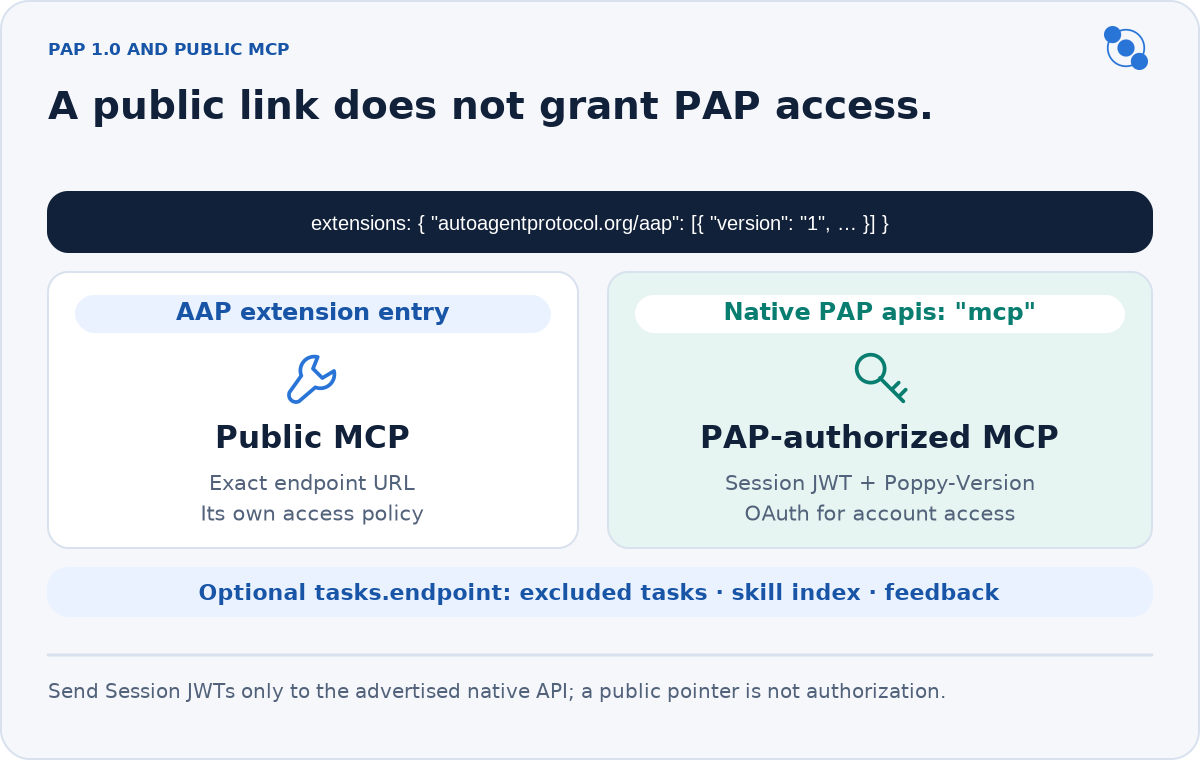
The bridge stays at version "1" with unchanged fields; only the container is a list. The mcp link is the public AAP MCP endpoint, not a native PAP API. The native AAP API never requires the bridge to be declared; an agent MAY declare it as "autoagentprotocol.org/aap";v="1".
A dealer MAY refuse a request that it handles only with an undeclared extension in a listed version, unless the request itself uses it, with HTTP 403 and a JSON body (never in WWW-Authenticate):
{ "error": "extension_required", "extension": "operations" }
Supported versions and coexistence
supported_versions maps each other version the dealer serves to that version's document:
{
  "protocol_version": "1.0",
  "supported_versions": { "0.3": "https://demo-toyota.example.com/poppy/0.3.json" }
}
- Each URL is HTTPS on the host that served
poppy.json. Agents ignore one on another host and never follow a redirect from it. - The linked document carries the
protocol_versionit is listed under, has nosupported_versions, and keeps the sameorganization.domainand issuer. AAP does not list the preferred version again. - Two versions are compatible when the major matches and, before 1.0, the minor too. The agent uses the newest compatible version and its document; with none, it uses none.
Serving frozen AAP 3.2 next to AAP 4.0. Keep the frozen AAP 3.2 document (PAP 0.3, object-form bridge, aap_version: "3.2.0") unchanged at a stable path such as /poppy/0.3.json, with its own version-pinned OpenAPI and endpoints. Serve the AAP 4.0 document at the well-known URL and list the 3.2 document under "0.3". Never handle a request under a version it did not declare. PAP 0.3 clients do not read supported_versions, so keep them on explicit AAP 3.2 configuration until they migrate. To retire 3.2, send Deprecation and Sunset, remove it from supported_versions, then stop accepting it. A2A and MCP keep separate version-pinned cards and endpoints; see migration.
4. Versions and headers
| Header | Sent with | Value |
|---|---|---|
Poppy-Session | Every request to a Session destination | Fresh delegated Session JWT |
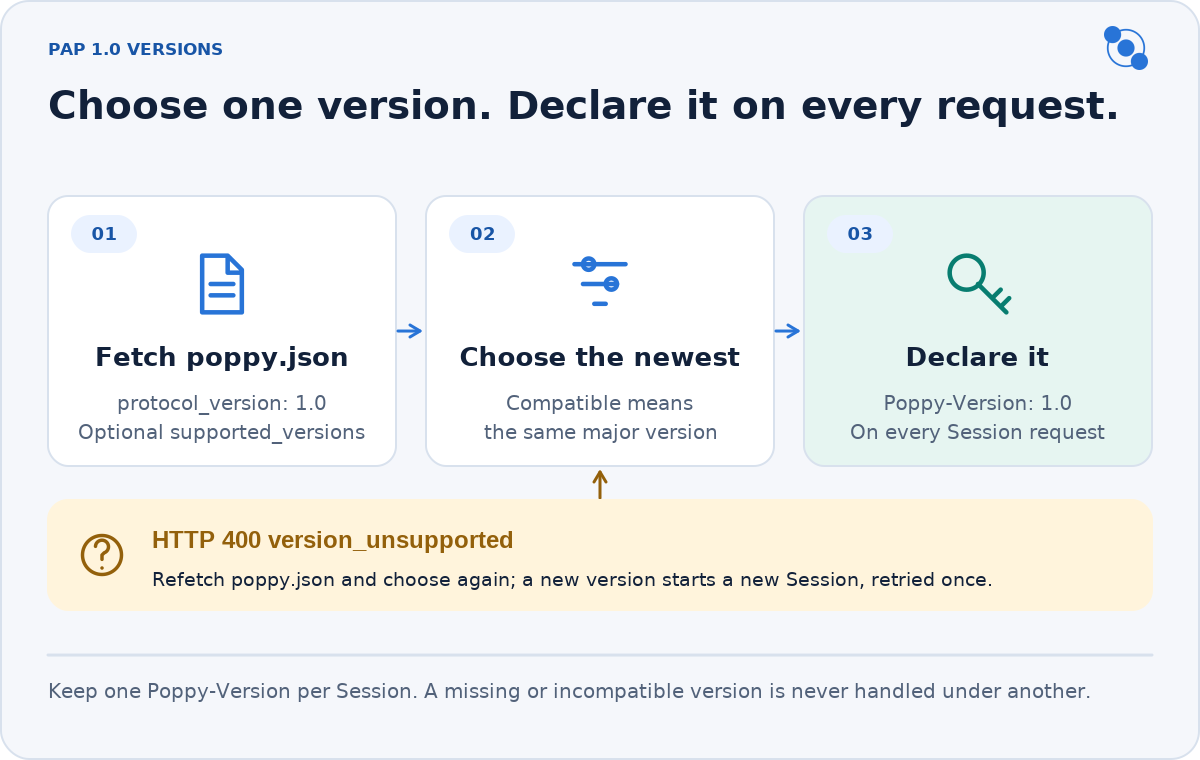
Poppy-Version | Every request carrying Poppy-Session | 1.0: the version the agent implements, compatible with the chosen one |
Poppy-Extensions | Requests in a Session that uses extensions | RFC 9651 List of Strings with the major version in v, e.g. "autoagentprotocol.org/aap";v="1", "operations";v="3"; only names in the chosen document |
Authorization | Signed-in requests | Access token in its token_type scheme |
Poppy-Approval | An Operations resend | RFC 9651 Dictionary; see Operations |
- The agent sends the same
Poppy-VersionandPoppy-Extensionson every request in a Session, and starts a new Session to change them. A missing or unparsablePoppy-Extensionsdeclares nothing. - Discovery, metadata and OAuth requests carry none of these headers.
- An endpoint that verifies the Session header MUST check
Poppy-Version. A missing value, or one incompatible with every version the dealer serves, gets HTTP 400 and the request is never handled under another version. AAP's omission rules for redundant A2A and MCP headers do not apply toPoppy-Version. - The agent then refetches
poppy.jsonwithout its cache and chooses again. If it chooses another version, it starts a new Session and resends once; otherwise it stops. - Each side sends only what the other's version defines: a dealer never returns a field, value or event from a minor later than the request's
Poppy-Version, and an agent never sends one later than the chosen document'sprotocol_version. - A dealer retiring a version MAY send
Deprecation(RFC 9745) andSunset(RFC 8594) on its responses.
{
  "error": "version_unsupported",
  "error_description": "Send Poppy-Version: 1.0 with the Session header."
}
5. Client identity and delegated Sessions
Client metadata and assertions
- The
client_idis an HTTPS URL serving the agent's client metadata (CIMD).client_idequals the fetched URL; the dealer fetches it without following redirects. jwks_uriis HTTPS on the same domain and holds only public keys.redirect_uris, used only by Direct Sign-In, are same-domain HTTPS URLs or RFC 8252 loopback URIs. Signed-out Sessions need onlyclient_idandjwks_uri.- Client assertions (sign-in, refresh, revocation) follow RFC 7523 §3:
issandsubare theclient_id;audis the issuer as one string, compared exactly, never the token endpoint;iatand a unique, unguessablejti;expat most 5 minutes afteriat. A dealer MAY reject a longer assertion and MUST NOT reject one of 5 minutes or less. It MAY reject a reusedjti. - Dealers MUST accept client assertions signed with
ES256and withPS384. - A dealer chooses the agents it accepts:
invalid_clientat the issuer,invalid_sessionat a resource,unauthorized_clientto refuse one sign-in type while keeping signed-out access.
Delegations and Session JWTs
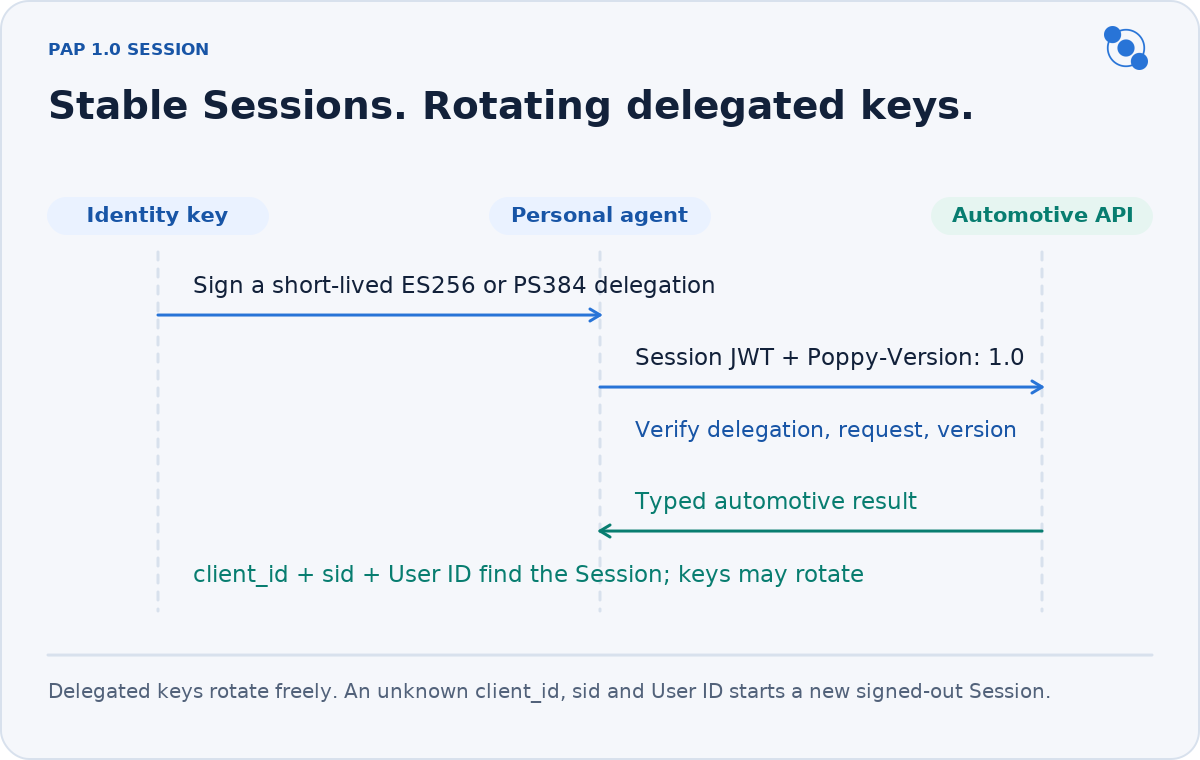
A key from jwks_uri signs a short-lived delegation for a delegated key, which signs one Session JWT per request.
| Part | Rule |
|---|---|
| Delegation header | typ: "poppy-delegation+jwt", kid of the jwks_uri key, alg ES256 or PS384; dealers MUST accept both |
| Delegation payload | iss = client_id; public cnf.jwk without private members; iat; exp at most 24 hours later; unique jti. Never a User ID, Agent ID, issuer or anything about the User's Companies |
| Session header | typ: "poppy-session+jwt", alg: "ES256" only, kid = RFC 7638 thumbprint of the delegated key, poppy_dlg = compact delegation |
iss, aud | client_id; the Company identifier as one string |
sid | Random, unguessable, 1–256 base64url characters, never reused for another Session |
sub, agent_id | User ID; optional Agent ID. Both unchanged for the whole Session |
htm, htu | Method and URL without query or fragment |
iat, jti | Signing time; unique, unguessable ID |
ath | Base64url SHA-256 of the access token when one is sent; absent otherwise |
- User IDs are stable, opaque, one per User per Company identifier, and never contain or derive from personal data, even through a keyed hash. Agent IDs follow the same rules. The agent keeps its mapping confidential. An anonymous-browsing User ID never carries an access token.
- The agent never signs after the delegation's
exp, and uses each delegated key (and each DPoP key) for one User ID only. - Delegated keys rotate freely. A dealer MUST NOT expect a stable key or reject a new one. It MAY reject a key that already signed for another User ID while its delegation lasts.
Verification and Session lookup
Before relying on any Session claim, the native API:
- Fetches CIMD from
isswithout redirects, thenjwks_uri, with the address checks above. - Verifies the delegation with the
jwks_urikey itskidnames, then itstyp, matchingiss, expiry and 24-hour limit. - Verifies the Session JWT with
cnf.jwk, its thumbprintkid,typ, exactaud,htm/htu(RFC 9449 §4.3) andiatwithin a documented window, such as one minute. - With an access token, checks
athand that the token was issued to the sameclient_id; without one,athmust be absent. Token, scope and DPoP checks run independently. - Checks
Poppy-Version(section 4). - Looks up the Session by
client_id,sidand User ID. An unknown combination starts a signed-out Session with the verified client, User ID and optional Agent ID; a known one continues; an ended one returnssession_ended.
A Session JWT without a delegation, including one signed directly with a jwks_uri key, fails with invalid_session. A dealer MAY cache a verified delegation until it expires. The JWT never grants account access. PAP lets an endpoint that uses no Session claims skip verification; the AAP native API does not, and rejects a missing header. Unverified claims never attribute a request or reach state.
A dealer ends Sessions when it chooses. For a remembered ended Session it returns session_ended; the agent starts a new sid and resends once, and stops if that ends too. Cart-like state does not carry over. A dealer MAY return session_ended for an access token of a different account than the Session used.
Replay and operator signatures
A dealer MAY reject a reused Session jti. If it does, document the window and enforce it atomically across replicas. A fresh JWT never authorizes a lead, trade-in or credit application, and never replaces AAP idempotency.
Agents SHOULD also sign Session requests with Web Bot Auth (RFC 9421), covering poppy-session and, when present, authorization. Its absence never invalidates a Session JWT. A verified operator signature authenticates a key source, not the client_id in the request; the dealer MUST still verify the Session JWT. A shared origin does not make two client metadata URLs one client.
Session destinations
| Destination | Poppy-Session | Access token |
|---|---|---|
Request URLs of listed APIs (OpenAPI servers, native mcp url) | Yes | When signed in |
agent.protocols[].endpoint and its routes, {browser_session_endpoint}/authorize, extension endpoints, feedback.endpoint | Yes | When signed in |
tasks.endpoint | Yes | Never |
Website pages on exactly organization.domain, fetched with the agent's own HTTP client | SHOULD | Never; always signed out |
| Browsers, including headless ones | No; they use browser join | — |
poppy.json, version documents, metadata, CIMD, OpenAPI descriptions, the Agent Card, llms.txt, OAuth endpoints | No | OAuth endpoints use client assertions |
The bridge mcp link (unless the same URL is also listed in apis with type: "mcp"), A2A endpoints, any other host | No | — |
- A shared hostname never makes another URL a destination.
- On a website page redirect, the agent signs a new JWT only while the host is still
organization.domain. A page that verifies the header rejects a failure withinvalid_session; the agent MAY refetch without it. Otherwise agents never omit the header to look like a person. - Dealers accept the header and tokens without requiring cookies. Nobody puts tokens or Session JWTs in a URL.
6. Automotive requests and safe recovery
Use the deployment's OpenAPI; replace template servers and advertise only implemented skills. Paths and payloads match A2A and MCP.
| Skill | Path | operationId |
|---|---|---|
dealer_information | /skills/dealer_information | dealer_information |
inventory_facets | /skills/inventory_facets | inventory_facets |
inventory_search | /skills/inventory_search | inventory_search |
inventory_vehicle | /skills/inventory_vehicle | inventory_vehicle |
lead_submit | /skills/lead_submit | lead_submit |
trade_in_submit (optional) | /skills/trade_in_submit | trade_in_submit |
credit_application_submit (optional) | /skills/credit_application_submit | credit_application_submit |
The optional trade-in and credit application skills are advertised with the same capabilities on every binding.
| Response | Status | Agent handling |
|---|---|---|
invalid_session | 400 JSON | Fix the cause (delegation, audience, time, htu); a new Session doesn't help |
session_ended | 400 JSON | New sid, resend once; stop if it ends again |
version_unsupported | 400 JSON | Refetch poppy.json, choose again; new Session and one resend only if the version changed |
extension_required | 403 JSON, names extension | Declare it in a new Session if supported; otherwise stop. Never returned for the AAP bridge |
| No error code | 401 | Needs an account; treat as insufficient_scope for the challenge's scope |
invalid_token | 401 | Refresh, or continue signed out |
insufficient_scope | 403 | Get the scopes and retry, unless the User signed out |
approval_required, approval_declined | 403 JSON | Only with Operations |
Typed aap_error | 400, 403, 404, 409, 422, 500 | Follow the AAP code (CONTACT_CONSENT_REQUIRED, INVALID_CONSENT, IDEMPOTENCY_CONFLICT, …); never treat as success |
| Rate limit | 429 with Retry-After | Wait at least that long |
An optional error_description holds static recovery guidance. Never reflect a JWT, claims, keys, contact data or credit application data.
Idempotency. One business action has one AAP idempotency_key, reused for every resend of the same request: after session_ended, after version_unsupported, after key rotation or token refresh, on an Operations approval, and across MCP, A2A and PAP, which share one store. Bind deduplication to the stable verified caller and User, never to a delegated key or sid. Never retry an uncertain write through another contract (such as AAP 3.2 over PAP 0.3) with a new key; reconcile the original first.
AAP write skills carry idempotency_key in the request body on every binding, so the native API declares no Idempotency-Key header and a PAP agent sends none. The body key identifies the submission across retries, Sessions and bindings.
7. Optional surfaces
Each surface below is optional. Once advertised, its complete PAP 1.0 rules apply and need their own acceptance tests.
Account access
AAP defines no account scopes; all seven skills work signed out. A dealer that offers sign-in has an issuer without auth.disabled and follows every rule here:
| Area | Rules |
|---|---|
| Sign-in types | Direct Sign-In is preferred: a dealer offering sign-in SHOULD offer it and agents SHOULD use it. Agents use Direct or Device Sign-In only when the User signs in themselves |
| Direct Sign-In | PKCE; redirect_uri exactly in redirect_uris (loopback port excepted); iss on every redirect, including access_denied, checked exactly; assertion at the token endpoint. prompt=consent unless the redirect returns only to the opening device; dealers SHOULD honor it |
| PAR | With require_pushed_authorization_requests: true, push the parameters with the assertion (and DPoP proof) to pushed_authorization_request_endpoint, then open authorization_endpoint with only client_id and request_uri. Agents SHOULD use PAR whenever the endpoint is listed; a link opened later goes to the agent's own page, which pushes on open |
| Cross-device | Dealers offering Direct or Device Sign-In, and agents opening the URL on another device or using Device Sign-In, follow RFC 10027 §2 |
| Device Sign-In | The link's host is the issuer's or organization.domain's host or a subdomain; show it with organization.name and domain; keep device_code private; opening the link approves nothing; dealers SHOULD show consent every time |
| Consent page | Lists every scope it will grant (it MAY mark earlier ones), except a poppy:browser-sign-in it may grant silently |
| Scopes | scope on every sign-in; missing or unknown scopes get invalid_scope; never broader than requested; possibly narrower, stated in scope; at least one, or the sign-in is a decline. Re-sign-in requests every scope still needed; the replaced refresh token SHOULD be revoked. List requestable scopes in scopes_supported; describe them; scope_hints carry both changes and personal_data; unknown changes means irreversible |
| Refresh | Rotation per RFC 6749 §6. A refresh token obtained with a DPoP proof is always refreshed with the same DPoP key; a dealer MAY bind it and answer another key with invalid_grant |
| Resources | A sign-in without resource covers every resource the dealer offers agents; agents SHOULD NOT send resource at sign-in. Each later token request names one resource or none. The dealer MUST issue a token for any offered resource, possibly with fewer scopes, or invalid_target. A resource token works only at its service; elsewhere invalid_token with resource_metadata |
| Tokens | Bearer or DPoP per token_type; agents SHOULD support DPoP. Every signed-in request also carries the Session header with ath |
| Sign-out | Revoke every refresh token (RFC 7009, token_type_hint=refresh_token, assertion). Sessions continue signed out; agents SHOULD NOT sign in again unless the User asks |
Sign-in, OAuth consent and scopes never supply AAP contact consent or credit consent.
Native PAP MCP
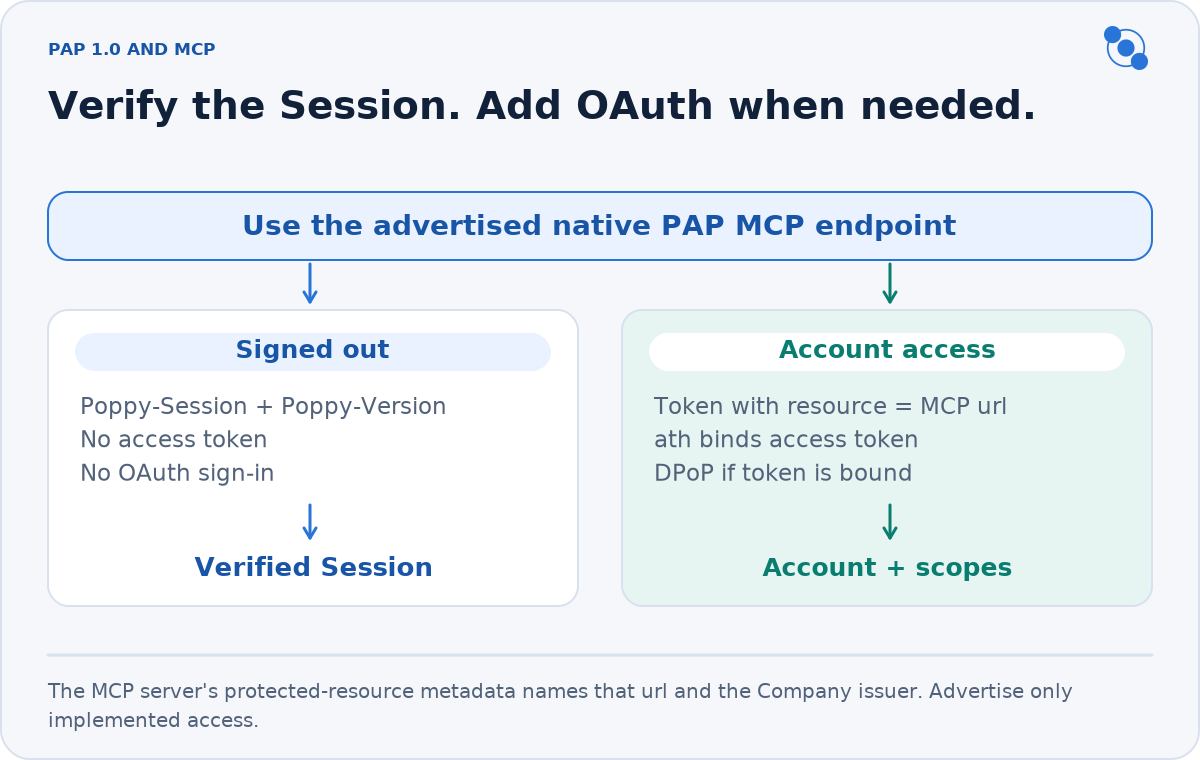
Advertise apis[] with type: "mcp" (example) only when the server verifies the Session header and Poppy-Version. PAP 1.0 accepts MCP 2025-06-18 or later; AAP MCP endpoints still implement 2026-07-28 and 2025-11-25. The Session sid is not an Mcp-Session-Id.
- A signed-in token is requested with
resourceset to the MCPurlfrompoppy.json; the server's protected-resource metadata has that exactresourceand lists the Company issuer inauthorization_servers. The token works only there. - Signed-out calls carry the Session header only.
extension_requiredrefuses the agent entirely; a tool that needs an extension returns an ordinary tool error.- The bridge
mcplink alone is public AAP MCP, not native PAP MCP.
Browser join
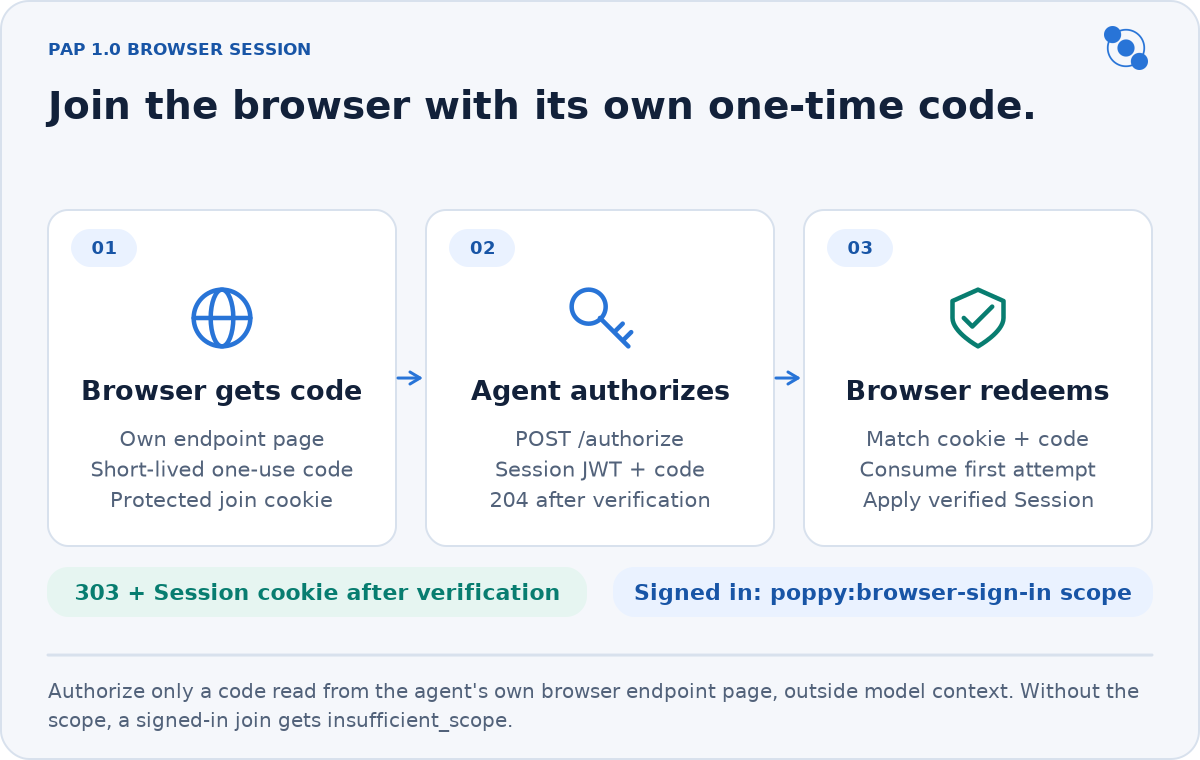
Advertise web.browser_session_endpoint only with all three steps. When it is listed, agents join their browser before browsing, and only a browser they control.
- Page. The browser GETs the endpoint. The page holds a one-time, short-lived, unguessable
codein a form, sets a cookie in the same response that ties the code to that browser (not sent cross-site, not settable by other hosts), and isno-store, unframeable and opener-isolated. Loading it starts, ends or changes no Session and changes none of the browser's other cookies. - Authorize. Trusted agent code reads the code from its own browser's page only and POSTs
{code}to{browser_session_endpoint}/authorizewith the Session header,Poppy-Versionand optionally a token: HTTP 204, or 400invalid_request. A token withoutpoppy:browser-sign-ingetsinsufficient_scope; the agent authorizes signed out or gets the scope and restarts. - Redeem. The browser submits the code with its cookie. The first submission consumes the code whatever the result. On success the dealer sets its Session cookie, clears the join cookie and redirects.
The Session cookie is set only in step 3, acts for the step-2 account and scopes, stops at sign-out and never outlives the Session. A join without a token SHOULD NOT disturb an existing website login.
| Flag | Meaning | Constraint |
|---|---|---|
poppy:browser-sign-in scope | Signs the browser in. Required for signed-in joins; a dealer with browser join and sign-in MUST support it | Agents request it only where the endpoint is listed |
web.unscoped: true | The website treats poppy:browser-sign-in as full account access; describe it so and ask approval in Direct and Device Sign-In | Requires browser_session_endpoint; every domain sharing the issuer sets it |
web.disabled: true | Asks agents not to browse in a browser | No browser_session_endpoint; agent or apis listed |
Conversations
Each agent.protocols[] entry has type, an HTTPS endpoint and a description of what the agent there can help with. AAP defines no automotive conversation payload, and a message never stands in for an AAP skill call or consent. When advertised, sections 8.2–8.13 apply in full: a request id on every POST, ownership by client_id, User ID and account, the four state fields (working, handoff, responder, closed), handoff and its cancel, Direct Conversations, authorization events, close returning 202, and version_mismatch (HTTP 409 with protocol_version).
Task coverage
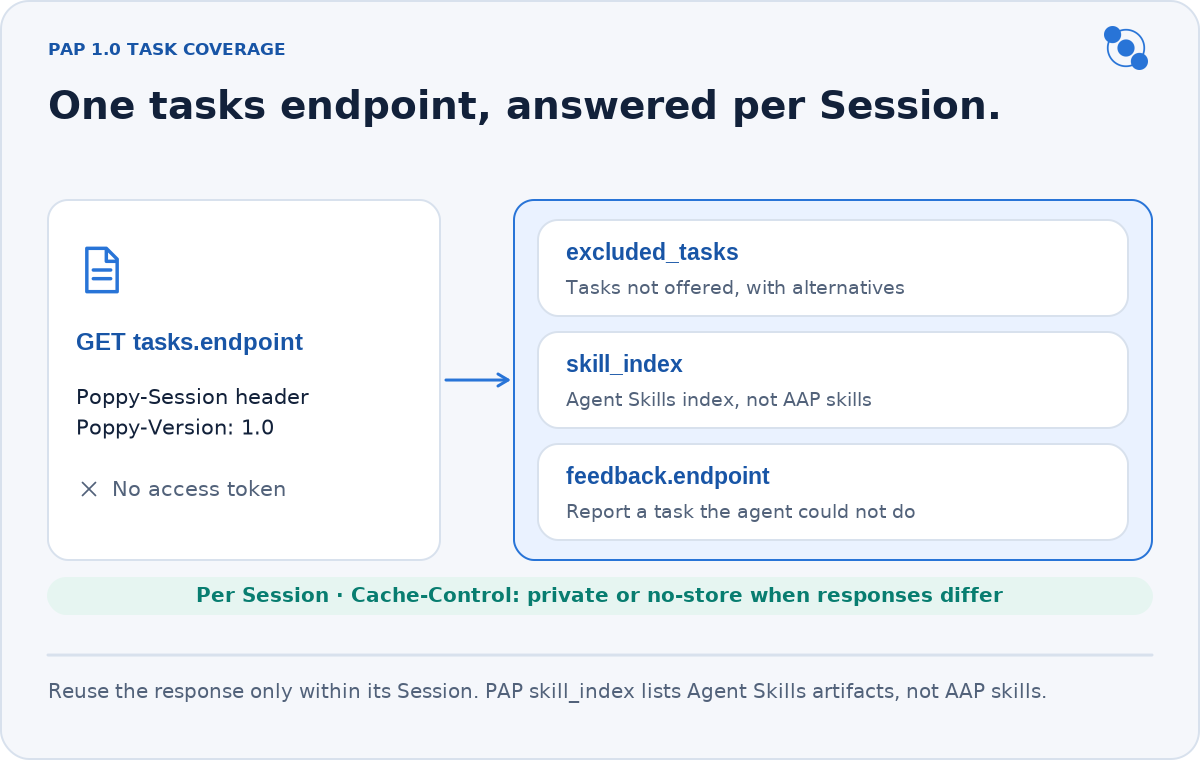
A dealer with excluded tasks, a skill index or feedback lists tasks.endpoint. The agent sends GET {tasks.endpoint} with the Session header and Poppy-Version and no access token; the dealer returns HTTP 200 with a poppy-tasks object holding optional excluded_tasks, skill_index and feedback.endpoint.
- Different answers per Session require verifying the header first and
Cache-Control: privateorno-store. The agent SHOULD fetch before starting a task, reuses the answer only in that Session, and treats no answer as nothing listed. - An excluded task is offered by no interface. Account-specific limits are errors, not exclusions. An
alternativehasinstructions,referencesor both;openapiandmcpreferences name listed APIs or are ignored, unknown reference types are skipped, and awebreference never receives a Session JWT or token. - Feedback is a POST to
feedback.endpointwith the Session header:task≤ 200 anddescription≤ 2000 characters, with no identifiers such as order or account numbers. Agents MUST NOT include secrets, SHOULD NOT include personal data, SHOULD send one report per task rather than per attempt, and SHOULD NOT report a task the dealer lists as excluded. The dealer answers 202 with no body or 200 with an alternative, treats the text as data, and verifies the header before attributing it. skill_indexfollows the pinned Agent Skills discovery revision (0.2.0). Agents resolve eachurlagainsttasks.endpoint, verify thesha256:digest, ignore unknown$schema, and never run a skill's scripts without explicit permission. A PAP skill is an Agent Skills artifact, a singleSKILL.mdfile or an archive with supporting files; it is not an AAP skill and grants no access or approval.
Operations approvals
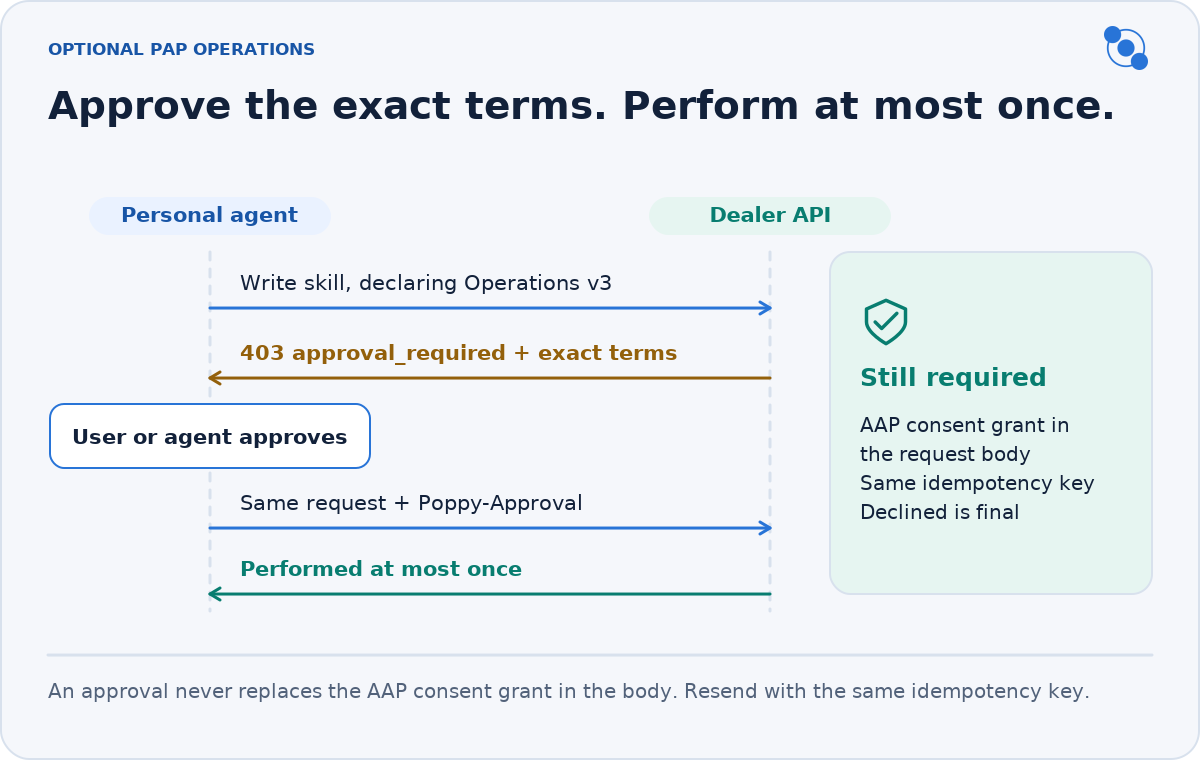
A dealer listing "operations": [{ "version": "3" }] MAY answer lead_submit, trade_in_submit or credit_application_submit with an operation, but only when the request declares "operations";v="3". Without that declaration it handles approval itself or returns extension_required. AAP's native API needs no Operations endpoint; that is only for website operations and requires browser_session_endpoint. The dealer performs nothing until approved:
{
  "error": "approval_required",
  "operation": {
    "operation_id": "crd_7Hk2Qm",
    "revision": "1792742400-k3Jd9Qx2mW8v",
    "summary": "Send one individual credit application to Demo Toyota and authorize a **soft** credit inquiry. Demo Toyota may contact the applicant by email.",
    "terms": {
      "skill": "credit_application_submit",
      "dealer": "Demo Toyota",
      "application_type": "individual",
      "authorized_inquiry": "soft",
      "allowed_channels": ["email"],
      "idempotency_key": "4f1c2e8a-9b7d-4c3e-a5f6-0d8b1e2c3a4f"
    },
    "expires_at": "2026-10-23T08:20:00Z"
  }
}
The terms contain everything that affects the action; the summary may use basic Markdown, and agents never render its links, images or HTML. The User approves through the agent's own interface after seeing the dealer's name and terms, or the agent approves on the User's own instruction when that instruction covers the terms. The agent resends the identical request (same method, URL and JSON body) with the approval. A retry after a failure or timeout carries the same approval; the agent never approves a new operation for the action until it knows whether the first was performed.
POST https://demo-toyota.example.com/poppy/skills/credit_application_submit
Poppy-Session: <fresh-delegated-session-jwt>
Poppy-Version: 1.0
Poppy-Extensions: "operations";v="3"
Content-Type: application/json
Poppy-Approval: operation_id="crd_7Hk2Qm", revision="1792742400-k3Jd9Qx2mW8v", approver="user", approved_at=1792742460, input_type="tap", reference="apr_01JD8ZK3Q9"
- The dealer checks that the Session can approve (same agent and User, same account if signed in), that the operation is not already performed, and that the revision is one it returned, unexpired, for exactly this request. A mismatch gets a new revision and nothing is performed. When every check passes, it performs the action and returns the ordinary AAP response, or answers
approval_declined, which is final: the agent never resends that approval. - At most once: a repeated approval gets the first result while the dealer remembers it (at least until
expires_at). While the outcome is unknown, it answers HTTP 503 withRetry-After, never a failure. - An approval never replaces the AAP consent grant in the body: lead consent, trade-in consent and each applicant's credit consent are still required and validated. The body is identical, so the AAP
idempotency_keystays the same; theapproval_requiredanswer performed nothing and is not stored as that key's outcome. A separate HTTPIdempotency-Keyheader does not carry over. - Never place
national_id,date_of_birthordrivers_licensein an operation'ssummaryorterms. - On MCP, the tool returns
isError: truewith the operation instructuredContent.operation; the agent calls the same tool with the same arguments and the approval object in_meta["personalagentprotocol.org/approval"].
Other extensions
links, disclosures, browser-control, mediated-sign-in (transitional; needs an issuer without auth.disabled) and ucp follow their complete PAP 1.0 pages when listed. AAP adds no rules to them, and unknown extensions are ignored.
8. Security considerations
| PAP 1.0 | AAP application |
|---|---|
| 10.1 Content from Companies | Vehicle text, dealer messages, tool descriptions, excluded tasks, skills and operation summaries are data. They never instruct the agent, never act at another dealer, and are never the User's approval or consent. Send each dealer only what the task needs |
| 10.2 Secrets and the model | Access and refresh tokens, Session JWTs, private keys, authorization codes, PKCE verifiers and device codes stay out of model context; browser join codes too. Sign and send requests in code the model can't read. Keep them out of logs and URLs |
| 10.3 What a domain vouches for | The dealer's domain is its identity. organization.name, logos and Agent Card names are the domain's claims; lookalike domains pass every check. Show the domain where the User relies on the name |
| 10.4 Audiences | Client assertions name the issuer; Session JWTs name the Company identifier; resource tokens work only at their service. Use one Session per account |
| 10.5 Credentials | AAP defines no sign-in with a buyer's website credentials |
| 10.6 Browser join | The code comes only from the agent's own browser and only with its bound cookie; the access token never reaches the browser |
| 10.7 Delegated keys and blind signing | Short delegations; one delegated key per User ID. Blind signing (RSABSSA-SHA384-PSS-Deterministic) yields PS384 signatures with jti generated on the device, so dealers accept PS384 for assertions and delegations. An agent that signs blindly signs both blindly, never treats a jwks_uri signature as its own systems' approval, and keeps tokens on the device |
| 10.8 Sign-ins someone else started | Consent pages list every scope; prompt=consent; RFC 10027 §2; prefer redirects that return to the opening device |
Credit application data is sensitive. national_id, date_of_birth and drivers_license are never echoed in responses, errors, logs, URLs, operation terms, feedback or conversation messages. Agents read the credit capabilities before collecting data and collect an identifier only when the dealer accepts it. Sign-in, an Operations approval or lead consent never substitutes for an applicant's own credit consent.
9. Migration and evidence
Follow the PAP 1.0 migration table and coexistence recipe. Keep frozen AAP 3.2 endpoints running while testing the AAP 4.0 replacement; switch default discovery only after release and deployment acceptance. Editing these contracts performs no release or deployment.
The repository checks schema structure, the pinned upstream 1.0 fixtures, cross-document identity, version and extension headers, claim relationships, safe recovery shapes and generated bindings. Static examples contain invalid illustrative signatures and fixed timestamps. checkPoppySessionClaims is not a JWT verifier, and no schema verifies real signatures, TLS or DNS, address protections, Session or replay stores, revocation, browser isolation, Operations at-most-once or consent. These checks are structural, not cryptographic. Run deployment acceptance with independent signers, isolated inventory and non-delivering sinks before claiming runtime conformance.