Automotive, ready for agents
Auto Agent Protocol gives AI agents a shared language for automotive retail. Discover a dealer, search actual inventory, inspect evidence and pricing, then send a lead with the buyer's permission. Dealers that support them can also value a trade-in and receive a credit application.
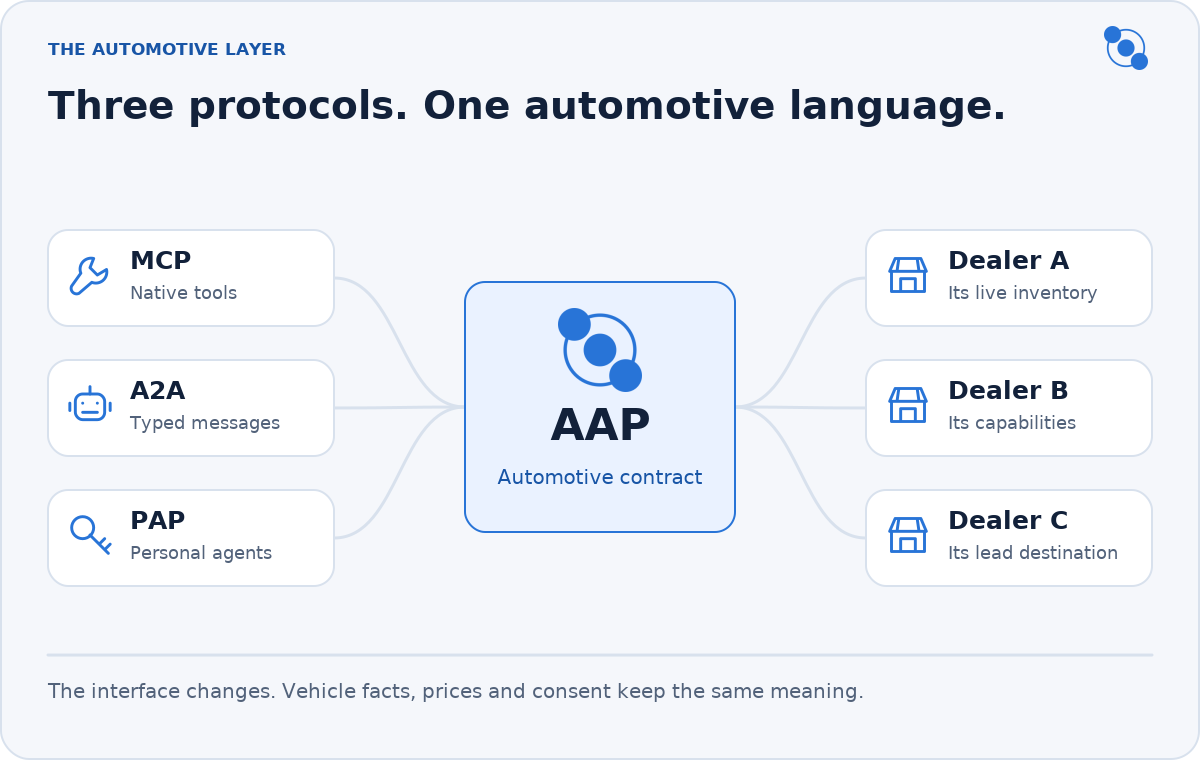
AAP 4.0 defines three native interfaces. Each carries the same typed request and response; none requires an extra hop through another protocol.
| Interface | How the agent calls | Baseline |
|---|---|---|
| MCP | Discover and call automotive tools | Streamable HTTP, 2026-07-28 + 2025-11-25 compatibility |
| A2A | SendMessage with an automotive DataPart | A2A 1.0, JSON-RPC 2.0 |
| PAP | Native OpenAPI operation with delegated Session JWT and Poppy-Version | PAP 1.0 |
A full AAP 4.0 dealer deployment implements all three with the same skill subset and business behavior. A client needs only its chosen interface. A partial implementation can describe the binding it supports, but cannot claim the full deployment profile. Conformance defines the exact boundary.
Five core skills, two optional. One shopping journey.
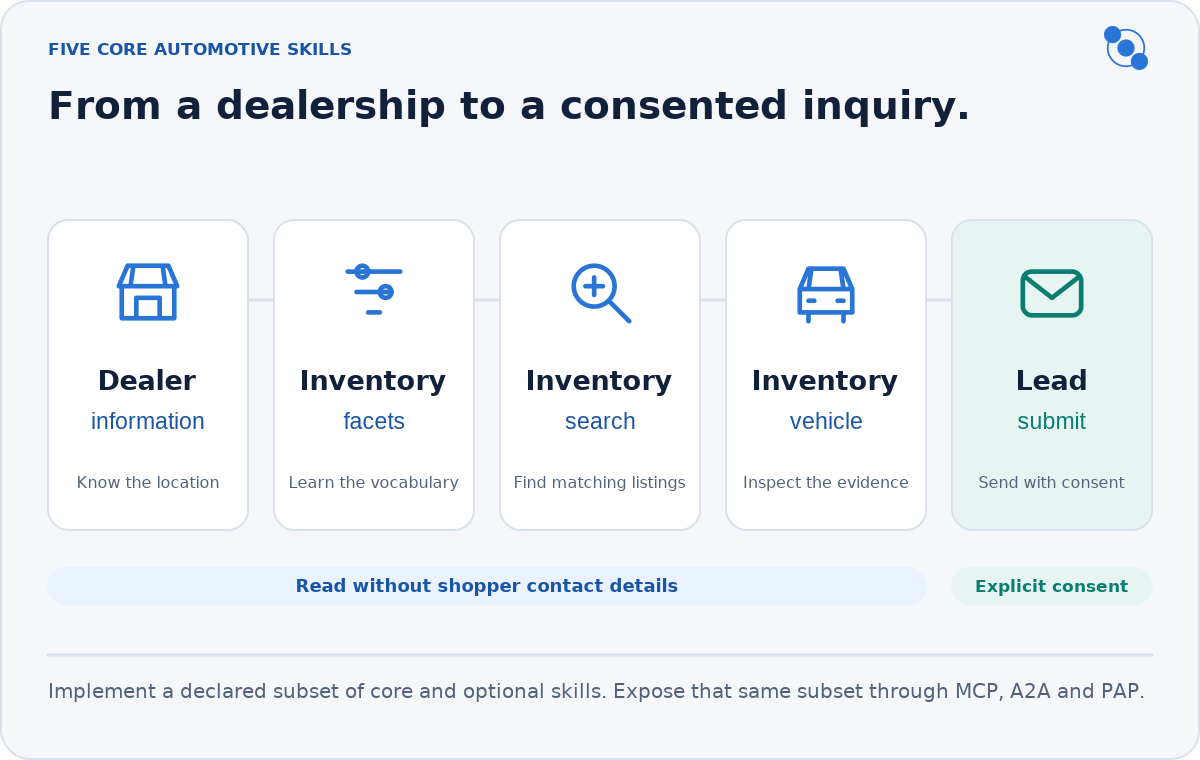
| Skill | Answer |
|---|---|
dealer_information | Who is this dealer, and where are its locations? |
inventory_facets | Which filters and feature codes are useful here? |
inventory_search | Which vehicles meet every supported constraint? |
inventory_vehicle | What is known about this specific listing? |
lead_submit | Can the dealer receive this explicitly authorized inquiry? |
Two optional skills extend the journey for dealers that offer them:
| Optional skill | Answer |
|---|---|
trade_in_submit | What is this trade-in worth, as an estimate, a range or an offer? |
credit_application_submit | Can the dealer receive this credit application, with each applicant's own credit consent? |
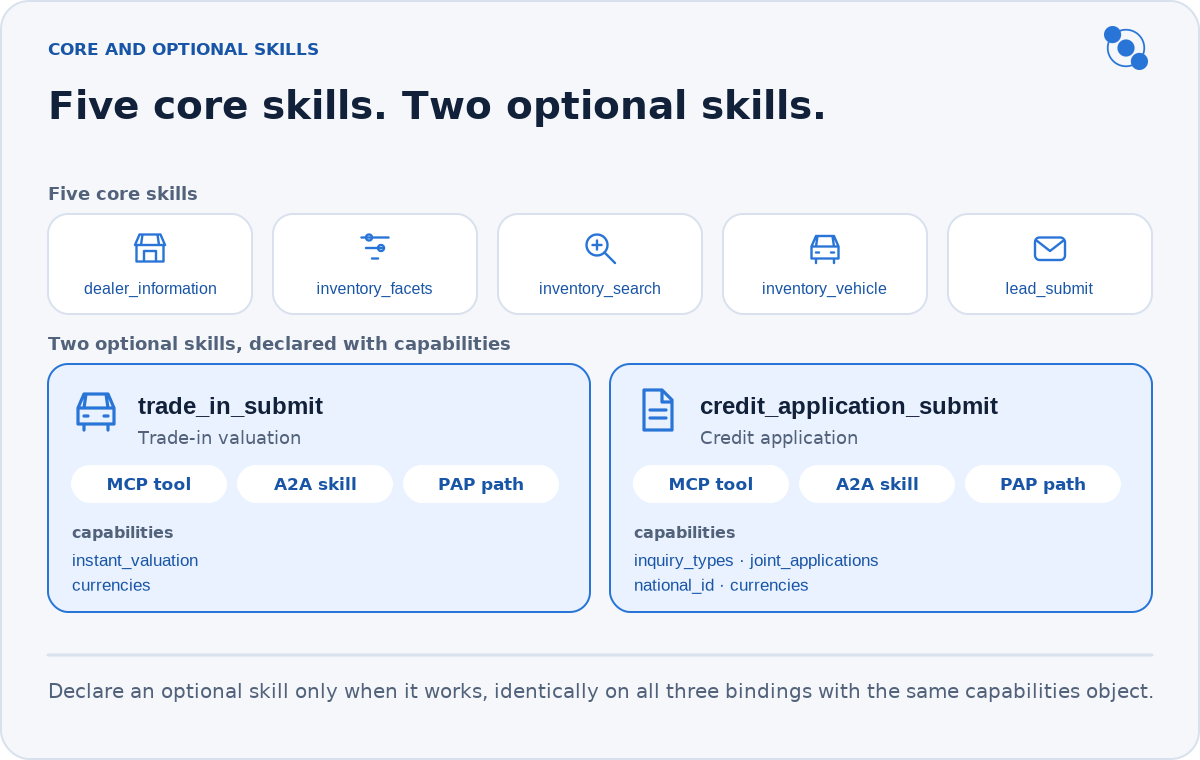
Declare one or more implemented skills, identically on every binding. An optional skill is declared only when implemented, with its capabilities in the Agent Card and the MCP tool metadata. Search with feature filters also requires facets for its feature vocabulary. For a complete shopping experience, implement all five core skills. The same vehicle model covers cars, EVs, motorcycles, RVs and trailers; an omitted vehicle_type means car.
Automotive meaning, shared everywhere
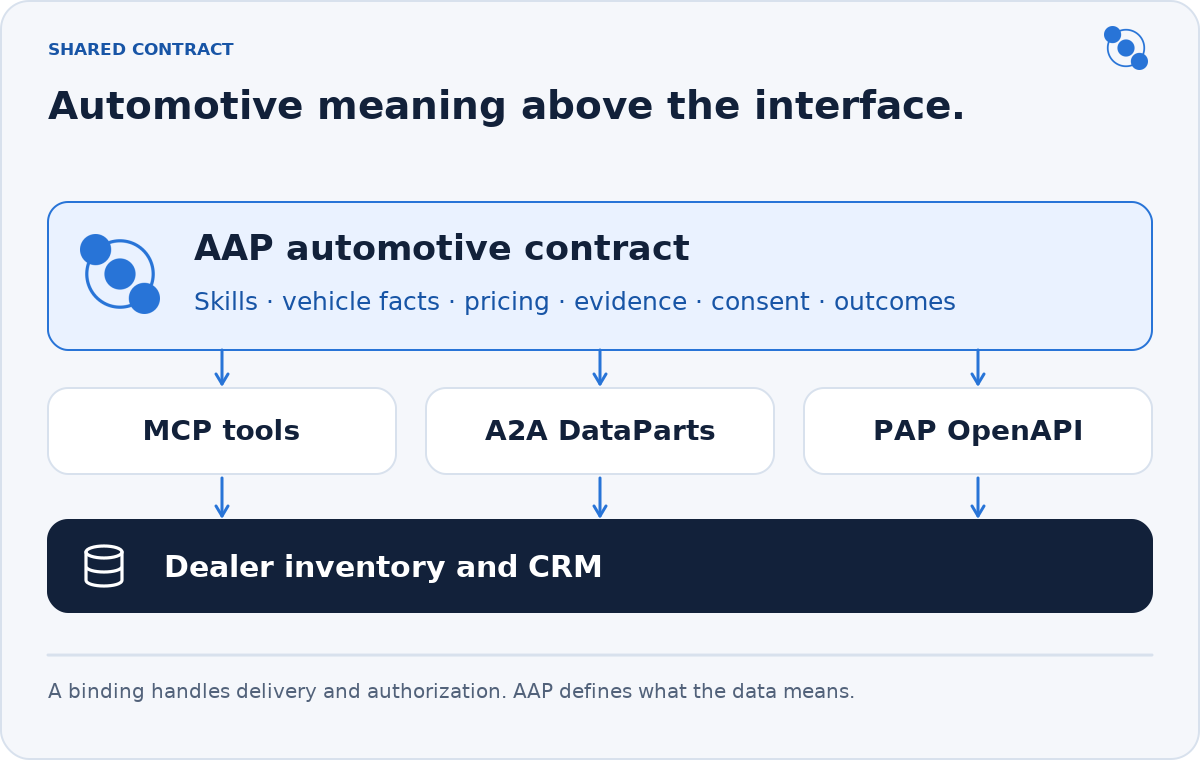
- Search: explicit capabilities, verified features, radius/distance semantics and complete cursor pagination.
- Truthful listings: availability, freshness, identifiers and evidence; missing data remains unknown.
- Clear pricing: one authoritative advertised
price; mandatory dealer charges are included, only government-required consumer charges are separate. New-vehiclerebatesnever change its meaning. - Explicit units: native USD/CAD prices and mi/km odometers; single-currency searches and exact odometer comparisons. Omitted labels preserve USD/mi.
- Controlled contact: explicit channel consent, mandatory retry keys and truthful appointment outcomes. Trade-in contact and credit applications each need their own consent.
AAP covers discovery, research and dealer contact. Trade-in valuation and credit application submission are optional skills. Payments, checkout, reservations and binding purchase quotes remain out of scope.
Start on the dealer's domain
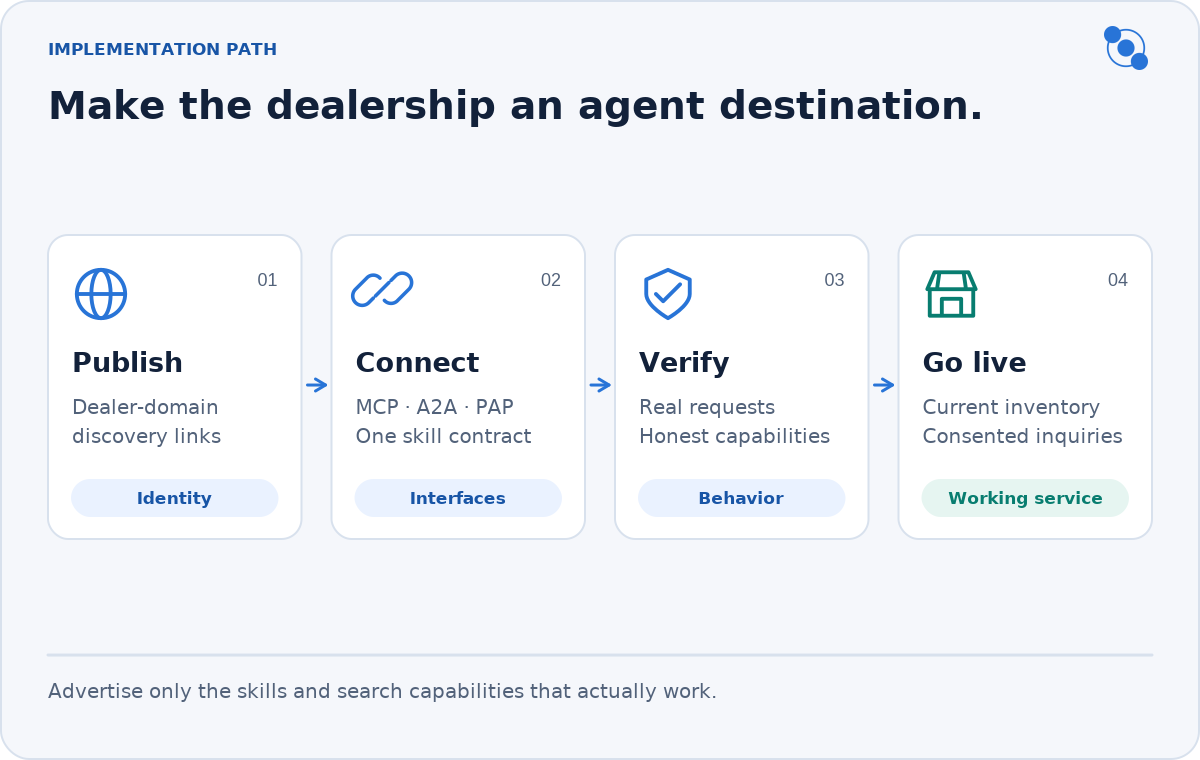
Publish /.well-known/agent-card.json, /.well-known/poppy.json and /llms.txt on the dealer's HTTPS website. They link the actual MCP endpoint, A2A interface and deployment-specific PAP OpenAPI. Services can run on a provider's tenant infrastructure.
An agent follows an explicit endpoint and its access requirements. It does not have to guess a URL or scrape a search form. Discovery improves access; it does not guarantee every assistant will automatically use a protocol.
The selected automotive contract is identified by:
https://autoagentprotocol.org/extensions/aap/v4.0
For a quick implementation path, read discovery, choose the MCP, A2A or PAP client guide, and validate against the schemas. Existing operators should start with the AAP 3.2 to 4.0 migration.