Dealer-domain discovery
Start at the dealership's website. Follow explicit links to working services. The service can run on a provider's infrastructure; the dealership remains the discoverable identity.
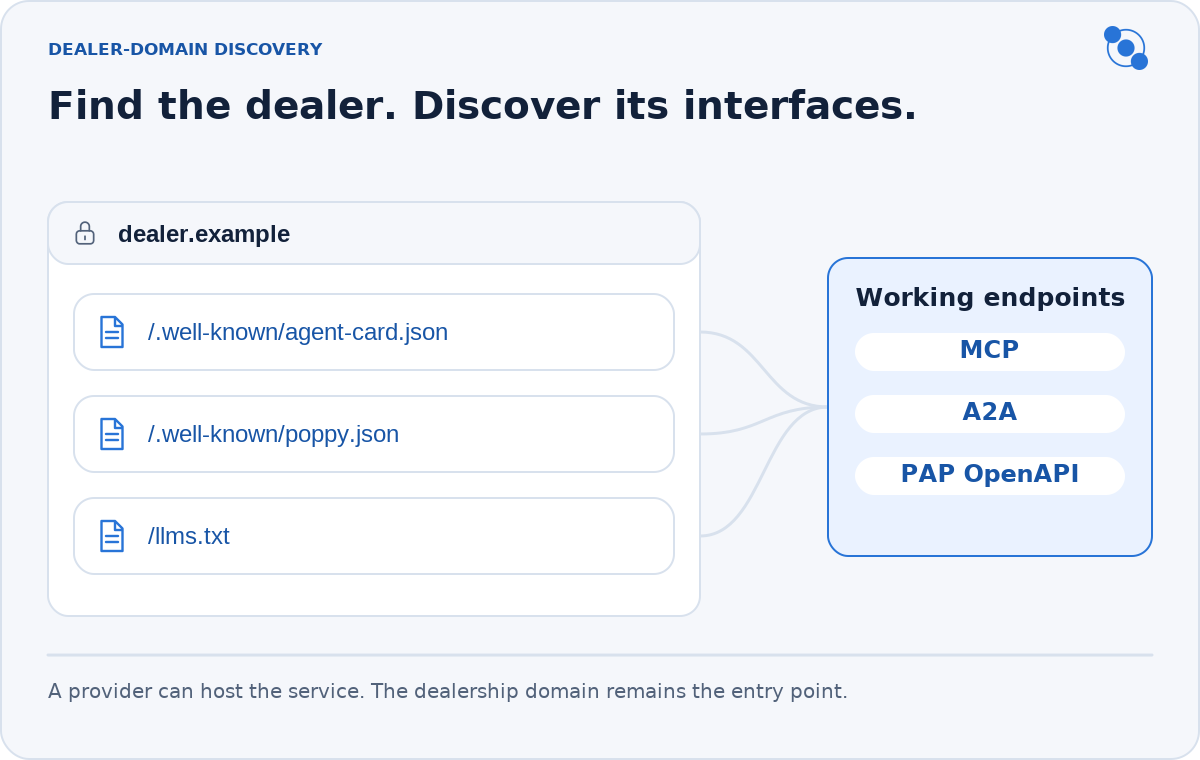
Publish three entry points
| Dealer URL | What an agent learns |
|---|---|
/.well-known/agent-card.json | A2A endpoint, selected AAP version, implemented skills, MCP URL and search capabilities |
/.well-known/poppy.json | PAP 1.0 organization, optional issuer, native OpenAPI and the AAP bridge to A2A/MCP |
/llms.txt | A short, readable index of those interfaces and their access requirements |
All three MUST be public over HTTPS. The two discovery documents MUST return JSON. llms.txt MUST return UTF-8 Markdown as text/plain or text/markdown. None of these requests submits a lead or needs a shopper's personal information.
AAP does not define a universal MCP well-known path. The exact MCP endpoint comes from these documents. A static tool catalog is not an MCP server.
Agent Card: identity and capabilities
Use the complete Agent Card example and schema. Replace the example identity and URLs, then retain only implemented skills.
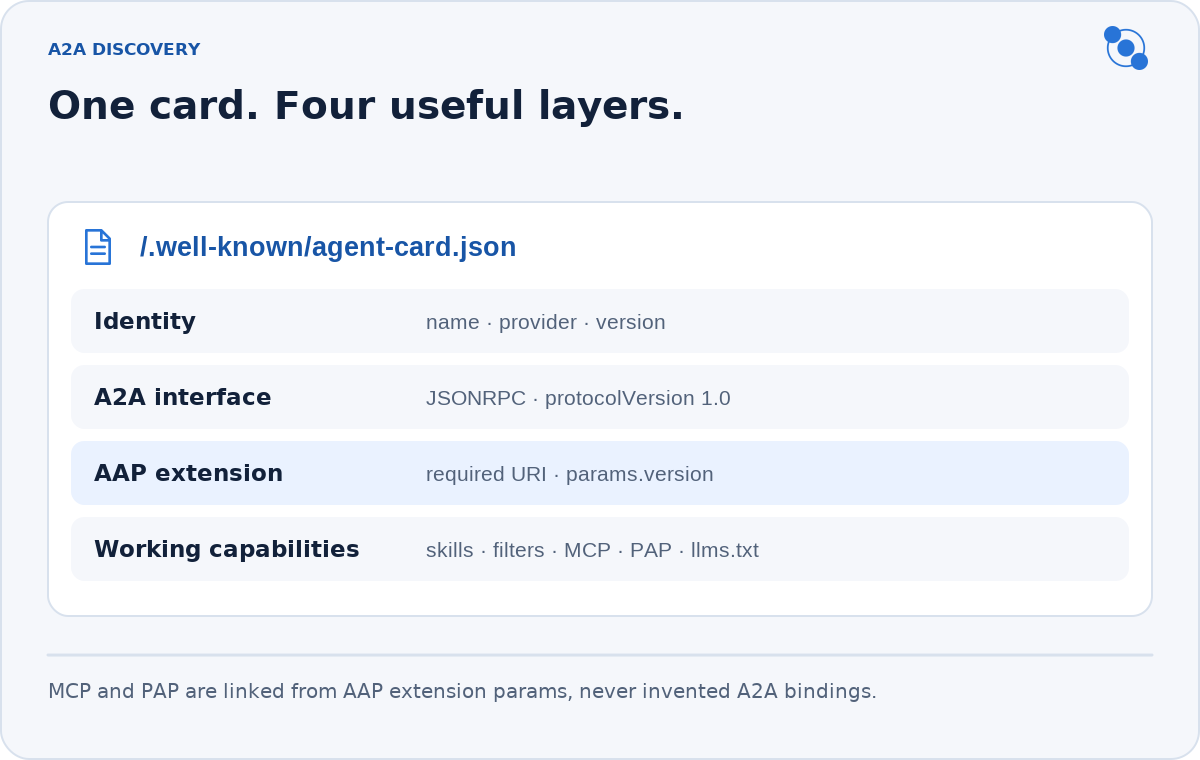
The card remains an ordinary A2A 1.0 Agent Card. AAP requires:
-
Exactly one AAP entry in
capabilities.extensions[], withrequired: trueand this contract's URI:https://autoagentprotocol.org/extensions/aap/v4.0 -
A
JSONRPCinterface withprotocolVersion: "1.0"insupportedInterfaces[]. Prefer it first. Additional A2A interfaces must expose equivalent functionality under A2A's rules. MCP and PAP are not A2AprotocolBindingvalues. -
One or more implemented AAP skills in
skills[], with unique IDs and the same subset in the AAP extension'sparams.skills. AAP 4.0 has seven skills: five core (dealer_information,inventory_facets,inventory_search,inventory_vehicle,lead_submit) and two optional (trade_in_submit,credit_application_submit). -
Complete extension
paramsfollowing aap-extension-params.schema.json:
| Params field | Required meaning |
|---|---|
id | Stable deployment identifier, never a shopper identifier |
version, schema_base_url | Selected AAP release and its immutable schema base |
skills | Canonical request/response schema URLs for every implemented skill |
skills["inventory_search"].capabilities | Actual filters, sort fields, defaults, limits and dealer/aggregate scope |
skills["trade_in_submit"].capabilities, skills["credit_application_submit"].capabilities | Required whenever the optional skill is declared: trade-in valuation, contact and currencies; credit application inquiry types, joint applications, national ID policy and currencies |
mcp | Exact URL, streamable-http, supported MCP revisions and public_read |
poppy | Canonical dealer-domain /.well-known/poppy.json URL |
llms_txt | Canonical dealer-domain /llms.txt URL |
Search defaults MUST be usable: default_sort.field belongs to sort_fields, and default_limit does not exceed max_limit. Feature filters require inventory_facets so a client can discover supported feature codes. An unsupported filter is an explicit error, never silently ignored. See search semantics.
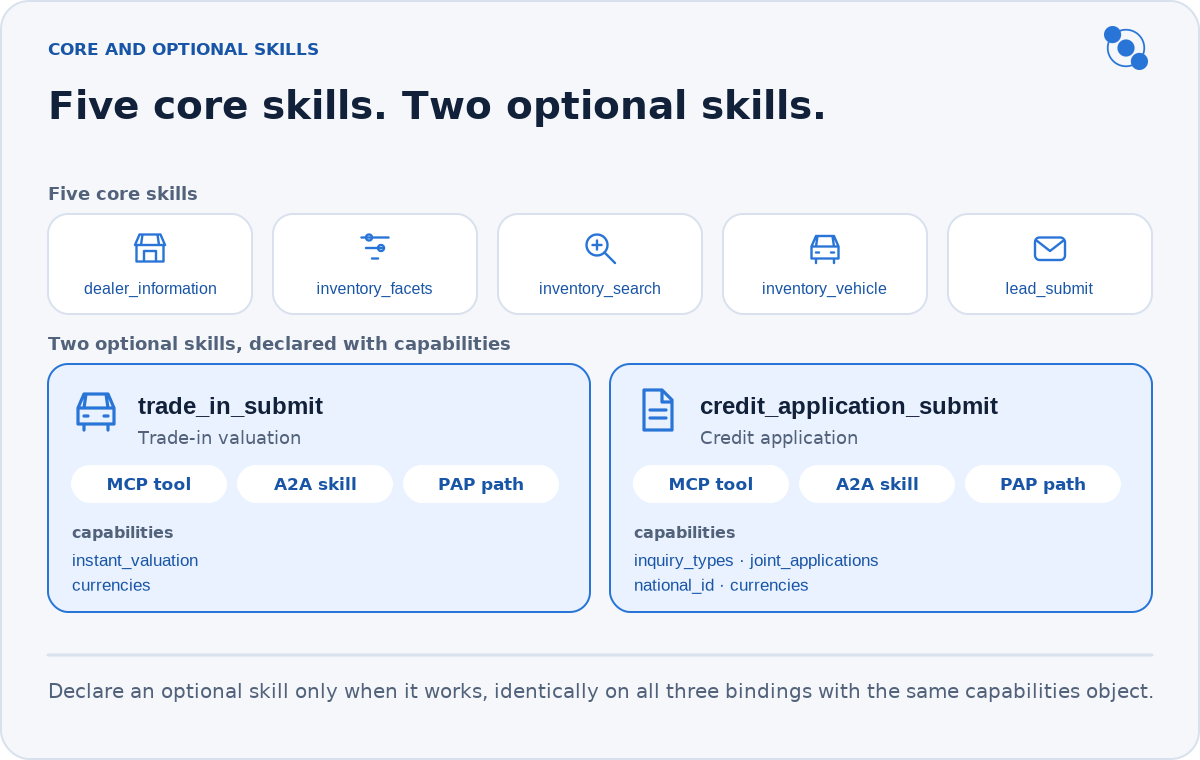
Declare an optional skill only when it works, with the same capabilities object here, in the MCP tool _meta["autoagentprotocol.org/aap"] and behind the PAP operation. Agents read those capabilities before collecting trade-in or credit data. See trade-in and credit application.
A facets-only deployment omits inventory_search and its capabilities. It accepts USD/CAD and mi/km contexts with USD/mi defaults under the facets-only fallback; clients can explicitly request CAD/km without a search declaration.
The card's software version is independent of AAP params.version. The A2A extension URI, not the software version, selects the automotive contract.
Poppy: an authenticated native API
The Poppy example publishes PAP 1.0 and a native OpenAPI interface; issuer discovery is optional and uses domain protected-resource metadata. extensions["autoagentprotocol.org/aap"] is a list holding exactly one version: "1" entry, which links the paired Agent Card, the same MCP URL, AAP release (aap_version) and llms.txt. Every request to the native API carries Poppy-Version: 1.0 with its Session JWT.
The public MCP pointer belongs in that AAP extension. A top-level apis entry with type: "mcp" additionally promises delegated PAP Session JWTs and, when account access is supported, protected-resource metadata and OAuth scope enforcement. Only advertise it when those behaviors exist. See native PAP MCP.
For redirects, PAP organization identity follows the final HTTPS discovery host, with its port when that isn't 443, comparing case only; www is a distinct host. The final URL keeps exactly /.well-known/poppy.json without a query. When an issuer exists, it must authorize that domain through protected_resources, with an entry exactly https://{organization.domain} (hostname case ignored; no path or trailing slash). Keep canonical links consistent after redirects and use one issuer per independent Company. Full rules are in PAP discovery.
llms.txt: a useful index, not registration
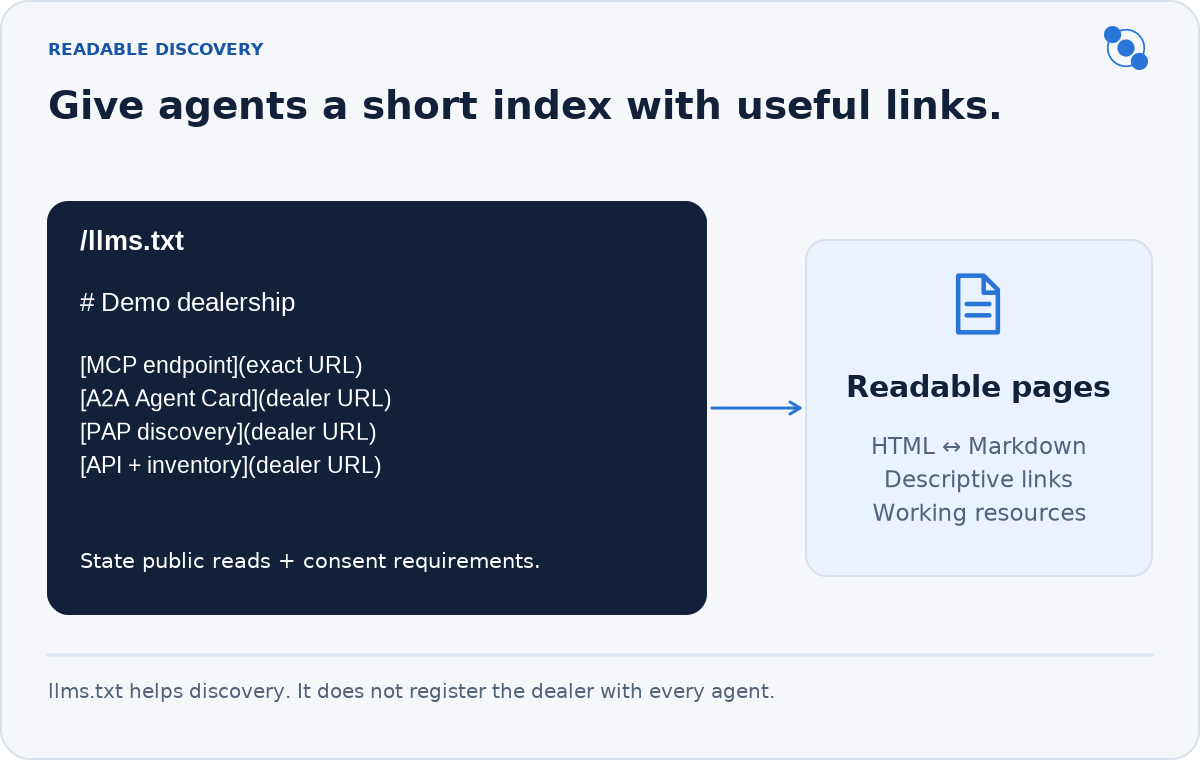
The llms.txt proposal provides a small Markdown index. It does not make every agent automatically discover or trust a website. AAP 4.0 requires this index as an additional entry point, alongside working protocol discovery.
Start from the dealer llms.txt example. Include the dealer name, selected AAP version, exact MCP URL, public/authenticated access requirements, Agent Card, Poppy document, deployment-specific OpenAPI and a link to human-readable inventory. State that lead submission needs explicit customer contact consent.
Use descriptive Markdown links rather than an unstructured list of URLs. Keep it short; link to details. If Markdown page representations exist, advertise them with registered HTML link relations:
<link rel="describedby" type="text/plain" href="/llms.txt" />
<link rel="alternate" type="text/markdown" href="/inventory.md" />
HTTP Link headers can advertise the same relationships. Only publish an alternate URL that actually serves a corresponding Markdown page. Do not describe a private rel="mcp" convention as a universally supported standard.
One declaration, three equivalent surfaces
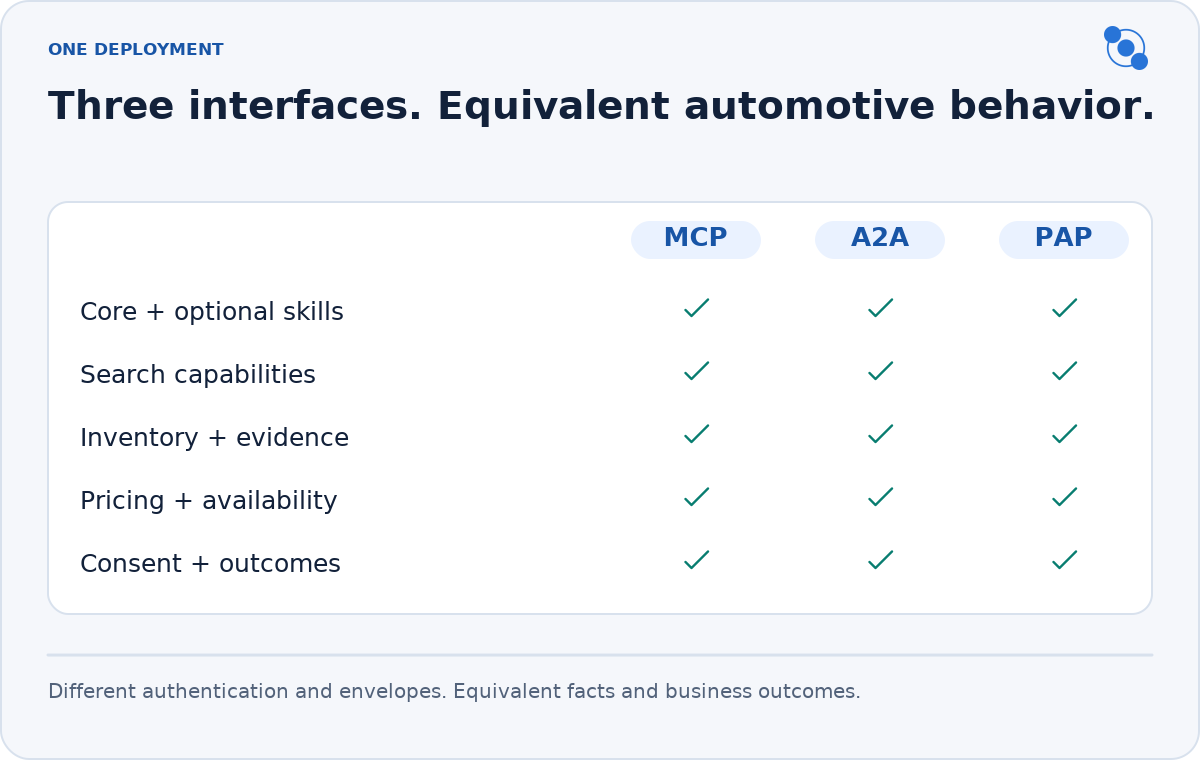
The AAP skill subset, automotive schemas, inventory visibility, search capabilities, pricing and consent rules MUST agree across MCP, A2A and PAP OpenAPI. A native PAP MCP entry, when present, MUST use the advertised MCP URL as both its url and resource.
MCP tools/list MUST expose the same AAP subset, with the same version and schema metadata. Its search, trade-in and credit application tools' _meta["autoagentprotocol.org/aap"].capabilities MUST match the Agent Card. The native OpenAPI operations MUST match that subset and its x-aap-extension MUST match the A2A extension URI.
Cache discovery using accurate HTTP cache headers, ETags and reasonable lifetimes. Invalidate it when endpoints, versions or capabilities change. Verify the linked service before switching discovery. Do not advertise a future implementation or a template server.
Transport and authorization
Every published endpoint and redirect MUST use HTTPS. Loopback HTTP is allowed only in a local development harness. Do not embed credentials in discovery URLs.
- MCP: public inventory reads are recommended. Protected access follows MCP OAuth discovery and the endpoint's declared authorization policy.
- A2A: follow
securitySchemes/securityRequirements. Portable clients sendA2A-Version: 1.0and the exactA2A-ExtensionsURI; a contract-pinned AAP endpoint also accepts their omission. If an interface declarestenant, echo it in every request. - PAP OpenAPI: send a fresh delegated
Poppy-SessionJWT andPoppy-Version: 1.0on every request. Signed-out shopping needs no OAuth token.
A link does not authorize credential forwarding. Authenticate to the selected resource under its own rules. See migration for separate version-specific cards and endpoints, and conformance for runtime acceptance.