PAP client walkthrough
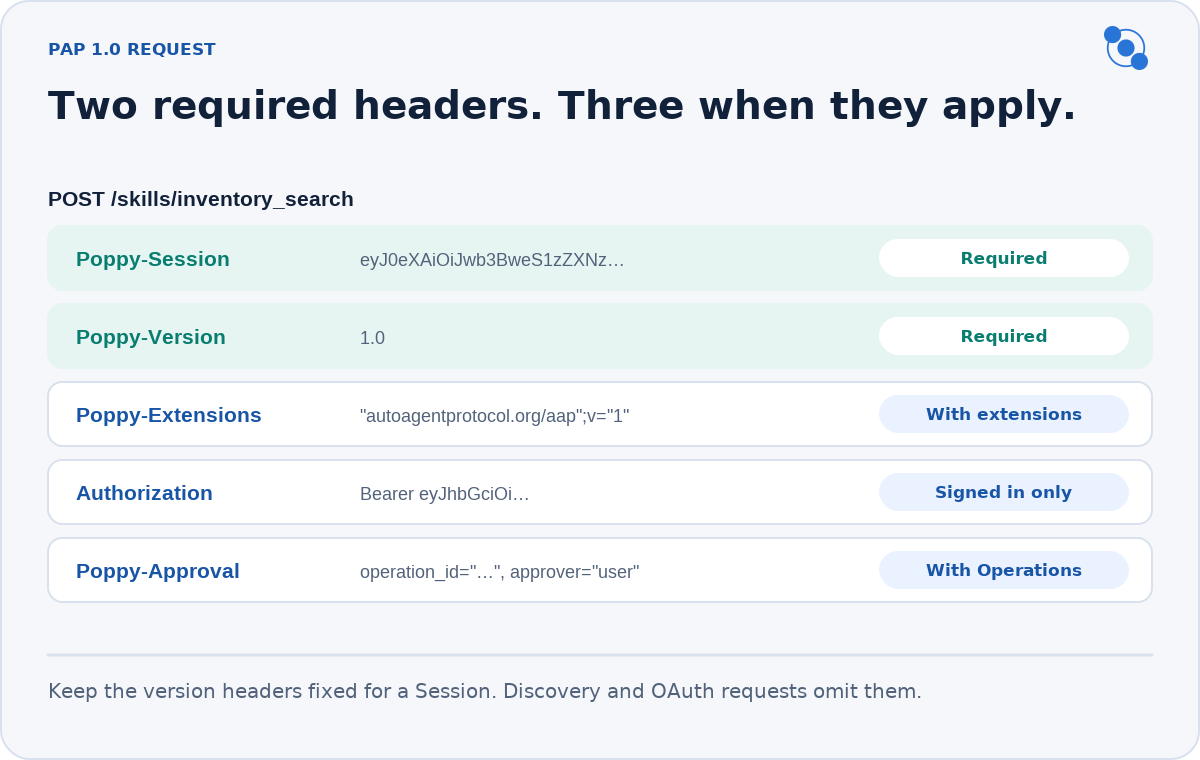
A personal agent needs three things per request: a fresh Session JWT, Poppy-Version: 1.0, and the typed AAP payload. This walkthrough applies the AAP 4.0 PAP 1.0 binding. Frozen AAP 3.2 uses published PAP 0.3; keep its client configuration separate.
1. Discover the dealer and choose a version
- Fetch
https://{dealer host}/.well-known/poppy.jsonover HTTPS with bounded, address-checked fetches. Follow only HTTPS redirects, and use the document only if the final URL is exactly that path with no query. - Check
organization.domainequals the final host (with its port when not 443), ignoring case only. - Choose the newest version, among
protocol_versionandsupported_versions, that is compatible with one you implement (same major; before 1.0, same minor). For AAP 4.0 that is1.0. Load asupported_versionsdocument only from the same host, without redirects, and only if itsprotocol_versionmatches. If nothing is compatible, stop. - Read
https://{organization.domain}/.well-known/oauth-protected-resource. HTTP 404 or no authorization servers: the Company identifier ishttps://{organization.domain}. One or more servers: select the issuer (auth.issuerwhen several), fetch its metadata, and checkissuerandprotected_resourcesboth ways. On a timeout or error, stop; never fall back to the domain. - Read the AAP bridge entry with
version: "1"inextensions["autoagentprotocol.org/aap"]and theopenapientry inapis. Fetch the OpenAPI and pick an implemented operation. The bridgemcplink is public AAP MCP: send it a Session header only when the same URL is also listed inapiswithtype: "mcp". - If
tasks.endpointis listed, GET it (step 3 headers, no access token) before starting a task, and respect excluded tasks.
2. Prepare signing code
Keep every key, JWT and token in code the model can't read.
- Publish client metadata at your HTTPS
client_id, with a same-domainjwks_uriof public keys. - Give each User a stable, opaque User ID for this Company identifier, never derived from personal data.
- Create a delegated ES256 key for this User ID only. Sign a
poppy-delegation+jwtfor it with ajwks_urikey (ES256, or PS384 when signing blindly) carrying onlyiss, the publiccnf.jwk,iat,expat most 24 hours later and a uniquejti. - Start a Session with a random, unguessable
sid(1–256 base64url characters, at least 128 random bits). Keepsub, optionalagent_id,Poppy-VersionandPoppy-Extensionsthe same for the whole Session. Delegated keys may rotate inside it.
3. Send a request
For each request, sign a new poppy-session+jwt with the delegated key: header alg: ES256, kid = the key's RFC 7638 thumbprint, poppy_dlg = the delegation; claims iss, aud (Company identifier), sid, sub, htm, htu (no query or fragment), iat, jti. Signed out, omit ath and send no token.
POST https://demo-toyota.example.com/poppy/skills/inventory_search
Poppy-Session: <fresh-delegated-session-jwt>
Poppy-Version: 1.0
Poppy-Extensions: "autoagentprotocol.org/aap";v="1"
Content-Type: application/json

{
  "type": "inventory_search_request",
  "filters": { "condition": ["used"], "price_max": 25000 },
  "pagination": { "limit": 5 },
  "sort": { "field": "price", "order": "asc" },
  "privacy": { "anonymous": true }
}
Poppy-Extensions is optional here: the AAP API never requires the bridge to be declared. Declare only extensions the chosen document lists. The Session and delegation examples carry fixed times and invalid signatures; never copy them into production.
Read advertised capabilities before filtering or submitting. Require evidence for equipment, keep currency and odometer contexts, report unknown data and follow every page. Never subtract conditional rebates from price. A valid HTTP 200 automotive response from this verified operation is evidence of PAP API success; discovery GETs alone are not.
4. Recover without duplicating actions
| Result | Client action |
|---|---|
HTTP 400 invalid_session | Fix the cause (delegation, audience, clock, htm/htu, Session identity), then send a fresh JWT. A new Session alone doesn't help |
HTTP 400 session_ended | Start a new sid and resend once; stop if that ends too |
HTTP 400 version_unsupported | Refetch poppy.json without cache and choose again. If the version changed, start a new Session and resend once; otherwise stop |
HTTP 403 extension_required | The named extension is needed. Declare it in a new Session if you support it; otherwise stop |
HTTP 403 approval_required | Only with Operations declared: show the terms, get approval, resend the identical request with Poppy-Approval |
HTTP 403 approval_declined | Final. Tell the User; never resend that approval |
| OAuth 401 / 403 | Token or scope problem, separate from the Session |
| HTTP 429 | Wait at least Retry-After |
| Uncertain write | Resend with the original idempotency_key; never a new key, another binding or another contract |
Session checks never replace consent. Submit no lead, trade-in contact or credit application without the User's explicit consent for that dealer, payload and channels. Test writes against a non-delivering sink.
5. Use optional features only when advertised
| Feature | What the client does |
|---|---|
| Account sign-in | Prefer Direct Sign-In: PKCE, iss check, prompt=consent unless the redirect returns to the opening device, PAR when required. Request every needed scope, without resource; then one resource per token request. Refresh with the same DPoP key. Send the token with a Session JWT whose ath matches. Never sign in an anonymous-browsing User ID |
| Native PAP MCP | Session header and Poppy-Version on every call; a signed-in token requested with resource = the MCP url |
| Browser join | Authorize only the code your own browser loaded, by JSON POST to {browser_session_endpoint}/authorize; a signed-in join needs poppy:browser-sign-in. Respect web.disabled |
| Website pages without a browser | SHOULD send the Session header (never a token) to pages on exactly organization.domain |
| Feedback | POST a short task and description without personal data to the feedback.endpoint from the tasks response |
| Operations | Declare "operations";v="3"; approve exact terms; the AAP consent grant and idempotency_key stay in the body unchanged |
Log safe request IDs, times, interface, status and validation stage only. A live integration still needs independent signer, DNS/TLS, Session-store, consent and shopping-agent acceptance; schema checks alone cannot establish those results.