Conformance and verification
This page defines AAP 4.0 conformance. Frozen AAP 3.2 keeps its published conformance rules. AAP 4.0.0 adopts PAP 1.0. Full dealer-deployment conformance requires MCP, A2A and PAP OpenAPI, consistent dealer-domain discovery, and every mandatory behavior for the skills advertised.
Scope of AAP 4.0 conformance
| Surface | Required baseline |
|---|---|
| Shared automotive contract | Shared AAP schemas, explicit currency/odometer contexts, rebates, evidence, pricing, consent, pagination and retry semantics |
| MCP | Streamable HTTP, 2026-07-28 and 2025-11-25 compatibility; complete tool schemas and structured outcomes |
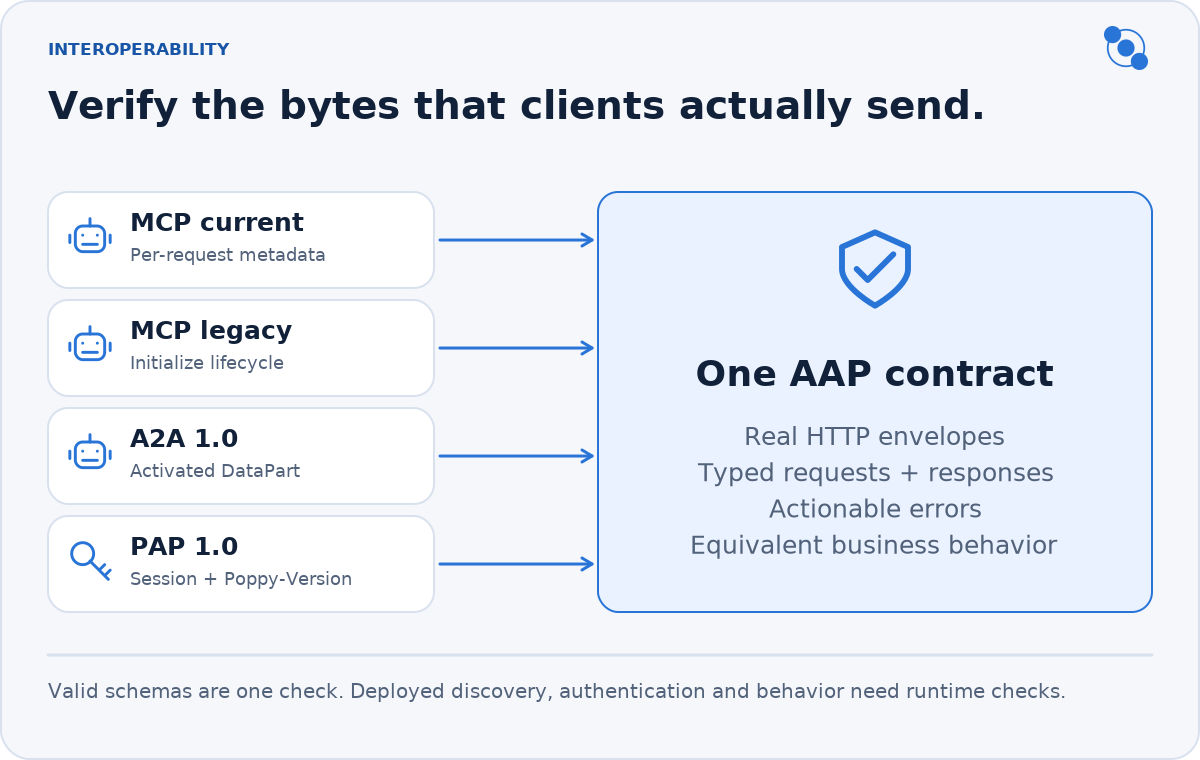
| A2A | A2A 1.0 JSON-RPC SendMessage, exact extension activation and canonical ProtoJSON |
| PAP | PAP 1.0: Poppy-Version, delegated per-request Session JWTs, list-form extensions and the native automotive OpenAPI; every optional surface that is advertised |
| Discovery | Dealer-domain Agent Card, Poppy document and llms.txt, all identifying the same deployment, skills and capabilities |
A dealer implements one or more of the five core skills, and optionally trade_in_submit and credit_application_submit, and exposes the same subset and capabilities through all three bindings. Feature filters additionally require inventory_facets. A buyer client needs only the binding it uses and the selected AAP contract.
An MCP-only implementation may say “implements the selected AAP MCP binding.” It must not claim full dealer-deployment conformance. Optional PAP account access, browser join, conversations, task coverage, Operations and native PAP MCP are required only when advertised. Supporting a protocol transport alone does not establish automotive conformance or universal assistant compatibility.
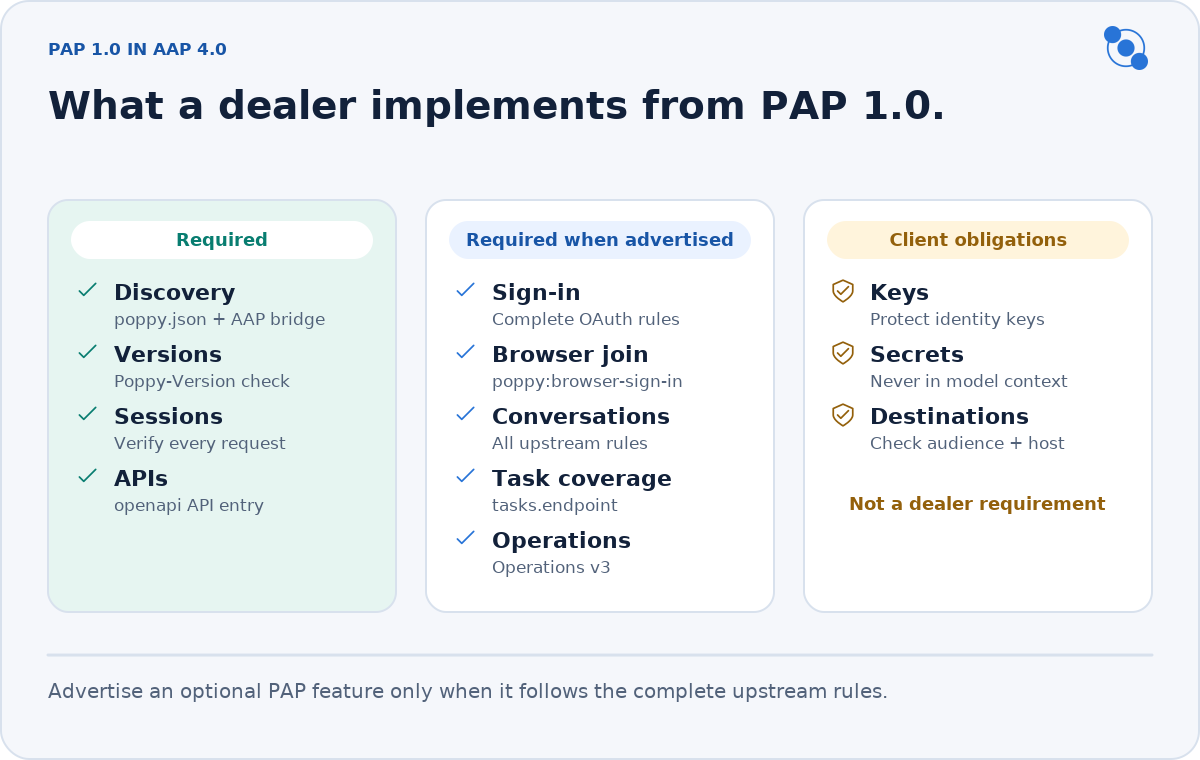
The PAP compliance matrix maps every PAP 1.0 section to its AAP status.
Evidence in this repository
| Verification | What it proves |
|---|---|
| JSON Schema and typed examples | Local references resolve; published request, response, discovery, authentication and Operations examples validate |
| Cross-document discovery | Contract, skill subset, endpoint identity, search, trade-in and credit capability declarations agree |
| Current and legacy official MCP clients | Real HTTP discovery and every tool call; complete self-contained schemas; structured skill failures |
| Pinned upstream MCP schema | Current protocol request/results include required metadata, completion state and caching fields |
| Official A2A JavaScript SDK | Real HTTP Agent Card discovery, every skill, tenant/header propagation and standard error details |
| Independent ProtoJSON decoder | Standard Any details decode and round-trip through the official protobuf parser |
| PAP contract and generated OpenAPI | Pinned upstream 1.0 schemas; version selection and supported_versions; Poppy-Version and Poppy-Extensions parsing; Company/issuer selection with ports; ES256/PS384 acceptance; delegation/Session claims and lookup by User ID; Session destinations; tasks response; Operations shapes; HTTP 400 recovery and shared automotive payloads |
| Release and website checks | Immutable snapshots, package exports, stable aliases, links, generated images and published artifacts |
The PAP helpers check decoded structures and relationships; they are structural, not cryptographic verifiers. Optional unadvertised surfaces are not certified by the fixture subset. These checks validate the specification and protocol fixtures. They do not certify a live dealership, production authorization service, consent event, credit bureau or CRM delivery. The pinned upstream sources are linked from the MCP, A2A and PAP pages.
Required deployment acceptance cases
Run these before advertising the AAP 4.0 binding. Use isolated inventory and non-delivering lead, trade-in and credit sinks for mutation cases.
| Area | Verify |
|---|---|
| Dealer discovery | All three entry points resolve over HTTPS; redirects end at the exact well-known path; organization.domain is the final host; linked endpoints and versioned schemas exist |
| Fresh agent onboarding | Give a supported agent only the dealer hostname. It discovers the exact advertised MCP endpoint, lists implemented tools and completes a public inventory search without private setup instructions. Target under one minute; record elapsed time, host/build and the actual transport used |
| Capability truth | Same implemented subset and search, trade-in and credit capabilities on all bindings; optional skills declared only when implemented, each with its capabilities; no template servers or unimplemented filters |
| MCP versions | Current metadata/header agreement, server/discover, caching and tools; current calls without optional clientInfo work; omitted mirror headers are inferred from the body; legacy initialize/initialized flow; no legacy Session requirement on current calls |
| Minimal client requirements | Every skill accepts omitted redundant headers under the AAP ingress rules: A2A defaults only on a contract-pinned endpoint; MCP derives copies from the body or this client's negotiated session. Supplied conflicts fail before execution. Public MCP needs no PAP credentials or browser Origin and accepts JSON-only responses; the PAP API requires its delegated Session JWT and Poppy-Version |
| A2A activation | Correct version, exact extension, tenant routing, canonical Messages; missing/mismatched values fail before execution |
| PAP versions | protocol_version 1.0; every skill call without Poppy-Version, or with an incompatible one, returns HTTP 400 version_unsupported before execution and is never handled under another version; 1.x minors accepted; no field from a later minor returned; supported_versions, if listed, on the same host with the same domain and issuer |
| PAP extensions | List-form extensions with exactly one AAP bridge version: "1" entry; the bridge is never required in Poppy-Extensions; unparsable headers declare nothing; extension_required is HTTP 403 JSON naming the extension; every other extension name is one PAP defines or starts with a domain |
| PAP identity | Real HTTPS CIMD/JWKS with no CIMD redirects; safe DNS resolution; exact client, final dealer host (port when not 443), domain metadata and bidirectional issuer authorization; issuer absence distinguished from failure |
| PAP Sessions | Independently signed delegations accepted with ES256 and PS384; direct identity-key signing rejected; key thumbprint, ≤24-hour delegation, freshness, method/URL, exact audience; Session found by client_id, sid and User ID, an unknown combination starting a new signed-out Session; agent_id unchanged; key rotation accepted; ended Sessions return safe HTTP 400; a bad Session header is refused before the body is examined; documented replay policy tested across replicas |
| PAP tokens | Signed-out requests carry no token and omit ath; an optional Bearer or DPoP token has matching ath and client; token and DPoP validated independently; anonymous-browsing token use rejected |
| PAP issuer and assertions, if an issuer exists | Exact selected issuer and protected_resources domain; existing issuer with auth.disabled keeps identity; refresh grant and revocation required, direct/device endpoints conditional; client assertions signed with ES256 and PS384 accepted; assertions lasting 5 minutes or less never rejected for lifetime |
| PAP sign-in, if advertised | Direct preferred; PKCE, exact redirect_uri, iss on every redirect; prompt=consent honored; PAR with request_uri when required; RFC 10027 §2; device link host and organization shown; consent page lists every scope; scope required, never broader, at least one granted; same DPoP key at refresh; one sign-in without resource yields a token per resource, one resource per request, invalid_target; a resource token rejected elsewhere; revocation and sign-out honored |
| Native PAP MCP, if advertised | Session header and Poppy-Version verified; token resource equals the MCP url; protected-resource metadata lists the Company issuer; cross-resource and cross-tenant tokens rejected |
| Website pages | Pages on organization.domain fetched without a browser accept the Session header without a token; a page that verifies it rejects failures with invalid_session; the header never reaches other hosts |
| Browser join, if advertised | Own-browser code and protected cookie; short-lived one-use code; Session-authenticated /authorize; signed-in join without poppy:browser-sign-in gets insufficient_scope; first redemption consumed even on failure; isolation headers; pre-existing-login and cookie rules of PAP §6; web.unscoped and web.disabled consistent |
| Task coverage, if advertised | tasks.endpoint answers with the Session header and no token; per-Session answers are private or no-store; alternatives reference only listed APIs; feedback limits; 202 empty or 200 alternative; skill index digests verify; Company text never supplies instructions or consent |
| Conversations, if advertised | Every entry has a description; request IDs, ownership, four state fields, handoff cancel, close 202, version_mismatch |
| Operations, if advertised | approval_required only for write skills and only when "operations";v="3" is declared; nothing performed before approval; identical resend with Poppy-Approval performs at most once; mismatched revision gets a new one; approval_declined final; consent grant still validated; same idempotency_key; MCP structuredContent.operation and _meta approval |
| Tenant and credential isolation | Another dealer cannot see private inventory, leads, trade-ins or credit applications; no token or Session JWT forwarding across redirects, resources or tenants |
| Search completeness | Every constraint applied; unsupported filters rejected; cursor continuation reaches all matches without hidden caps; changed/expired cursors fail |
| Features and geography | Known feature vocabulary, source evidence, unknown-data handling, correct radius boundary and stable distance ordering |
| Aggregate identity | Each result's endpoint-unique vehicle ID resolves the same seller and listing; duplicate VINs/stock numbers never choose an arbitrary dealer; dealer_information resolves its dealer ID to the actual recipient before consent; unknown IDs fail and mismatched identities stop delivery |
| Inventory and pricing | Current eligible status, real update timestamp, stable identifier, authoritative fee-inclusive price; unknown price stays unknown |
| Rebates | rebates[] only on condition: new; unique program_id; unconditional programs already inside price and never subtracted again; conditional programs never inside price and never advertised as price minus rebate; expired programs not presented; omitted means unknown |
| Currency and units | USD/mi omission defaults; explicit CAD/km vehicle, rooftop and query labels; Canadian capability defaults; unsupported currency errors; same country with different currencies or odometers; no mixed-currency price ranges or sorting; exact mi/km mileage boundaries and null handling; _mi fields stay miles; both contexts bind cursors; all three bindings return equivalent native numbers |
| Consent | Missing/invalid/expired grants fail before delivery; every permitted channel has contact data; no unauthorized follow-up |
trade_in_submit, if advertised | customer and consent are required exactly as for a lead, and a request without them fails with CONTACT_CONSENT_REQUIRED before any record; a dealer delivering to a CRM over ADF answers received, one with a valuation API may answer valued; consent scope exactly trade_in_submission with contact data per channel; valued carries an amount, a full range or both, received and rejected carry none; offer has expires_at, omitted kind means estimate; instant_valuation: false means every accepted submission returns received; lead_submit still accepts a trade-in block and never returns a valuation |
credit_application_submit, if advertised | Capabilities read before collection; each applicant carries their own credit consent with verbatim text; joint applications only when declared, with a co-applicant; a hard inquiry never made on a soft authorization; national_id collected only when accepted; national_id, date_of_birth and drivers_license never echoed in responses, errors, logs or URLs; missing fields answered with a typed error naming them; status separate from any decision; applications are processed through an API integration and never relayed through ADF/XML, email or CRM notes |
| Concurrent retries | Lose the first response, then retry: one delivery and the complete original outcome with replayed: true for leads, trade-ins and credit applications; changed payload conflicts; concurrent calls, Session renewal, version re-selection, Operations resends and correlated bindings share the result |
| Appointment outcome | confirmed has a real booking and time; alternatives are explicit; partial success never hides an accepted lead |
| Errors and throttling | Correct protocol envelope/status, safe field diagnostics, Retry-After/retry timing and bounded client behavior |
| Optional surfaces | Every advertised PAP sign-in, native MCP, browser, task coverage, conversation, Operations or other extension passes its complete PAP 1.0 rules |
Also reject peer-supplied metadata or endpoint URLs resolving to private, loopback or link-local addresses unless explicitly configured for a trusted local deployment. Do not automatically forward authenticated requests after endpoint redirects.
Run the repository checks
Use Node.js 22+ and pnpm 10, with one heavy command at a time:
pnpm install --frozen-lockfile
pnpm validate
pnpm test:contract
pnpm typecheck
pnpm check:images
pnpm check:releases
pnpm test:release
pnpm --filter @autoagentprotocol/schemas build
pnpm --filter @autoagentprotocol/types build
pnpm --filter @autoagentprotocol/validator build
pnpm check:packages
pnpm build
pnpm check:branding --build
pnpm freeze-check --base origin/main
The independent protobuf check uses Python 3.10+ in a virtual environment:
python -m pip install -r tools/protojson-requirements.txt
python tools/validate-protojson-errors.py
Operators can additionally use the pinned PAP 1.0 Company implementation kit against their authenticated deployment. Its validator runs 131 checks, each quoting the PAP 1.0 sentence it tests; the 78 that cover discovery, issuer metadata, client assertions, Sessions, versions, APIs, MCP, tasks and feedback map onto the rows above, and the rest apply to conversations, browser join and sign-in when a dealer advertises them. Schema acceptance cannot prove signature verification, replay stores, live TLS or consent.
Publish the frozen contract before a runtime advertises it. A release number describes the specification; the operator's verified behavior establishes deployment conformance.