Personal Agent Protocol
AAP 3.0 combines the A2A v1.0 profile and MCP with a native Personal Agent Protocol (PAP, “Poppy”) draft 0.3 guest API. The automotive payloads, pricing rules, supported skills, consent and lead semantics are the same across all three interfaces. A personal agent that understands Poppy and OpenAPI can use the automotive API without understanding A2A or the AAP discovery extension.
Poppy 0.3 is an in-progress upstream draft, pinned here for reproducible implementation. Compatibility here means this specific upstream revision, not a promise about future drafts, every vendor's client, or optional features that a deployment does not advertise. The baseline is upstream commit 86f0c8d, reviewed 2026-10-26. The normative A2A baseline is v1.0.0. These upstream requirements apply in addition to this profile. AAP does not weaken their authentication or authorization rules.
1. Conformance and scope
An AAP 3.0 dealer deployment MUST:
- Publish
/.well-known/agent-card.jsonand/.well-known/poppy.jsonon its dealership domain over HTTPS. The spelling is.well-known, and both filenames include.json. - Implement the A2A JSON-RPC
SendMessageprofile, including required extension activation and A2A v1.0 wire semantics. - Publish Poppy discovery conforming to
poppy.schema.json: organization identity,auth.issuer, at least oneapisentry oftype: "openapi", and theautoagentprotocol.org/aapextension linking the matching A2A card, MCP endpoint andllms.txt, with the selectedaap_version. - Implement Poppy signed-out Sessions and the guest OpenAPI interface in this chapter. The OpenAPI skill set MUST equal the AAP skill subset on the linked card. Neither surface may advertise an unimplemented skill.
- Implement the MCP binding and apply the same vehicle visibility, search capabilities, pricing, consent, validation and business outcomes across all three interfaces. Authentication and envelopes differ; automotive meaning does not.
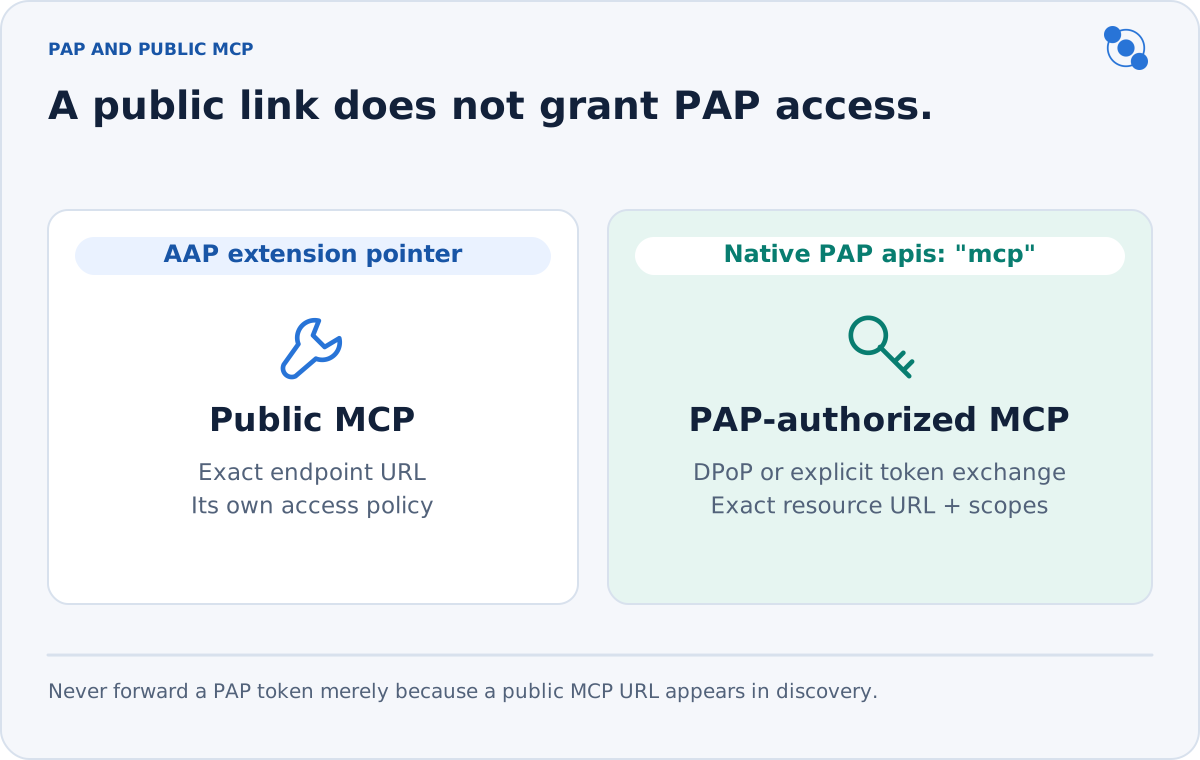
Customer accounts, sign-in, account scopes, native PAP authorization for MCP, browser session bridges, feedback, Company Agent conversations and Operations are optional. The AAP MCP endpoint itself is required; its public extension link does not claim PAP token support. If advertised, their complete upstream requirements become mandatory. A Session authenticates the personal agent and identifies a pseudonymous user; “guest” does not mean unauthenticated API access.
A website-only Poppy document (organization, web: {} and an optional AAP extension) is valid discovery and a useful migration stage. It is not the complete AAP 3.0 profile: a core Poppy client ignoring the extension can only browse that website. poppy-document.schema.json validates PAP 0.3 reader input, retaining unknown fields and interface types. poppy.schema.json adds AAP publication requirements and permits only upstream-defined API and conversation types. Before PAP 1.0, a client MUST NOT use an unsupported major.minor version. Support for 0.1 or 0.2 does not imply support for 0.3. Legacy clients use the frozen version-specific contract.
2. Paired discovery
Publish this example at the dealer's /.well-known/poppy.json, replacing every example domain and endpoint with an implemented service:
{
  "protocol_version": "0.3",
  "organization": {
    "name": "Demo Toyota",
    "domain": "demo-toyota.example.com"
  },
  "auth": {
    "issuer": "https://demo-toyota.example.com/poppy"
  },
  "apis": [
    {
      "type": "openapi",
      "url": "https://demo-toyota.example.com/poppy/openapi.yaml",
      "resource": "https://demo-toyota.example.com/poppy",
      "description": "Dealer information, inventory facets, search, vehicle details and consented leads using AAP payloads and Poppy guest sessions."
    }
  ],
  "web": {},
  "extensions": {
    "autoagentprotocol.org/aap": {
      "version": "1",
      "agent_card": "https://demo-toyota.example.com/.well-known/agent-card.json",
      "documentation": "https://autoagentprotocol.org/",
      "aap_version": "3.0.0",
      "mcp": "https://api.provider.example/aap/3.0.0/demo-toyota/mcp",
      "llms_txt": "https://demo-toyota.example.com/llms.txt"
    }
  }
}
The Agent Card remains an ordinary A2A v1.0 card. Its sole AAP extension is https://autoagentprotocol.org/extensions/aap/v3.0, marked required: true. Poppy fields MUST NOT be added as invented A2A core fields. The three version identifiers have different meanings:
| Identifier | Value | Meaning |
|---|---|---|
| AAP release / A2A extension URI | 3.0.0 / URI above | Automotive payload and profile contract; preparation resolves the release version |
Poppy protocol_version | 0.3 | Upstream Poppy draft |
extensions["autoagentprotocol.org/aap"].version | 1 | Major version of the discovery bridge's field contract, independent of AAP SemVer |
Both discovery resources MUST be accessible without session credentials and served as JSON. Discovery starts at the dealer's HTTPS well-known URL. poppy.json MAY redirect, but every hop MUST use HTTPS. The final URL MUST retain exactly /.well-known/poppy.json with no query; do not relocate discovery to an arbitrary JSON path. The document's organization.domain MUST match the final host after redirects, comparing case only; www is a distinct host. An agent MUST verify this identity and the issuer binding before requesting or forwarding credentials. Clients SHOULD honor HTTP cache headers. The AAP bridge's agent_card MUST describe the same deployment and skills, even when the card is hosted elsewhere. The dealer-domain well-known card still MUST exist.
Each independent Company MUST have its own OAuth issuer. A provider hosting several independent dealers MUST allocate separate issuers, even on shared servers. Domains using one issuer represent one Company and share User IDs, Sessions and Account Tokens; their auth objects MUST be identical. For aliases of one Company, publish each final host in its own document and include https://{domain} for every such domain in OAuth metadata protected_resources. Each domain entry has no port, path, query, fragment or trailing slash; only hostname case is ignored. Other service resource URLs may appear alongside those domain entries. For example, if dealer.example redirects discovery to www.dealer.example, the returned organization is www.dealer.example, and OAuth metadata must authorize that domain.
Discovery extension version 1
The domain-prefixed name autoagentprotocol.org/aap follows Poppy §3.3. It formalizes the existing discovery bridge without changing its field names:
| Field | Required | Meaning |
|---|---|---|
version | Yes | String "1"; incompatible bridge changes need a new major |
agent_card | Yes | HTTPS URL of the matching A2A Agent Card; read its AAP extension to select the automotive contract |
mcp | AAP 3.0 | The same MCP URL as the Agent Card; this pointer does not establish Poppy session support |
aap_version | AAP 3.0 | Selected automotive contract release |
llms_txt | AAP 3.0 | Canonical dealer-domain /llms.txt |
openapi | No | Existing OpenAPI description; its own published security applies |
api_catalog | No | Existing API catalog discovery URL |
documentation | No | Human/agent documentation URL |
The three fields marked AAP 3.0 are additions required by this automotive profile; the generic bridge version remains 1, and its existing optional fields retain their meanings. Every URL MUST be absolute HTTPS without embedded credentials. Readers MUST ignore unknown extension names and fields. They MUST NOT assume that a linked public A2A/MCP/API endpoint accepts Poppy tokens, or forward a token to it solely because it appears in this extension. Native Poppy capabilities belong in top-level apis, agent or web and carry their upstream obligations. Clients unaware of this extension use the standard OpenAPI entry.
3. Issuer and agent identity
The auth.issuer MUST be HTTPS without query or fragment. Resolve OAuth metadata using RFC 8414: remove a terminating slash from an issuer path, then insert /.well-known/oauth-authorization-server before that path. This changes only the metadata location; the returned issuer MUST still match the original auth.issuer exactly, including any trailing slash. For the example issuer, fetch:
GET https://demo-toyota.example.com/.well-known/oauth-authorization-server/poppy
{
  "issuer": "https://demo-toyota.example.com/poppy",
  "token_endpoint": "https://demo-toyota.example.com/poppy/oauth/token",
  "revocation_endpoint": "https://demo-toyota.example.com/poppy/oauth/revoke",
  "protected_resources": ["https://demo-toyota.example.com"],
  "grant_types_supported": ["urn:ietf:params:oauth:grant-type:jwt-bearer", "refresh_token"],
  "token_endpoint_auth_methods_supported": ["private_key_jwt"],
  "dpop_signing_alg_values_supported": ["ES256"]
}
Before using the document, the personal agent MUST check metadata issuer against auth.issuer character for character, and require protected_resources to authorize https://{organization.domain} as above. Do not normalize an explicit :443, a trailing slash or a percent-encoded host into an accepted domain entry.
token_endpoint, revocation_endpoint, grant_types_supported and protected_resources are required. The grants MUST include both JWT bearer and refresh_token, including for a guest-only issuer; this alone does not advertise a sign-in flow. authorization_code advertises Direct Sign-In and requires authorization_endpoint; the device-code grant advertises Device Sign-In and requires device_authorization_endpoint. auth.direct and auth.device are removed. A Company that offers neither grant nor auth.mediated offers only signed-out Sessions.
A personal agent publishes an HTTPS client_id metadata URL, an exactly matching metadata client_id, HTTPS jwks_uri on that domain, redirect_uris and token_endpoint_auth_method: "private_key_jwt". JWKS contains only public identity keys. Redirects are HTTPS on the client domain or RFC 8252 §7.3 loopback literals: http://127.0.0.1:{port}/{path} or http://[::1]:{port}/{path}. Registration and authorization redirects match exactly except for a loopback port. That exception applies to the local user callback, never to remote metadata or JWKS fetches.
Companies MUST verify signatures, allowed algorithms, expiry, replay, identity and both assertions' single-string exact issuer audience. The token endpoint is not an accepted assertion audience. Published identity keys sign the distinct client and Session assertions. A separate, unpublished DPoP key pair is created for each Session; it cannot rotate within that Session. ES256 proof verification is mandatory. Algorithm metadata is optional, but MUST include ES256 if present. If token authentication methods are advertised, they MUST include private_key_jwt.
All remote protocol URLs use HTTPS. Outside discovery, clients MUST NOT forward tokens, proofs, assertions or credentials after redirects. Remote endpoint, metadata and JWKS fetching MUST defend against SSRF, DNS rebinding and redirects into private, loopback or link-local networks unless deliberately configured for a trusted environment. Bound fetch sizes, timeouts and caching without weakening TLS or identity checks. A Company MAY require agent registration and return invalid_client; guest shopping requires no customer account but does require a working personal-agent identity.
4. Guest sessions and proof of possession
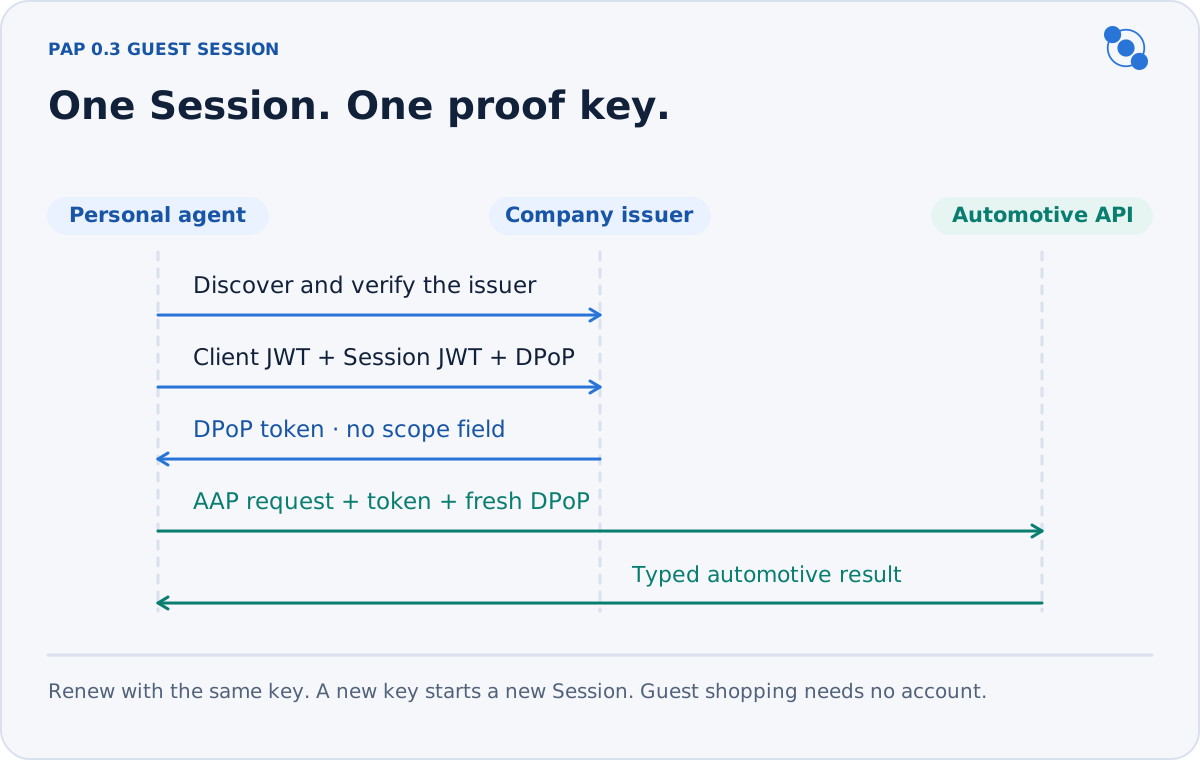
For each User and Company issuer, the personal agent MUST generate a stable opaque User ID that is not derived from personal information, even by hashing it. Reuse it across sessions for that issuer; do not reuse it across Companies or publish the mapping. For anonymous browsing, PAP also permits an ephemeral User ID that is discarded afterward and MUST NOT be used to sign in.
To start a signed-out Session, send a URL-encoded token request with:
| Parameter / header | Requirement |
|---|---|
grant_type | urn:ietf:params:oauth:grant-type:jwt-bearer |
assertion | Signed session JWT: iss = client ID, sub = issuer-specific User ID, string aud = exact auth.issuer, iat/exp at most 300 seconds apart, fresh jti with at least 128 random bits |
client_id | HTTPS client metadata URL |
client_assertion_type | urn:ietf:params:oauth:client-assertion-type:jwt-bearer |
client_assertion | Separate signed JWT: iss = sub = client ID, string aud = exact auth.issuer, iat/exp at most 300 seconds apart, its own fresh jti with at least 128 random bits |
DPoP header | Fresh RFC 9449 proof for this token endpoint; no ath at the token endpoint |
resource | Required by this AAP profile when an API entry advertises it; use that exact resource URI |
| Session identity | The proof key's RFC 7638 JWK thumbprint; no session_id parameter |
The Company MUST verify both assertion signatures against the authenticated client's public JWKS, exact issuer audiences, identity and expiry. It MUST reject a reused assertion jti from that client until expiry, and a reused token-endpoint DPoP jti within its acceptance window. A valid DPoP proof binds the resulting token to its key. Token-endpoint proofs name the token endpoint in htu, not the assertion audience. A successful request therefore needs two distinct signed assertions and a third, separate proof JWT. A successful response has Cache-Control: no-store and:
{
  "access_token": "example-opaque-session-token-not-a-credential",
  "token_type": "DPoP",
  "expires_in": 3600
}
expires_in MUST be positive. Session Tokens are opaque to the personal agent; it MUST NOT inspect token claims to implement protocol behavior. The JWT bearer grant always returns a signed-out DPoP token with no scope field and no Account Token. An empty OAuth scope string is invalid. session_id and signed_in are removed. A sign-in or Account Token grant instead returns a signed-in token, and may omit scope only when it equals the requested scopes. Clients determine state from the grant, never from the presence of scope alone. The Company MAY restrict guest actions, but this AAP profile exposes its advertised automotive skills to authorized signed-out Sessions. Customer permission for lead.submit is still required.
Renew with fresh assertions and a fresh proof from the same Session Key. The Company finds the Session by its key thumbprint and MUST verify the same client and User ID. A changed owner returns invalid_grant. Companies SHOULD retain ended-key tombstones; after invalid_grant on a Session Key, the client MUST discard that key and start with a new one. If the server forgets an ended key, renewal can create a new Session; clients MUST tolerate that. Signed-in Sessions renew through their Account Token. Always use the newest token; Session and token lifetimes are separate.
An optional Session assertion agent_id identifies one of a User's agents, not a separate client. It is stable, opaque, pairwise per Company and never derived from personal information. Renewals MUST retain the original value, or its absence. Account Tokens and conversations remain shared by that User. An Account-Token-created Session has no Agent ID; to assign one, start with the JWT grant and then use the Account Token with the same Session Key.
Every native OpenAPI request MUST carry Authorization: DPoP <Session Token> and a fresh DPoP proof. The resource server MUST verify signature, token expiry and audience/resource, the bound public key, htm, htu (without query/fragment), iat, jti, and ath (base64url-encoded SHA-256 access-token hash). The proof header MUST use typ: "dpop+jwt", an accepted asymmetric algorithm and a public jwk without private key material. Exactly one DPoP header is allowed. At API endpoints, rejecting a reused proof jti is optional under PAP 0.3; token-endpoint replay rejection remains mandatory. Clients always generate fresh proofs. Clients MUST support server nonces and retry with a fresh proof when challenged, keeping nonce state per issuing server. Session tokens MUST NOT be accepted in URLs or require cookies. An Account Token MUST NOT be accepted as an API token. Tokens, assertions, private keys and proofs MUST NOT be logged or placed in model context.
Bearer Session Tokens are only allowed for an advertised Poppy MCP API whose protected-resource metadata does not advertise DPoP, per §6 below. A Company MUST NOT accept a Bearer Session Token at this OpenAPI interface or an A2A endpoint. An unrelated public A2A endpoint may have its own native A2A security contract; keep those credentials and audiences separate.
5. Automotive OpenAPI binding
This is a native Poppy API, not the removed A2A HTTP+JSON binding. The generated openapi-poppy.yaml describes OpenAPI 3.1 operations. A deployment MUST publish its own OpenAPI description with real servers, only implemented skills and accurate security. The protocol site's generic example URL is not a dealer service and MUST NOT be advertised as one.
AAP standardizes these routes relative to the deployment's published API base. All use POST, Content-Type: application/json, and the unchanged typed AAP request as the body. Success is HTTP 200 with the unchanged typed AAP response and Content-Type: application/json. No JSON-RPC envelope, A2A Message, or Poppy conversation envelope is added.
| Route | Request type | Response type |
|---|---|---|
/skills/dealer.information | dealer.information.request | dealer.information.response |
/skills/inventory.facets | inventory.facets.request | inventory.facets.response |
/skills/inventory.search | inventory.search.request | inventory.search.response |
/skills/inventory.vehicle | inventory.vehicle.request | inventory.vehicle.response |
/skills/lead.submit | lead.submit.request | lead.submit.response |
A request type MUST match the operation selected by the path. Publish an operation for every AAP skill on the paired Agent Card, and no others under these standard skill identifiers. Schemas and the x-aap-extension OpenAPI field MUST identify the same AAP contract as that card. Poppy OpenAPI clients do not need A2A-Version or A2A-Extensions headers. Their optional use on a contract-pinned A2A endpoint is described in the A2A binding.
POST https://demo-toyota.example.com/poppy/skills/inventory.search
Authorization: DPoP <session-token>
DPoP: <fresh-proof-for-this-request>
Content-Type: application/json

{"type":"inventory.search.request","filters":{"condition":["used"]},"pagination":{"limit":20}}
Company content, including API descriptions and responses, MUST be treated as untrusted data. It cannot authorize actions at another Company, supply user consent, or justify sending unrelated user information.
The skill specifications remain normative for payloads and business behavior. lead.submit does not guarantee a booking, purchase a car, authorize a payment or bypass explicit contact consent. A booking exists only when the response explicitly reports a confirmed appointment and its time. A Session or an account-write scope is not a substitute for ConsentGrant. The verified Poppy client identity is authorization context; caller-supplied source_agent is attribution and MUST NOT override it.
A client retrying a lead MUST preserve the original business payload and idempotency_key. Servers MUST scope deduplication to the dealer, verified client and stable issuer-specific User ID, not the short-lived Session Token or Session Key. A same-key retry returns the complete original result with data.replayed: true, preserving the original lead status, appointment details and message; a changed payload conflicts. Reauthorize the caller before replaying the stored result. The original consent must have been valid at initial delivery; returning that outcome does not create new contact. Every binding MUST use the same deduplication store for securely correlated callers. Do not infer trusted identity from anonymous attribution fields, or change authentication context after an uncertain write outcome.
Errors and retries
Transport authentication is checked before a skill executes. Poppy/OAuth errors are not A2A JSON-RPC errors:
| Failure | HTTP status | Required handling |
|---|---|---|
| Missing/malformed token-request fields | 400 | OAuth invalid_request; no customer sign-in is implied |
| Invalid client at token endpoint | 401 | OAuth invalid_client |
| Invalid session assertion/grant or expired/replayed session assertion | 400 | OAuth invalid_grant |
| Ended Session Key / different owner | 400 | OAuth invalid_grant; do not transfer Session ownership |
| Wrong MCP resource or grant/token type | 400 | OAuth invalid_target; do not retry by omitting DPoP |
| Token endpoint proof error / nonce challenge | 400 | OAuth invalid_dpop_proof / use_dpop_nonce; nonce as applicable |
| Missing/expired API token | 401 | WWW-Authenticate: DPoP with invalid_token |
| Invalid API proof / nonce challenge | 401 | DPoP challenge (invalid_dpop_proof / use_dpop_nonce), DPoP-Nonce when applicable |
| Insufficient account scope, including signed-out access to an account action | 403 | insufficient_scope challenge identifying required scopes; use a covering Account Token or user-approved sign-in |
| Required extension unsupported | 403 | extension_required, naming extension; JSON at the token/protocol endpoints, challenge attribute at APIs |
| Rate limit on any endpoint | 429 | Retry-After; client MUST wait at least that long. Token/protocol endpoints return {"error":"rate_limited"} |
For skill errors, return the standard standalone aap.error body with the following HTTP mapping. The standalone body has type: "aap.error"; the A2A-only google.protobuf.Struct wrapper and its @type are not part of this body. Do not wrap it in JSON-RPC error.data on this binding.
| AAP code | HTTP status |
|---|---|
UNSUPPORTED_SKILL, DEALER_NOT_FOUND, VEHICLE_NOT_FOUND | 404 |
SCHEMA_VALIDATION_FAILED, MISSING_REQUIRED_FIELD, INVALID_CONDITION, UNSUPPORTED_FILTER, UNSUPPORTED_SORT, INVALID_CURSOR | 422 |
CONTACT_CONSENT_REQUIRED, INVALID_CONSENT | 403 |
VEHICLE_UNAVAILABLE, APPOINTMENT_TIME_UNAVAILABLE, IDEMPOTENCY_CONFLICT | 409 |
RATE_LIMITED | 429, with Retry-After |
INTERNAL_ERROR | 500 |
Malformed JSON MAY return 400 before a skill can be identified. Authentication responses may have no AAP body; clients MUST inspect status/challenge headers before assuming a typed skill error. Retry only when allowed by protocol error semantics and preserve lead deduplication. Never replay a DPoP proof itself.
6. Optional Poppy surfaces
Only advertise implemented capabilities. Readers MUST ignore unknown fields and skip unfamiliar API, conversation and alternative reference types. AAP publication schemas reject removed 0.2 fields to catch incomplete migrations; they do not turn reader tolerance into permission to publish old semantics as 0.3.
Account scopes and sign-in
Companies define their own scopes. PAP defines no built-in read/write scopes, and the entire poppy: prefix is reserved. Any sign-in method requires metadata scopes_supported. Every offered scope MUST have a description in a listed OpenAPI OAuth scheme or in auth.scopes, which replaces auth.custom_scopes:
{
  "issuer": "https://demo-toyota.example.com/poppy",
  "scopes": {
    "saved_searches:read": "Read the customer's saved vehicle searches"
  },
  "scope_hints": {
    "saved_searches:read": { "changes": "none", "personal_data": true }
  }
}
This is an optional auth object for an account-capable deployment, not a new inventory-search requirement. Each hint MUST include changes (none, reversible or irreversible) and personal_data; it describes the most consequential operation requiring that scope. Readers MUST treat unknown changes values as irreversible, ignore unknown fields, and treat missing hints as unknown. Hints describe company claims; they are not customer consent.
| Surface | Obligations when advertised |
|---|---|
| Direct Sign-In | §4.5: metadata authorization-code grant, user-controlled sign-in, PKCE S256, state and exact response iss checks. Bind the code to the Session Key with dpop_jkt, or a DPoP proof on PAR. Companies MUST support dpop_jkt. Code exchange uses the bound key |
| Device Sign-In | §4.6: metadata device grant/endpoint; follow RFC 10027 risk assessment and mitigations, preferring Direct Sign-In when possible. First token poll binds the device code to the Session Key; a later different key gets invalid_grant. Honor expiry, pending, polling interval and slow-down rules |
| Mediated Sign-In | §4.7: declared fields/scopes, DPoP, credential secrecy, rate limits and multi-step challenges. Scopes are a subset of scopes_supported; SHOULD be transitional until direct/device flows cover the same tasks |
| Account Tokens | §§4.4, 4.8–4.9: every successful sign-in grants at least one requested scope and returns refresh_token; zero approved scopes means decline. Optional positive refresh_token_expires_in communicates lifetime; refresh may rotate the token. Account Tokens bind client/User/account, not one Session Key |
Every sign-in request MUST include a nonempty scope string, and grants MUST NOT exceed the requested and method-allowed scopes. A Session can never switch to a different account, even after sign-out: return account_mismatch and start a new Session. A newly generated key with an Account Token creates a Session; an existing key signs in that Session only after ownership checks. On Account Token invalid_grant, follow §4.8 to distinguish revoked account authorization from an ended Session before deciding what to discard.
Revoking an Account Token signs out the affected Sessions and SHOULD invalidate their issued Session Tokens immediately. State checks and short token lifetimes are fallbacks. Guest browsing may continue, while account actions return insufficient_scope with the missing scopes. Do not silently sign the User back in after they signed out or disconnected access. Account Tokens go only to token/revocation endpoints, never to an automotive API. Model context MUST NOT contain tokens, private keys, authorization codes, PKCE verifiers or device codes; credentials stay in trusted signing/sending code.
Native PAP MCP
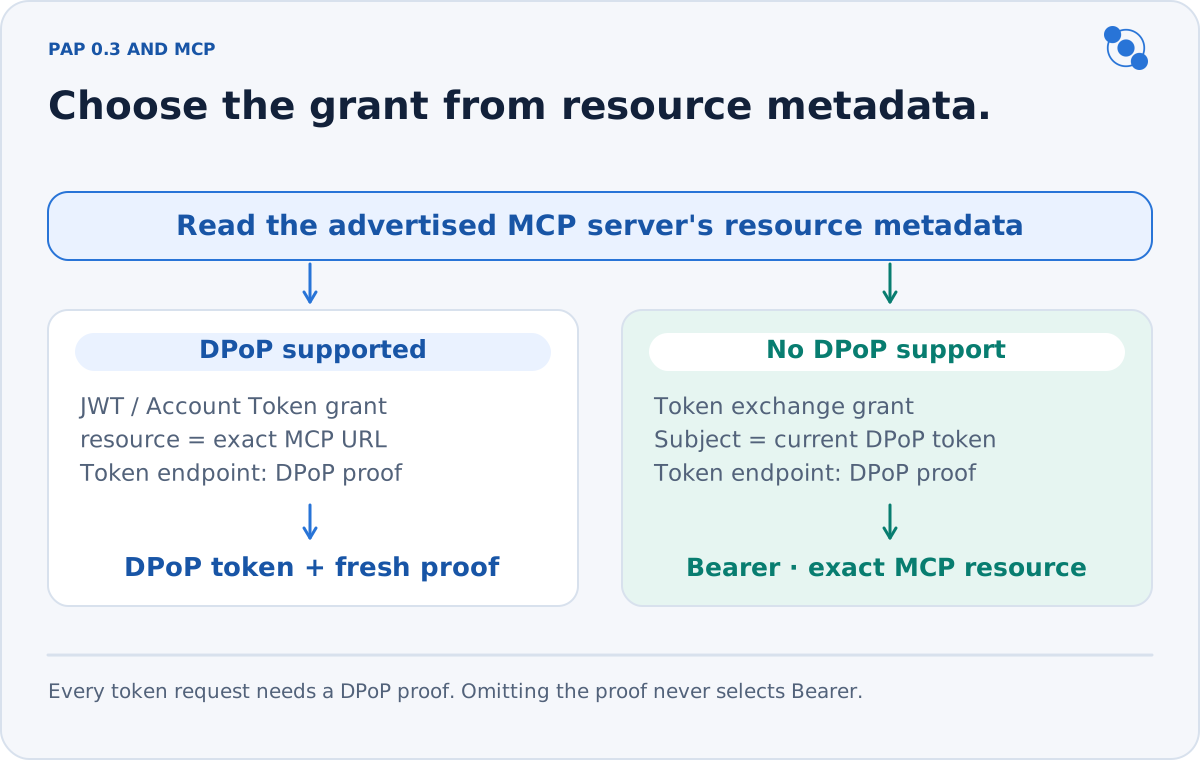
A public MCP URL in the AAP extension does not promise PAP authorization. A native apis entry with type: "mcp" MUST implement PAP §4.3 and §6: Streamable HTTP MCP 2025-06-18 or later, accept scoped Session Tokens, and publish RFC 9728 metadata with resource exactly equal to its advertised URL and authorization_servers including the exact auth.issuer. AAP additionally requires its current and compatibility MCP bindings.
| MCP resource metadata | Token flow for PAP clients |
|---|---|
Advertises dpop_signing_alg_values_supported containing ES256 | Normal JWT bearer or Account Token grant, with DPoP, resource equal to the MCP URL; use Authorization: DPoP plus a fresh resource proof |
| Does not advertise DPoP | First obtain a normal DPoP Session Token, then use RFC 8693 token exchange, still with DPoP at the token endpoint; use the returned Bearer token only at that exact MCP URL |
The complete optional fixture pairs native MCP discovery, issuer metadata and resource metadata. The default discovery example remains a public MCP pointer plus native PAP OpenAPI.
For non-DPoP MCP the issuer MUST advertise urn:ietf:params:oauth:grant-type:token-exchange. Required form fields are grant_type, subject_token, subject_token_type: urn:ietf:params:oauth:token-type:access_token, exact resource, client_id, client_assertion_type and client_assertion. Create a new client assertion with its own fresh jti; never reuse either assertion from the guest grant. The fresh proof uses the Session Key and has no ath. The Company MUST verify that the subject DPoP token is current, belongs to that client and is bound to the proof key. The result is a Bearer token with issued_token_type: urn:ietf:params:oauth:token-type:access_token, positive expires_in, and the same or narrower scopes. A signed-out exchange omits scope. See the request and response examples.
A normal grant targeting non-DPoP MCP, or token exchange targeting DPoP-capable MCP, returns invalid_target. An invalid subject token returns invalid_grant. Missing proof never selects Bearer. On expiry or sign-in/out, exchange a current DPoP token again. Tokens are restricted to the exact resource URL, not its entire host; a DPoP token sent as Bearer MUST be rejected. MCP 401 challenges advertise resource_metadata for every accepted scheme. New MCP servers SHOULD support DPoP. Generic MCP clients retain standard MCP OAuth; native PAP clients always send their Session Token.
Browser sessions
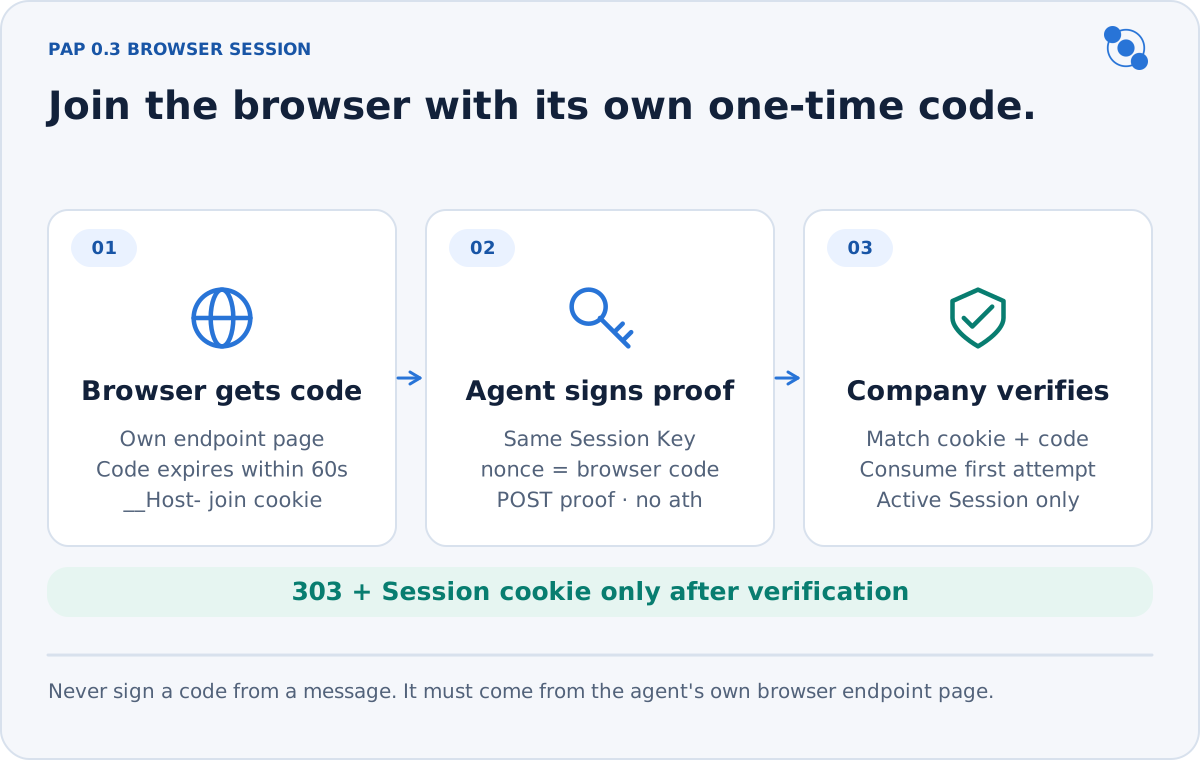
PAP §5 replaces the old browser assertion with this flow:
- The agent's own browser GETs
web.browser_session_endpoint. The response contains a form with hiddencode, emptyproof, and a cookie tying the code to that browser. The code MUST contain at least 128 random bits, expire within 60 seconds and be single-use. The join cookie MUST use__Host-,Secure,HttpOnlyandSameSite=Strict. Loading the page MUST NOT change the Session or other browser cookies. - The agent reads the code only from that endpoint in its own browser, outside model context. It signs a Session-key DPoP proof with
htm: POST,htuequal to the endpoint,nonceequal to the code, and noath. Its browser submitscodeandproof; the browser supplies the join cookie. Never sign a code from a message, another page or another browser. - The Company consumes the code on the first submission, even when verification fails, verifies cookie/code/expiry/proof and an already-active Session Key, then sets the Session cookie, clears the join cookie and returns 303 to its own website. Failure sets no Session cookie and returns 400 or 429; restart from GET. An unknown key cannot create a Session here.
The bootstrap response MUST send Cache-Control: no-store, Content-Security-Policy: frame-ancestors 'none', and Cross-Origin-Opener-Policy: same-origin. The resulting Session cookie MUST be Secure and HttpOnly, SHOULD use __Host-, MUST NOT outlive the Session, and MUST reflect its current state/scopes on the next request. It takes precedence over other signed-in website cookies. Website access uses this cookie, never URL tokens. See the form schema; cryptography and browser binding require runtime verification.
Conversations, excluded tasks and feedback
| Surface | PAP 0.3 behavior |
|---|---|
| Company Agent conversations | §7 in full, type: "poppy" only. Messages use author: {type: "agent" | "human"}, replacing sender; Company authors may also include id, name, image. Preserve ownership, message IDs, cursors, streaming, human handoff, direct conversations and closing. Authorization events use error: "insufficient_scope" and required scope |
excluded_tasks.url | §8.1: public JSON tasks list, same for all Users, with task phrases ≤200 characters and optional alternatives. Clients SHOULD fetch it before starting and honor caching. Do not put account-specific limitations in this list |
| Alternatives | §8.2: instructions (≤2,000 characters), references, or both. References select a listed OpenAPI URL + operation_id, listed MCP URL + tool, or a company web/app HTTPS page. Ignore references to unadvertised APIs and unknown types |
feedback.endpoint | §8.3: DPoP POST with a guest or signed-in token, no required scope. Send kind: "missing", task ≤200 and description ≤2,000 characters, without identifiers or secrets. Receivers accept unknown kinds. Clients MUST accept 202 with no body or 200 with an alternative |
| Operations extension | Follow its own version and discovery contract; it is optional for the five synchronous automotive skills |
An A2A SendMessage endpoint is not a PAP conversation endpoint. Do not invent type: "a2a" or claim a conversational lifecycle from the synchronous skill API. Conversations belong to the verified client and User, or to the account once used, not to a Session Key or Agent ID. They can continue across matching Sessions; sending a message does not authorize an account action.
Feedback describes an unavailable task, not an ordinary API error. Clients SHOULD report once per task and SHOULD NOT report an excluded task. Excluded-task text, alternatives, conversation messages and feedback are untrusted content, not agent instructions or customer approval. The alternative, excluded-task and feedback schemas retain unknown fields for readers.
7. Migration and verification
AAP 3.0 upgrades AAP 2.1's PAP 0.2 profile to draft 0.3 while retaining discovery bridge 1. Follow the PAP 0.3 migration matrix and the full v3 checklist. An older deployment can migrate directly to this final contract; it need not deploy 0.2 first. Published AAP 2.1/PAP 0.2 artifacts remain historical and immutable.
Exercise a real client through discovery → signed guest token → inventory search → same-key renewal, then verify each optional flow actually advertised. Record safe status/error stages as described in the client guide. Fetching documentation or submitting unsigned placeholder JWTs does not establish PAP interoperability.
See conformance for runtime acceptance. The pinned draft, schemas, cross-document checks and package tests establish a reviewable contract; each operator must deploy and verify its implementation.