Introduction
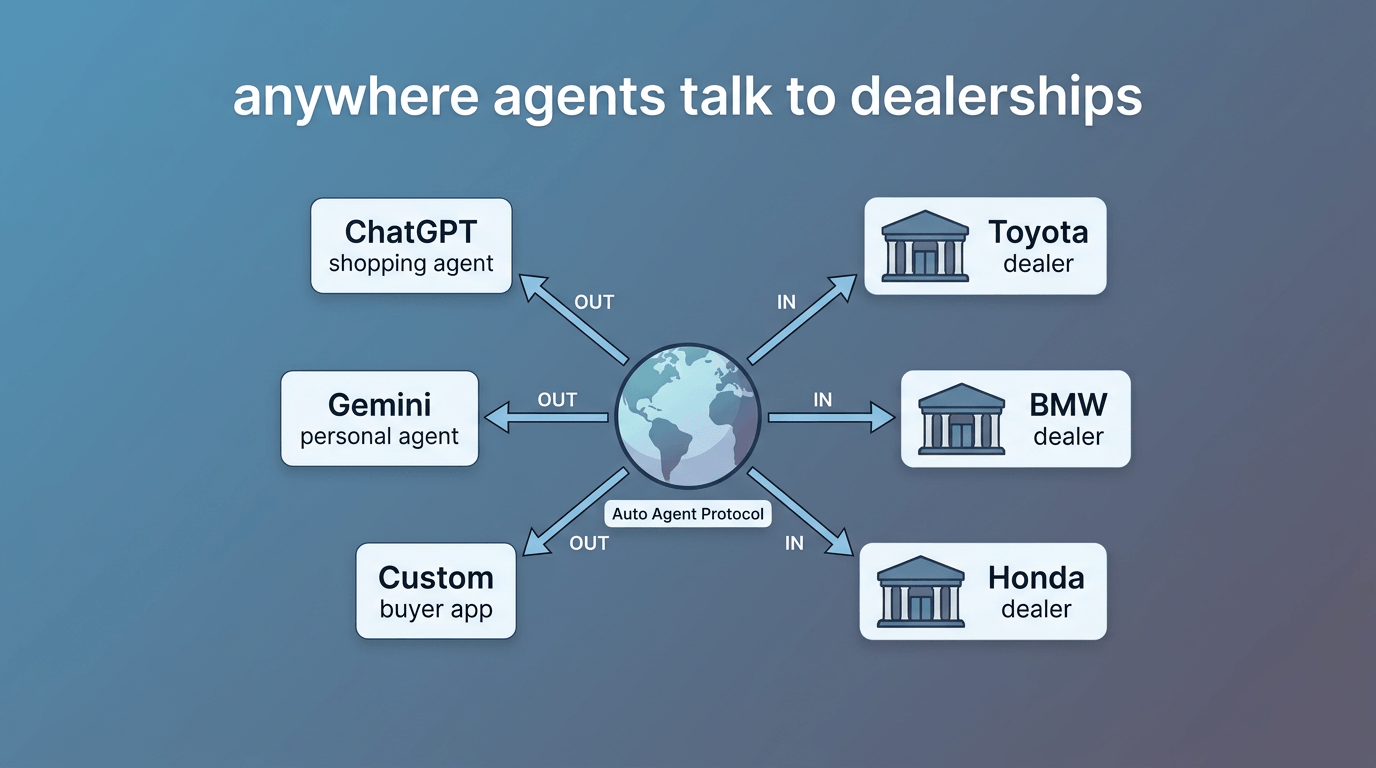
Auto Agent Protocol (AAP) is a strict A2A v1.0 profile that defines the typed automotive data shapes AI agents and car dealerships exchange when they discover, browse, and submit leads.
AAP does not invent a new wire protocol. It rides on top of the A2A (Agent2Agent) specification: every AAP message travels inside an A2A Message.parts[].data value as a typed DataPart. Dealers MAY expose their AAP skills via either A2A binding — JSON-RPC 2.0 or HTTP+JSON/REST. gRPC is out of scope for v0.1.
The extension is identified by a single URI:
https://autoagentprotocol.org/extensions/a2a-automotive-retail/v0.1
A dealer agent declares itself AAP-compliant by listing this URI in capabilities.extensions[] of its A2A agent card and by implementing one or more of the five standard AAP automotive skills. Agents pick the subset they support; AAP RECOMMENDS at least inventory.search + lead.submit for an end-to-end shopping flow, but neither is mandatory.
What AAP standardizes
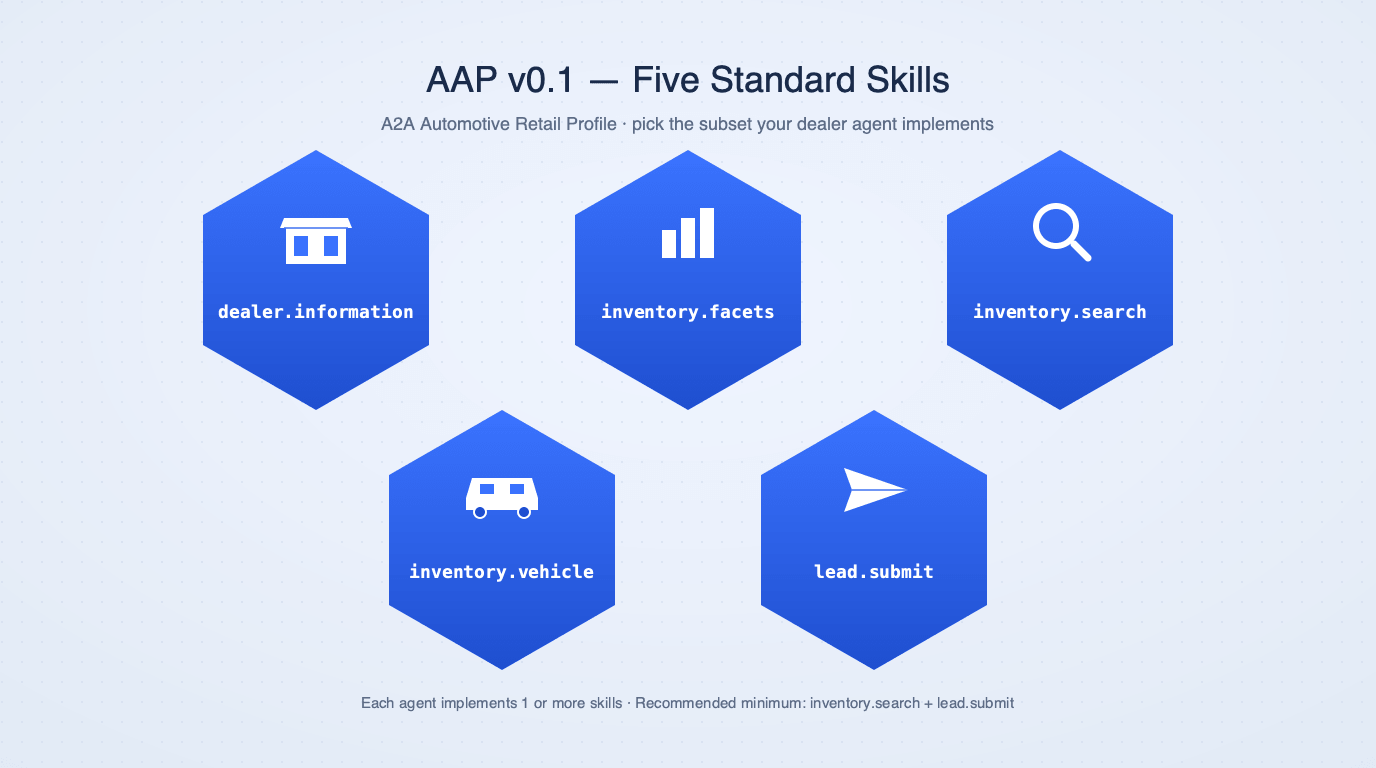
AAP v0.1 defines a vocabulary of five standard skill IDs that cover the read-and-lead lifecycle of automotive retail. A dealer agent picks whichever subset matches its capabilities — none of the five is individually mandatory.
| Skill | Purpose |
|---|---|
dealer.information | Dealership profile, locations, brands, hours, contact channels, capabilities |
inventory.facets | Aggregated counts and ranges over the dealer's inventory |
inventory.search | Filtered, paginated inventory queries |
inventory.vehicle | Detail view of one specific vehicle (by VIN, stock, or vehicle_id) |
lead.submit | Unified consented lead carrying customer info plus optional vehicle of interest, trade-in, and appointment |
It does NOT cover authentication beyond bearer, payments, financing approval, RFQ/quote workflows, trade-in valuations, or reservations. Future versions MAY extend this surface; v0.1 is intentionally minimal.
Layered architecture
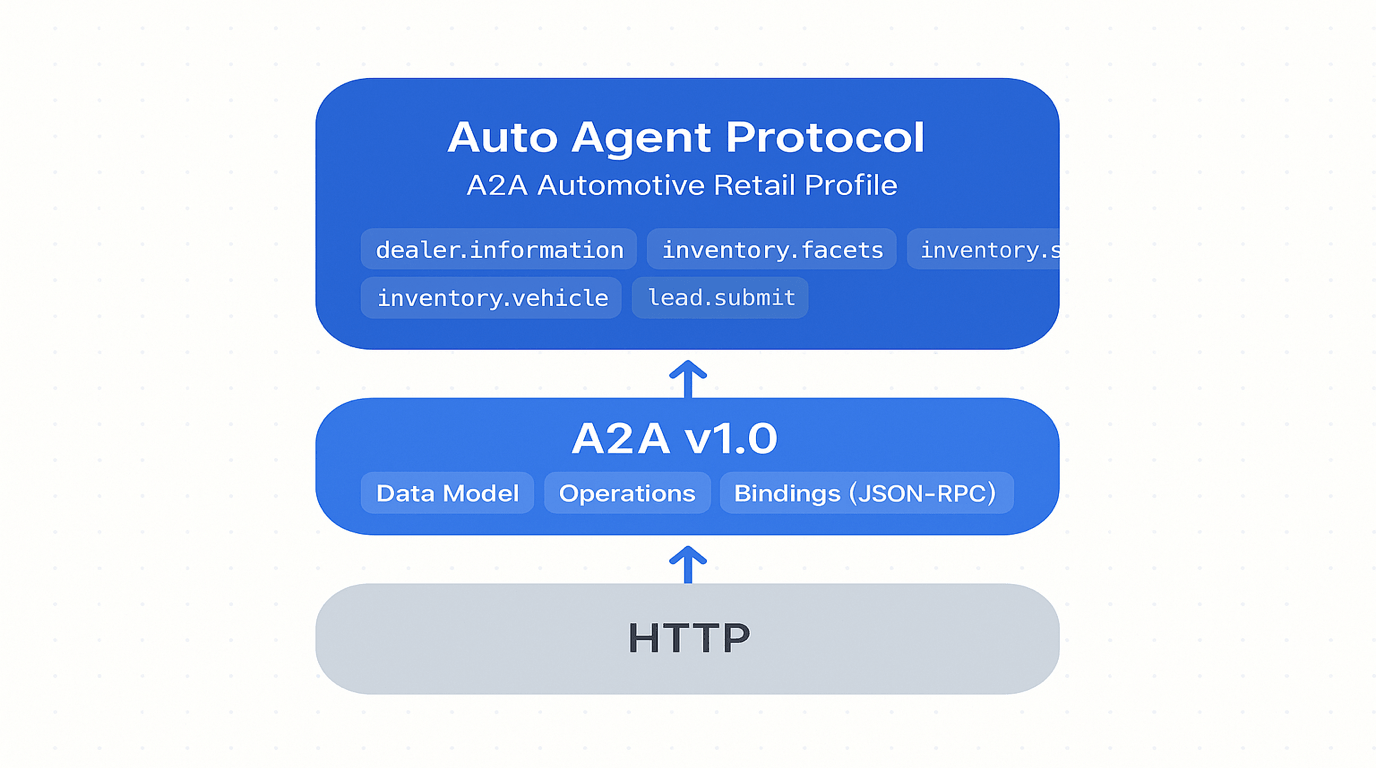
AAP sits as a profile on top of A2A, which itself sits on top of HTTP. AAP never touches the wire format directly — it defines the shape of typed DataParts that A2A bindings carry.
Anything an A2A client already does — message envelopes, task model, error mapping, server-sent events — works unchanged. AAP only specifies the typed payloads inside DataPart.data.
Quick start
A buyer agent talks to a compliant dealer agent in three steps.
1. Discover the agent
Fetch the A2A agent card at the dealer's well-known URL:
curl https://demo-toyota.example.com/.well-known/agent-card.json
Confirm the card lists the AAP extension URI under capabilities.extensions[].uri and exposes at least one supported_interfaces[] entry whose protocol_binding is JSONRPC or HTTP+JSON.
2. Pick a binding
A2A defines two protocol bindings AAP supports. Both carry identical AAP payloads.
| Binding | A2A spec | AAP page |
|---|---|---|
| JSON-RPC 2.0 | A2A Section 9 | JSON-RPC binding |
| HTTP+JSON | A2A Section 11 | REST binding |
3. Send a typed AAP message
Wrap an AAP request inside an A2A Message and POST it to the agent endpoint. Below is the simplest call — dealer.information over the HTTP+JSON binding (using the A2A v1.0 wire format):
curl -X POST https://demo-toyota.example.com/a2a/message:send \
  -H "Content-Type: application/json" \
  -d '{
    "message": {
      "messageId": "01HZ9G5N8D1Y4M6SP9C4XKVW3Q",
      "role": "ROLE_USER",
      "parts": [
        {
          "data": { "type": "dealer.information.request" },
          "mediaType": "application/vnd.autoagent.dealer-information-request+json"
        }
      ]
    },
    "configuration": {
      "acceptedOutputModes": ["application/vnd.autoagent.dealer-information-response+json"]
    }
  }'
The dealer agent replies with an A2A Message whose first DataPart.data is an AAP response:
{
  "message": {
    "messageId": "01HZ9G5P2KA8RT9WMS3B4C5D6E",
    "role": "ROLE_AGENT",
    "parts": [
      {
        "data": {
          "type": "dealer.information.response",
          "data": {
            "dealer_id": "dealer_demo_toyota",
            "legal_name": "Demo Toyota of San Francisco, LLC",
            "trade_name": "Demo Toyota",
            "brands": ["Toyota"],
            "address": {
              "address_line_1": "100 Market St",
              "city": "San Francisco",
              "state": "CA",
              "zip": "94105"
            }
          }
        },
        "mediaType": "application/vnd.autoagent.dealer-information-response+json"
      }
    ]
  }
}
Where to read next
- Why automotive needs AAP — the gap AAP fills against A2A, ACP, MCP, and ADF.
- A2A profile — how AAP slots into A2A's three-layer architecture.
- Discovery — full agent card example.
- Contract manifest — machine-readable skill mapping for planning agents.
- Pricing and FTC compliance — the four pricing fields and why
priceis the FTC-final out-the-door amount. - Skills reference — one page per skill with full request/response examples.