Introduction
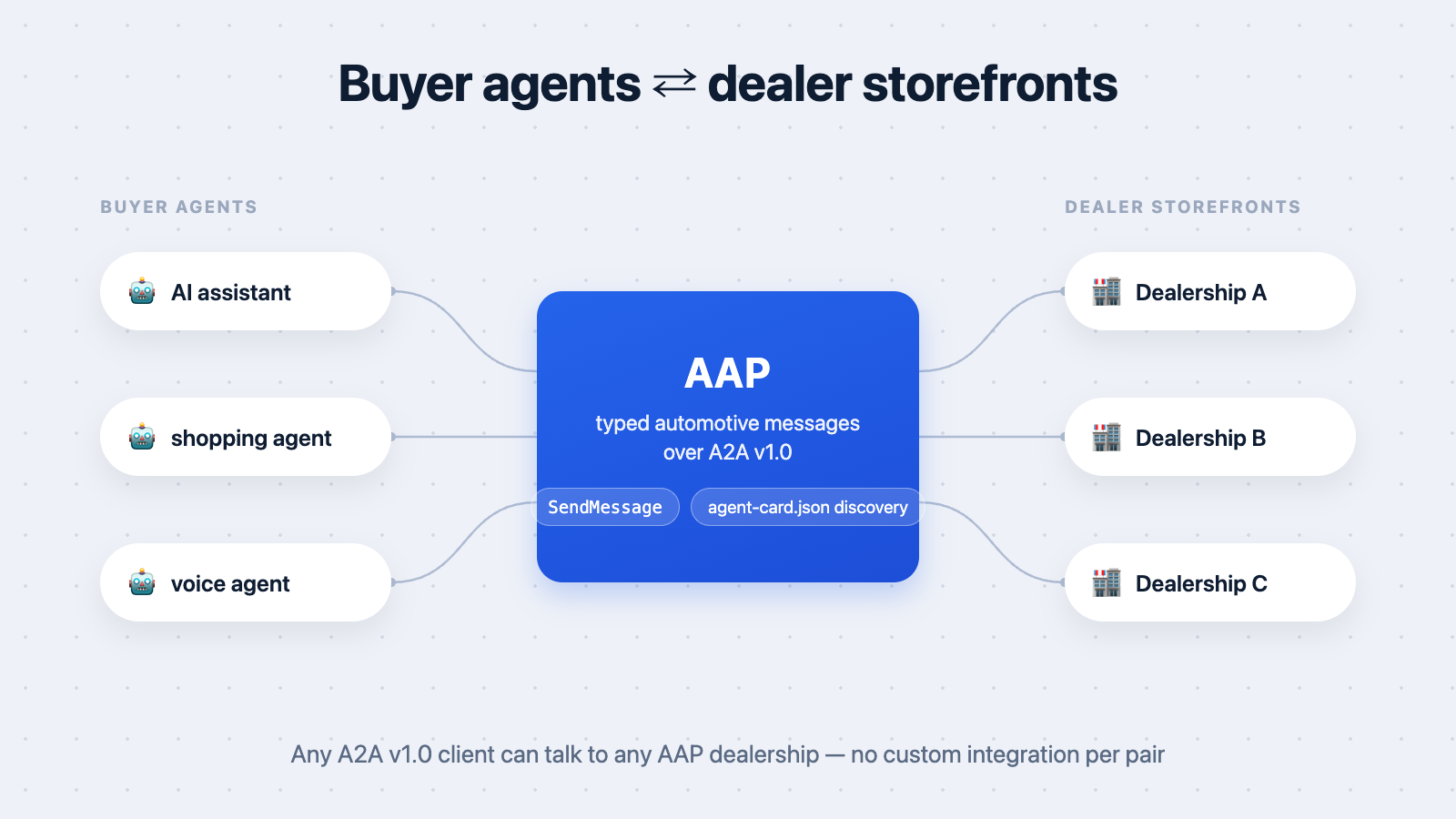
The Auto Agent Protocol (AAP) lets AI assistants shop at car dealerships. People increasingly ask an AI assistant to find their next car. AAP is the free, open standard that lets any of those assistants find a dealership, browse its real inventory, and — with the customer's clear permission — send the dealership a sales lead. For a dealership, joining in means publishing one small file on your own website and answering a few well-defined questions; no app store, no middleman, no per-partner integration work.
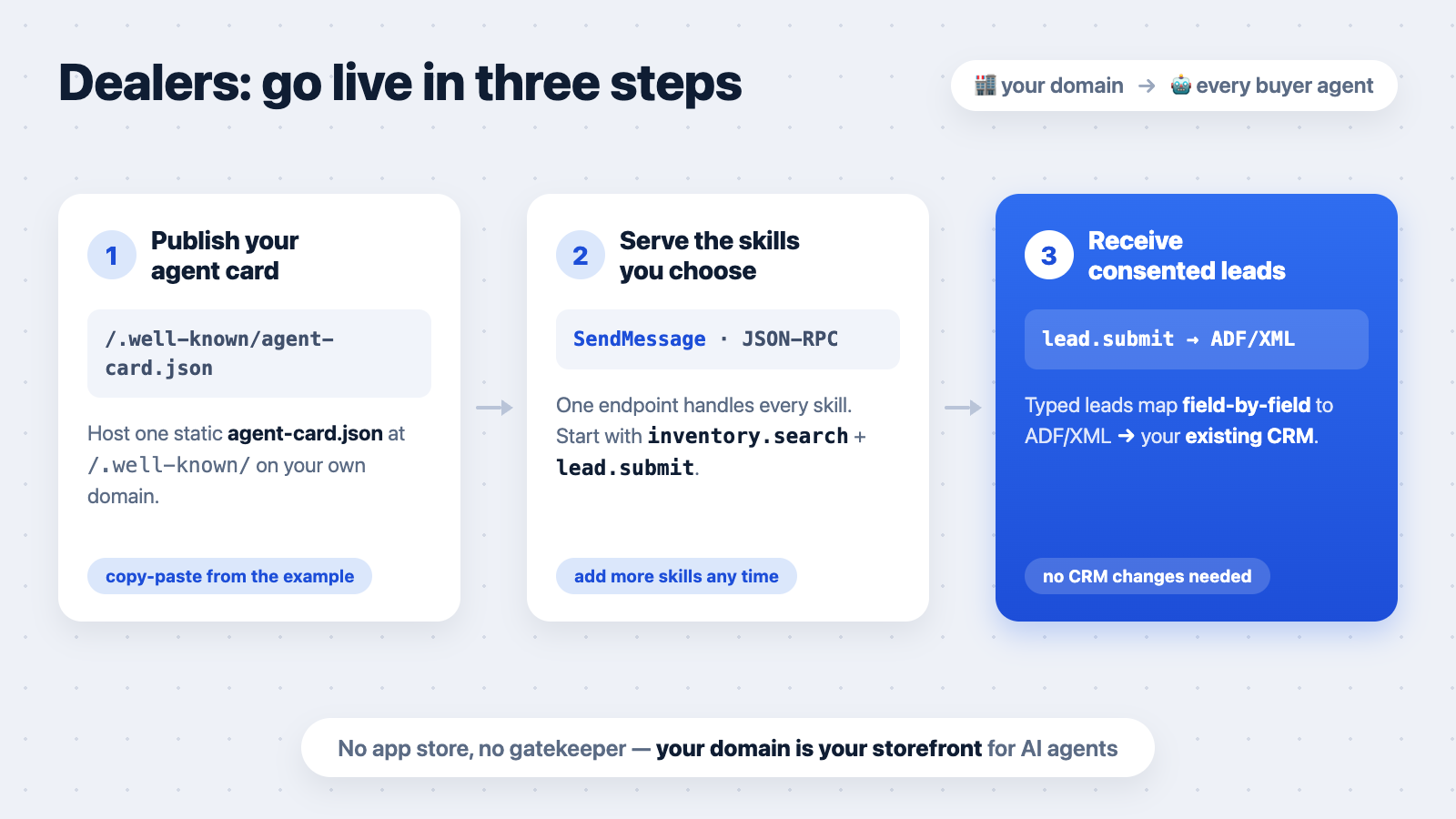
In technical terms: AAP is a strict A2A v1.0 (Agent2Agent) profile that defines the typed automotive data shapes AI agents and dealer agents exchange when they discover, browse, and submit leads. AAP does not invent a new wire protocol — every AAP message travels inside an A2A Message.parts[].data value as a typed DataPart. A JSON-RPC 2.0 interface is REQUIRED on every AAP agent card; an HTTP+JSON/REST interface MAY be added as an optional second binding. gRPC is out of scope for v1.0.
The extension is identified by a single URI:
https://autoagentprotocol.org/extensions/a2a-automotive-retail/v1.0
A dealer agent declares itself AAP-compliant by listing this URI in capabilities.extensions[] of its A2A agent card and by implementing one or more of the five standard AAP automotive skills. Agents pick the subset they support; AAP RECOMMENDS at least inventory.search + lead.submit for an end-to-end shopping flow, but neither is mandatory.
What AAP standardizes
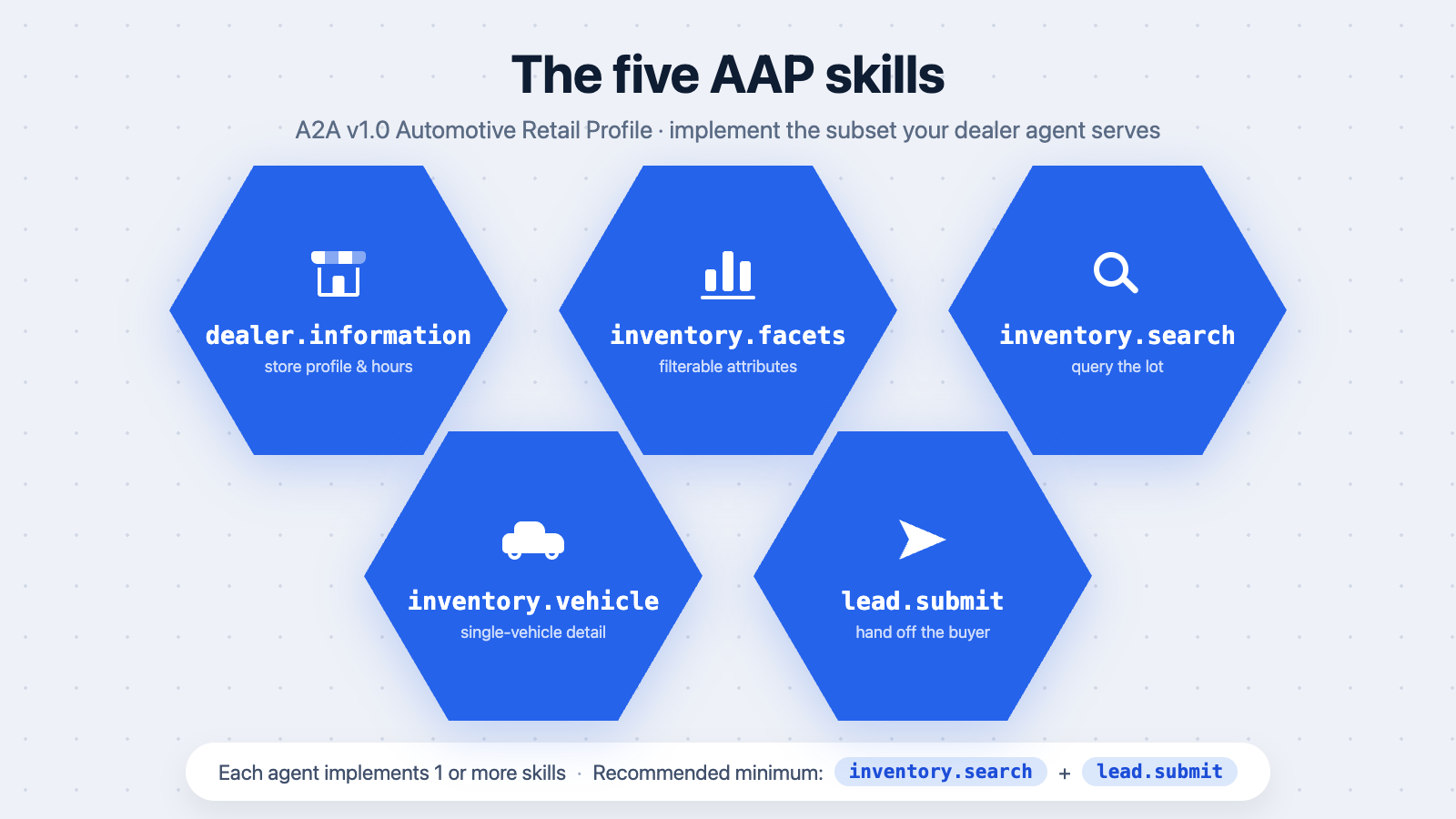
AAP v1.0 defines a vocabulary of five standard skill IDs that cover the read-and-lead lifecycle of automotive retail. A dealer agent picks whichever subset matches its capabilities — none of the five is individually mandatory.
| Skill | Purpose |
|---|---|
dealer.information | Dealership profile, rooftops, hours, contact channels, capabilities |
inventory.facets | Aggregated counts and ranges over the dealer's inventory |
inventory.search | Filtered, paginated inventory queries |
inventory.vehicle | Detail view of one specific vehicle (by VIN, stock, or vehicle_id) |
lead.submit | Unified consented lead carrying customer info plus optional vehicle of interest, trade-in, and appointment |
It does NOT define authentication (v1.0 agents are public by default; auth is left to A2A), payments, financing approval, RFQ/quote workflows, trade-in valuations, or reservations. Future versions MAY extend this surface; v1.0 is intentionally minimal.
Layered architecture
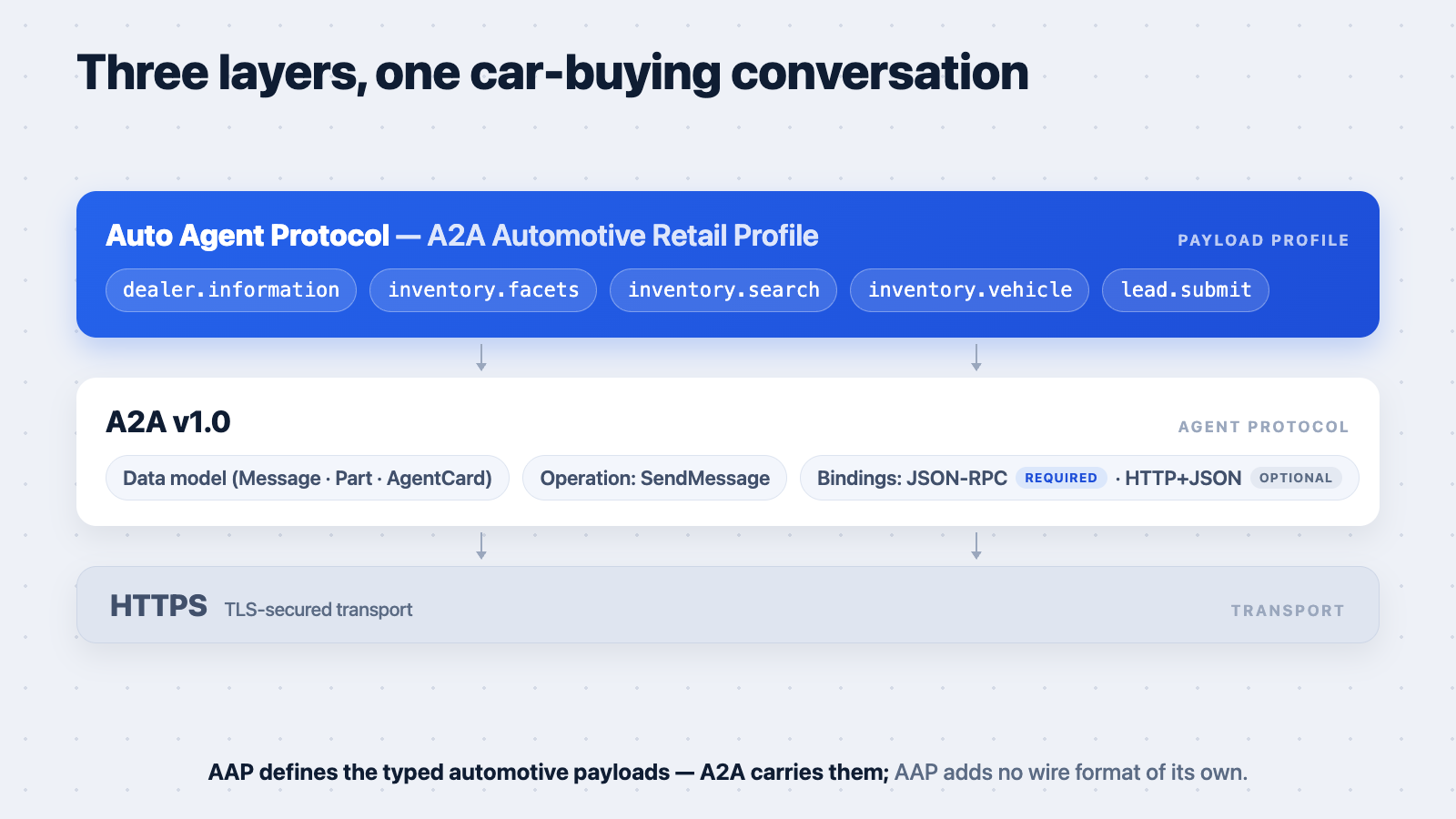
AAP sits as a profile on top of A2A, which itself sits on top of HTTP. AAP never touches the wire format directly — it defines the shape of typed DataParts that A2A bindings carry.
AAP uses exactly one A2A operation: SendMessage — a request Message goes in, a response Message comes out. The optional A2A surface (SendStreamingMessage, the tasks operations Get/List/Cancel/Subscribe, push notification configs, GetExtendedAgentCard) is out of scope for AAP v1.0: dealer agents do not need to implement it, and buyer agents MUST NOT require it. AAP only specifies the typed payloads inside DataPart.data.
Quick start
A buyer agent talks to a compliant dealer agent in three steps.
1. Discover the agent
Fetch the A2A agent card at the dealer's well-known URL:
curl https://demo-toyota.example.com/.well-known/agent-card.json
Confirm the card lists the AAP extension URI under capabilities.extensions[].uri and includes a supportedInterfaces[] entry whose protocolBinding is JSONRPC (REQUIRED on every AAP agent card; an HTTP+JSON entry MAY also be present).
2. Pick a binding
Every AAP agent exposes the JSON-RPC 2.0 binding; a dealer MAY additionally offer HTTP+JSON. Both carry identical AAP payloads; gRPC is out of scope for AAP v1.0.
| Binding | Status | A2A spec | AAP page |
|---|---|---|---|
| JSON-RPC 2.0 | REQUIRED | A2A Section 9 | JSON-RPC binding |
| HTTP+JSON | OPTIONAL | A2A Section 11 | REST binding |
3. Send a typed AAP message
Wrap an AAP request inside an A2A Message and send it with SendMessage — the single A2A operation AAP uses. Below is the simplest call — dealer.information over the REQUIRED JSON-RPC binding, using the A2A v1.0 ProtoJSON wire format (ROLE_USER/ROLE_AGENT enum names, no kind discriminators) that A2A v1.0 clients send and parse:
curl -X POST https://demo-toyota.example.com/a2a \
  -H "Content-Type: application/json" \
  -d '{
    "jsonrpc": "2.0",
    "id": 1,
    "method": "SendMessage",
    "params": {
      "message": {
        "messageId": "01HZ9G5N8D1Y4M6SP9C4XKVW3Q",
        "role": "ROLE_USER",
        "parts": [
          {
            "data": { "type": "dealer.information.request" },
            "mediaType": "application/vnd.autoagent.dealer-information-request+json"
          }
        ]
      },
      "configuration": {
        "acceptedOutputModes": ["application/vnd.autoagent.dealer-information-response+json"]
      }
    }
  }'
The dealer agent replies with a SendMessageResponse in the JSON-RPC result — { "message": <Message> } — where the message is an A2A Message whose first DataPart.data is an AAP response:
{
  "jsonrpc": "2.0",
  "id": 1,
  "result": {
    "message": {
      "messageId": "01HZ9G5P2KA8RT9WMS3B4C5D6E",
      "role": "ROLE_AGENT",
      "parts": [
        {
          "data": {
            "type": "dealer.information.response",
            "data": {
              "name": "Demo Auto Group",
              "welcome_message": "Welcome to Demo Auto Group.",
              "rooftops": [
                {
                  "name": "Demo Toyota San Francisco",
                  "legal_name": "Demo Toyota of San Francisco, LLC",
                  "website": "https://demo-toyota.example.com",
                  "phones": [
                    {
                      "name": "Sales",
                      "value": "+14155550100"
                    }
                  ],
                  "address": {
                    "country": "US",
                    "state": "CA",
                    "city": "San Francisco",
                    "address_line_1": "100 Market St",
                    "zip": "94105"
                  },
                  "timezone": "America/Los_Angeles",
                  "capabilities": [
                    "sales",
                    "service",
                    "financing"
                  ]
                }
              ]
            }
          },
          "mediaType": "application/vnd.autoagent.dealer-information-response+json"
        }
      ]
    }
  }
}
Verified interoperability
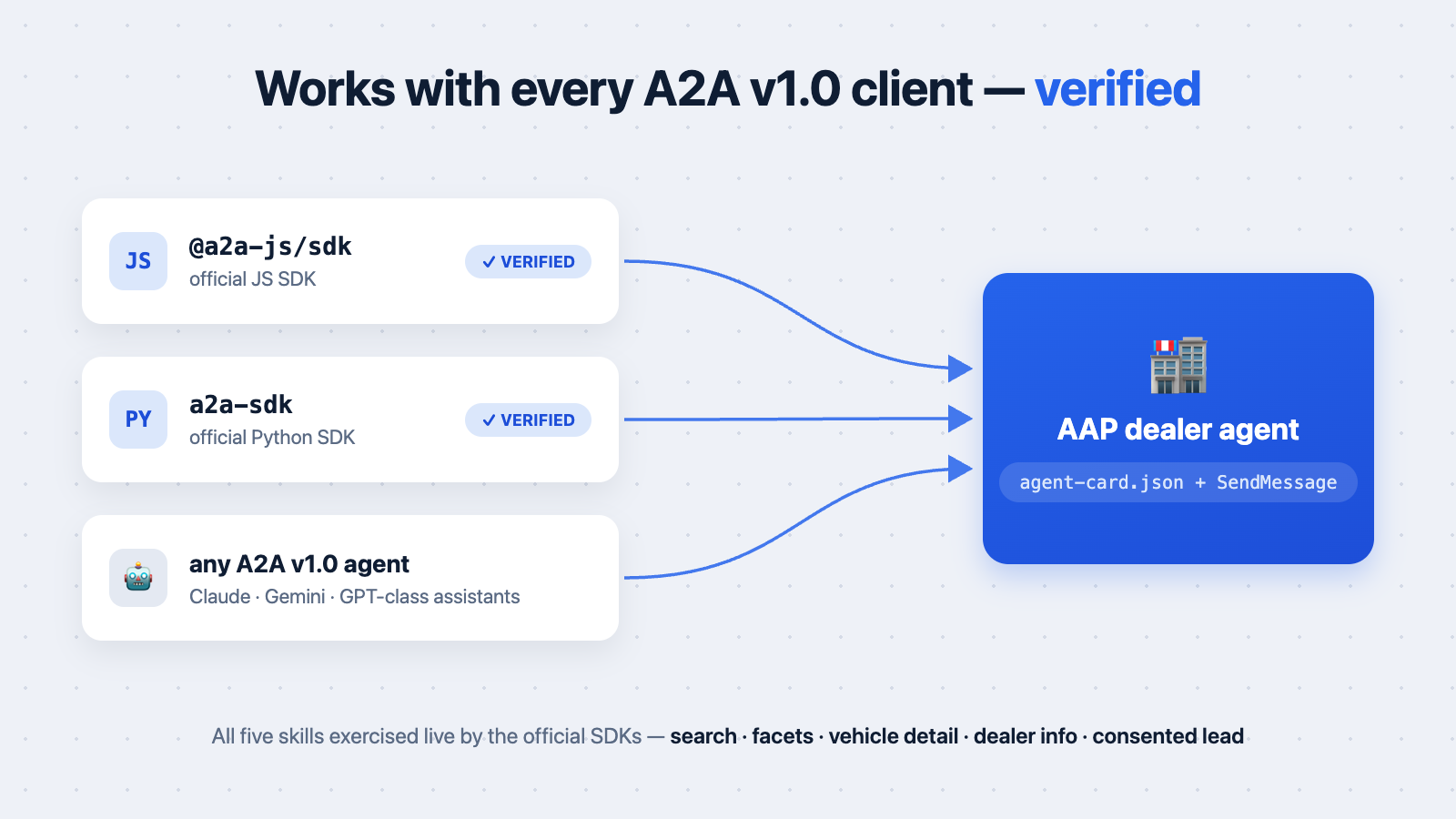
All five skills have been exercised live through the official A2A v1.0 SDKs (@a2a-js/sdk and a2a-sdk for Python): inventory search, facets, vehicle detail, dealer information, and a consented lead.submit — with no AAP-specific client code.
Where to read next
- Why automotive needs AAP — the gap AAP fills against A2A, ACP, MCP, and ADF.
- A2A profile — how AAP slots into A2A's three-layer architecture.
- Discovery — full agent card example.
- Pricing and FTC compliance — the four pricing fields and why
priceis the FTC-final out-the-door amount. - Skills reference — one page per skill with full request/response examples.