Versions and migration
AAP 4.0.0 adopts PAP 1.0. It is a major release: PAP 1.0 changes required Session headers, discovery shapes and key acceptance, so AAP 3.2 clients and servers must migrate. Automotive payload fields keep their meaning. AAP 4.0 renames skill ids and message types to snake_case, and adds vehicle rebates, horsepower and two optional skills.
Four independent version numbers
| Identifier | Meaning in AAP 4.0 |
|---|---|
AAP 4.0.0 / contract v4.0 | Target automotive schemas, bindings and behavior: five core and two optional skills. Draft authoring still uses 4.0.0 |
MCP 2026-07-28 + 2025-11-25 | Current wire protocol and explicit compatibility path |
A2A 1.0 | Agent Card, Message and JSON-RPC protocol. Upstream 1.0.1 is a patch with no contract change |
PAP 1.0 | Stable specification pinned to commit 8c02b4282eda53468a7c09412558bc8b060d95f6; AAP bridge entry stays version: "1"; optional Operations extension version 3 |
A server's software version is separate. A PAP 0.3 client is not an AAP 4.0 client, a PAP 1.0 client is not automatically an AAP client, and MCP version negotiation does not choose an automotive schema version.
AAP 3.2 to 4.0
PAP 1.0 migration
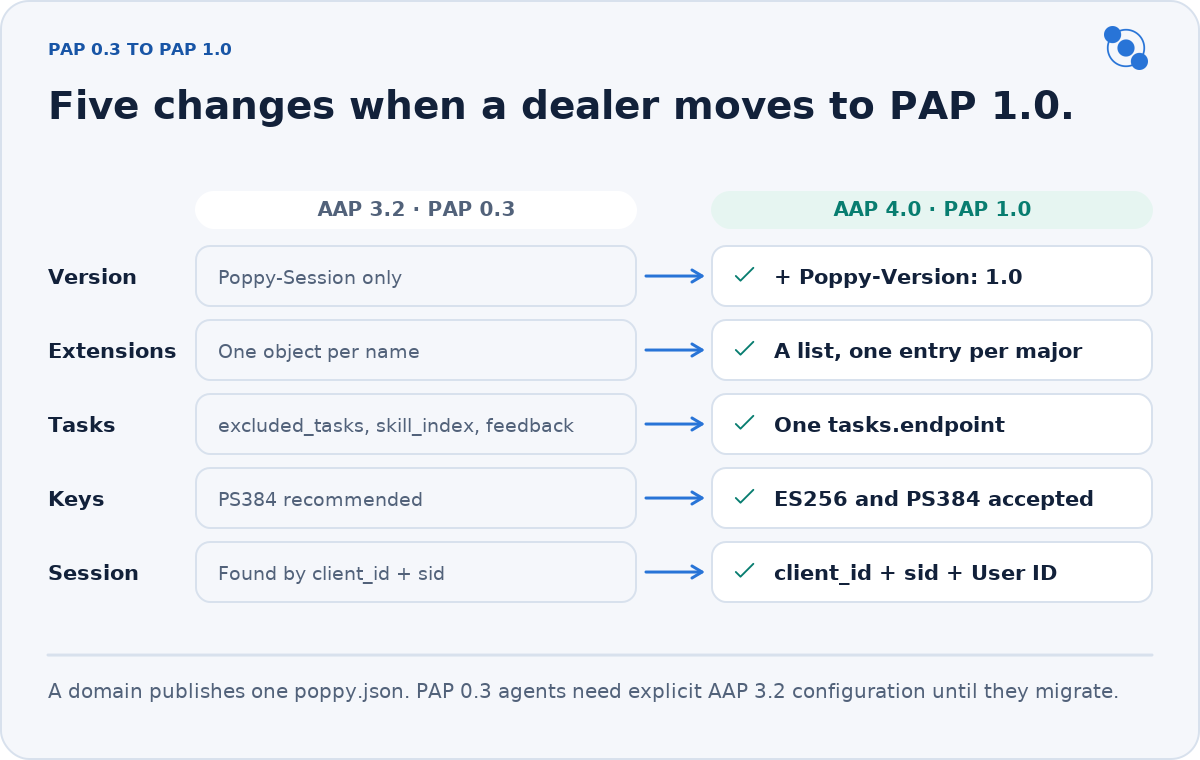
AAP 4.0 targets PAP 1.0 at commit 8c02b4282eda53468a7c09412558bc8b060d95f6 (spec SHA-256 559a191127cb81d4e77360cd1cfae35233178a89b71b39c0534142a2bab918d6). Frozen AAP 3.2 keeps published PAP 0.3 at commit 6fb46d381ac1b94265795132af13848ec442b6f6. Full rules are in the PAP binding.
| Surface | Frozen AAP 3.2 (PAP 0.3) | AAP 4.0 (PAP 1.0) | Action |
|---|---|---|---|
protocol_version | "0.3" | "1.0"; readers accept every 1.x document and ignore unknown fields | Publish 1.0 |
| Version selection | One version per document | Optional supported_versions on the same host, same domain and issuer; newest compatible version wins | Link the frozen document while both are served |
| Request headers | Poppy-Session | Also Poppy-Version: 1.0 on every request; Poppy-Extensions (RFC 9651, e.g. "autoagentprotocol.org/aap";v="1") when using extensions; same values per Session | Send them; servers verify Poppy-Version before every skill |
| Version errors | None | HTTP 400 version_unsupported; the client refetches poppy.json and chooses again. Only if it chooses another version does it start a new Session and resend once; otherwise it stops | Implement on both sides; no omission leniency |
| Extensions | One object per name | A list with one entry per major version; AAP bridge entry version: "1" with unchanged fields | Wrap the bridge object in a list |
| Extension errors | None | HTTP 403 JSON {"error":"extension_required","extension":…}; never for the AAP bridge | Handle it; remove extensions from client metadata |
| Task coverage | excluded_tasks.url, skill_index, feedback.endpoint in poppy.json | One tasks.endpoint; GET with the Session header and no token returns the Session's excluded tasks, skill index and feedback endpoint | Move them to the tasks response (poppy-tasks) |
| Signing algorithms | ES256 required, PS384 recommended | Dealers MUST accept ES256 and PS384 for client assertions and delegations; Session JWTs stay ES256 | Accept PS384 |
| Client assertions | Short-lived | exp at most 5 minutes after iat; 5 minutes or less is never rejected | Bound replay stores accordingly |
| Session lookup | client_id + sid | client_id + sid + User ID; an unknown combination starts a new signed-out Session | Change the lookup key |
organization.domain | Host | Host, plus port when not 443 | Keep production on 443 |
| Website pages | Never carry the Session header | Pages on exactly organization.domain, fetched without a browser, SHOULD carry it, never a token | Clients send it; pages may verify it |
| Sign-in, if advertised | PKCE, device grant | Direct preferred; iss; prompt=consent; PAR; consent lists every scope; RFC 10027 §2; device link host check; same DPoP key at refresh; one sign-in for every resource; invalid_target | Re-test the whole flow |
| Browser join, if advertised | Three steps | Plus poppy:browser-sign-in for signed-in joins, web.unscoped, web.disabled | Add the scope and flags |
| Conversations, if advertised | status | Required description; four state fields; request IDs; handoff cancel; close returns 202; version_mismatch | Re-implement to 1.0 |
| Operations, if advertised | Not covered | Version 3 approvals for the three write skills | Optional |
| Native PAP MCP, if advertised | Streamable HTTP | PAP accepts MCP 2025-06-18 or later (AAP keeps its two revisions); token resource = the MCP url | Re-test resource metadata |
The automotive payloads, consent rules, lead_submit and idempotency semantics carry over. Bind idempotency to the stable verified caller and User, never to a delegated key or sid, and reconcile uncertain writes before switching.
snake_case names
AAP 4.0 uses one spelling. Skill ids, message types and the two envelope types drop their dots; field names, error codes and MCP tool names were already snake_case. Payload fields keep their meaning.
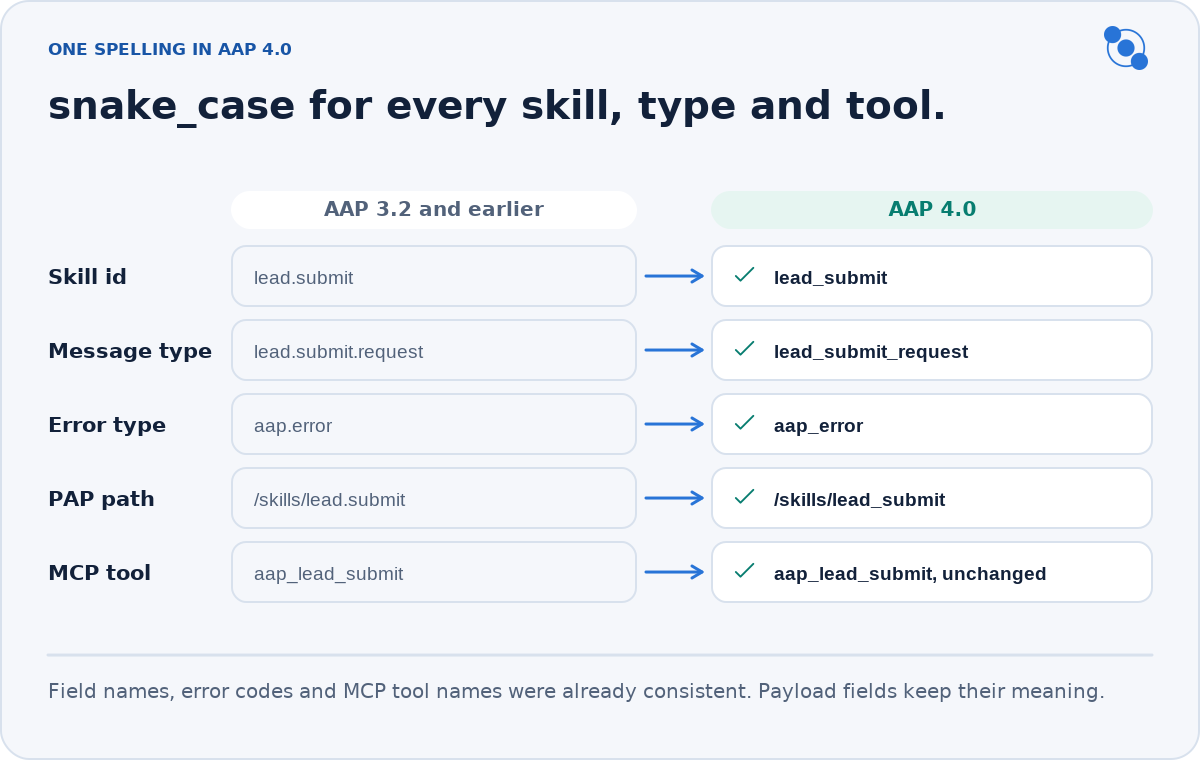
| AAP 3.2 and earlier | AAP 4.0 | MCP tool (unchanged) |
|---|---|---|
dealer.information | dealer_information | aap_dealer_information |
inventory.facets | inventory_facets | aap_inventory_facets |
inventory.search | inventory_search | aap_inventory_search |
inventory.vehicle | inventory_vehicle | aap_inventory_vehicle |
lead.submit | lead_submit | aap_lead_submit |
| not available | trade_in_submit | aap_trade_in_submit |
| not available | credit_application_submit | aap_credit_application_submit |
| Where the name appears | Before | In AAP 4.0 |
|---|---|---|
Agent Card skills[].id and AAP params.skills keys | lead.submit | lead_submit |
Payload type | lead.submit.request, lead.submit.response | lead_submit_request, lead_submit_response |
Error and event type | aap.error, aap.event | aap_error, aap_event |
Error detail field in details.errors[] | instanceLocation | instance_location |
| Reserved event kinds | lead.status_changed, appointment.status_changed | lead_status_changed, appointment_status_changed |
PAP path and x-aap-skill | /skills/lead.submit | /skills/lead_submit, equal to the operationId |
MCP _meta skill and type fields | lead.submit, lead.submit.request | lead_submit, lead_submit_request |
| Unchanged | MCP tool names, PAP operationId, media types such as application/vnd.autoagent.lead-submit-request+json, schema file names, field names, error codes |
A 3.x payload with a dotted type is rejected by the 4.0 schemas. Rename in clients and servers together, on the version-pinned 4.0 endpoints only. The older sections of this page describe earlier releases in the current spelling.
Contract additions
| Addition | Contract |
|---|---|
| Rebates | Optional rebates[] on the shared Vehicle, new vehicles only. Unconditional programs are already in price; conditional ones never are. Omitted means no information. See pricing |
horsepower | Optional Vehicle number, peak total output in hp |
| Newly typed names | rebates and horsepower were free additional vehicle attributes in 3.2. A feed that used either name with another shape, such as "horsepower": "203 hp", must rename or convert it |
trade_in_submit | Optional skill: a consented trade-in submission with the same customer data as a lead; the reply may carry a valuation as an amount, a range or both, estimate or offer. See trade-in |
credit_application_submit | Optional skill: individual or joint application with each applicant's own credit consent (soft or hard inquiry). See credit application |
| Consent scope | New trade_in_submission for trade-in contact; lead_submission is unchanged |
| Capabilities | Both optional skills require a capabilities object in the Agent Card params and the same object in the MCP tool _meta |
| PAP schemas | poppy-tasks replaces poppy-excluded-tasks; new poppy-operation, poppy-approval, poppy-approval-required, poppy-operation-result, poppy-approval-declined |
| Errors | No new AAP error codes |
A dealer declares only the skills it implements, identically on all three bindings. Clients must not assume the optional skills exist.
Coexistence
- Keep frozen AAP 3.2 endpoints, Agent Card and Poppy document unchanged while AAP 4.0 is tested.
- Publish AAP 4.0 at separate version-pinned Agent Cards and endpoints. One origin has one default well-known card; distribute other card URLs by configuration or a registry, or use separate origins.
- For PAP, serve the AAP 4.0 document at
/.well-known/poppy.jsonwithsupported_versions: {"0.3": "<URL of the frozen document on the same host>"}, keeping the sameorganization.domainand issuer. PAP 0.3 clients do not readsupported_versions; keep them on explicit AAP 3.2 configuration until they migrate. - Never retry an uncertain write through another contract with a new key. Reconcile it with its original key first.
- Retire AAP 3.2 by sending
DeprecationandSunset, then removing it fromsupported_versions, then stopping it.
AAP 3.0 to 3.1
History: the additive 3.0 → 3.1 transition. Its rules still hold in AAP 4.0.
| Area | Existing 3.0 meaning | Additive 3.1 behavior |
|---|---|---|
| Vehicle amounts | Whole USD | Optional currency labels USD or CAD; omission still means USD. It covers price, list_price, msrp and vehicle fees |
| Vehicle odometer | Miles | Optional mileage_unit labels mi or km; omission still means mi. Returned numbers remain native |
| Rooftop fee defaults | Whole USD | Optional rooftop currency; omission still means USD. Never infer vehicle currency from it |
| Search and facets | USD prices, mi odometer comparisons | Optional top-level currency and mileage_unit; use declared capability defaults, falling back to USD/mi. One currency scopes every matching set; mileage comparisons convert exactly |
| Facets without search | USD/mi requests without search capabilities | Accept explicit USD/CAD and mi/km contexts; omitted contexts remain USD/mi. No search capability declaration is needed |
| Capabilities | No monetary or odometer context | Optional currencies, default_currency, default_mileage_unit; declarations must agree across bindings |
| Results and cursors | USD/mi implicit | Label effective nondefault contexts explicitly on search/facet data; bind both contexts into cursor identity. Per-vehicle labels never inherit query context |
| Geographic and electric range | Explicit _mi fields | Unchanged: miles for every country and odometer unit |
| Leads and trade-ins | USD/mi if numeric values are present | Preserve explicit currency and odometer labels with each partial vehicle description |
This requires schema, generated tool/OpenAPI metadata and runtime changes together. Documentation alone cannot establish the new fields or comparison behavior. Keep existing 3.0 and approved connector endpoints operating under their original contracts while publishing separate 3.1 discovery and endpoints. See currency and odometer context for exact defaults and comparison rules.
For implementers
History: the AAP 2.1 → 3.0 major migration. Implementations coming from 2.1 apply it, then the later transitions, ending with AAP 3.2 to 4.0. It made MCP native, added dealer-domain discovery links and search capabilities, and tightened automotive results and lead outcomes. Migrate the implementation and its clients before switching discovery. Keep each supported automotive contract at its own card and endpoint identity.
| Area | AAP 2.1 | AAP 3.0 action |
|---|---|---|
| MCP | Reference manifest/optional adapter | Implement native Streamable HTTP for both required revisions, actual tools/list and typed success/error results |
| Request headers | A2A version and extension headers mandatory | Accept omitted A2A headers on contract-pinned endpoints and omitted MCP mirror headers when the body or this client's negotiated session supplies the value. Keep supplied-value conflict checks and all authentication requirements; see the binding pages for this AAP compatibility extension |
| PAP | Draft 0.2 authentication and discovery | AAP 3.0 adopted the earlier draft 0.3 profile. Upgrades apply the published 0.3 migration below, then the PAP 1.0 migration; changing the version label is insufficient |
| Discovery | A2A + PAP pair | Add complete AAP params, exact MCP URL, search capabilities, release metadata and dealer /llms.txt |
| Search filters | Empty arrays, repeated values and empty queries can validate | Advertise supported keys/sorts; deduplicate arrays and omit empty optional filters. Reject make: [], make: ["Honda", "Honda"], empty/whitespace-only query, unknown keys and unsupported constraints; implement explicit query token rules |
| Features | Free-text attributes | Add features_all (AND), features_any (OR), advertised feature vocabulary and source-backed feature_evidence; unknown is not absent |
| Geography | Location context without a radius contract | If advertised, implement near, haversine miles, radius filtering and distance_mi ordering |
| Coordinate names — breaking for deployed clients | Some deployment extensions accept near.lat / near.lng, including in validation-error hints; these were not AAP 2.1 schema fields | Use near.latitude / near.longitude. Update handlers, client/tool schemas, examples and error hints together; AAP 3.0 rejects the short keys |
| Pagination | Offset/limit; schema permits pagination.limit up to 1000 | Maximum falls to 100. Update clients requesting 101–1000 to use at most the advertised max_limit (never above 100) and follow next_cursor; total is exact or null; no silent result caps |
| Search response | data.limit is optional | Always return the effective data.limit, even when the client omitted it, plus next_cursor, applied_filters and effective sort; include query terms and distance/evidence when applicable |
| Aggregate seller | Opaque dealer_id without a lookup | Expose dealer_information with a dealer_id selector; echo the same ID and actual seller profile before consent. Parameterless dealer-scoped requests remain valid |
| Inventory listings | Some guarantees only in prose | Require eligible status, updated_at and a stable identifier in search/detail responses |
| Lead retries | Optional key; duplicate is a lead status | Require idempotency_key; retain atomic deduplication for at least 24 hours. Replay the complete original result with data.replayed: true, preserving received/rejected, appointment details and message. status: "duplicate" is removed |
| Contact channels | Consent declaration | Require matching contact data and an authorized preferred channel; reject unusable grants before delivery |
| Appointment outcome | Some conditions only described | Enforce time on confirmed and alternatives on proposed. Any appointment included on a rejected lead must also be rejected |
| Errors | Existing automotive vocabulary; retry timing optional and may use seconds | Add DEALER_NOT_FOUND, UNSUPPORTED_FILTER, UNSUPPORTED_SORT, INVALID_CURSOR. RATE_LIMITED requires details.retry_after_ms; multiply seconds by 1,000. retry_after_seconds alone is insufficient. HTTP 429 also requires Retry-After |
| Error details | aap_error.details accepts unrestricted JSON, including strings, arrays and null | When present, details must be an object. Convert custom diagnostics to details.errors[], where each item requires a JSON Pointer instance_location, a nonempty keyword and a nonempty error; additional detail fields remain allowed |
The public DayHours and WeeklyHours TypeScript exports are retained. DayHours remains {open, close} | null; consumers keep their existing imports.
In AAP 3.0, pricing semantics, the five canonical skill IDs, A2A 1.0 wire form and discovery bridge 1 remained, and PAP moved to draft 0.3. Do not weaken authentication to make a client with missing credentials appear compatible.
Release order and version discovery
- Publish the approved version-pinned specification, schemas and artifacts.
- Upgrade clients and server handlers, then pass runtime acceptance.
- Publish consistent Agent Card, Poppy and
llms.txtlinks to the implemented endpoints. - Switch the default discovery only when that complete contract works.
One A2A card declares exactly one required AAP extension. Several required versions do not express an either/or choice. A2A forbids automatic fallback to an earlier extension version.
For coexistence, retain separate version-specific cards and endpoints. One origin has one default well-known card; distribute other card URLs through explicit configuration or a registry, or use separate origins. For a coordinated cutover, communicate which clients must migrate and when the old endpoint retires. A new URI alone does not make retirement backward compatible.
Do not retry an uncertain lead, trade-in or credit application through an older contract with a new key. Preserve its identity and reconcile the earlier outcome.
PAP 0.3 migration
History: the AAP 3.1 → 3.2 transition. AAP 4.0 continues with the PAP 1.0 migration.
AAP 3.2 targeted published 0.3 at commit 6fb46d381ac1b94265795132af13848ec442b6f6. Frozen AAP 3.1 pins October 26 commit 86f0c8d8db3c95cf06d7e05370ec4bddf7d25bc7, which used the same upstream 0.3 label but a different authentication model. AAP 3.2.0 made this migration as a minor-release exception and reserved the next major for PAP 1.0. Required authentication fields and meanings changed, so older clients required migration. The release tool permits this minor exception only for the reviewed specification hash and the 3.1.0 → 3.2.0 pair. The release snapshot and package versions identify this transition; frozen earlier releases remain unchanged.
| Surface | Frozen AAP 3.1 profile | Frozen AAP 3.2 published PAP 0.3 binding |
|---|---|---|
| Signed-out access | OAuth guest JWT grant, two assertions, Session Token and DPoP | Fresh delegated Poppy-Session JWT on each request; no guest token grant |
| Company identity | Required auth.issuer | Discover domain protected-resource metadata; optional issuer; domain fallback only after explicit absence, never errors |
| Existing Company issuer | Mandatory guest issuer | Retain its exact identity; auth.disabled: true disables new sign-in without resetting User IDs or Sessions |
| Session identity | DPoP key thumbprint | client_id + sid; same User/Agent IDs, delegated keys may rotate |
| Delegation | Not defined | Identity-key-signed ES256/PS384 delegation, public ES256 delegated key, at most 24-hour lifetime, no user/company identifiers |
| Request binding | Token plus DPoP | Session JWT method/URL/time; optional token hash and same-client binding; OAuth DPoP remains separate when used |
| Failure recovery | Guest token/proof OAuth errors | HTTP 400 invalid_session or session_ended; safe optional description; new-SID retry once for ended Session |
| Issuer grants | JWT bearer and refresh required | Ordinary OAuth refresh required; account sign-in optional |
| Discovery fields | apis[].resource, auth.mediated | Resource metadata via RFC 9728; mediated sign-in is an extension; optional auth.disabled, conversation access and skill_index |
| Account token | Session-bound guest/sign-in token flow | Ordinary Bearer or DPoP access token plus refresh; reduced scopes permitted, scope expansion forbidden |
| Native PAP MCP | Mandatory guest-token exchange for non-DPoP | Session header and ordinary OAuth where needed; no mandatory legacy exchange |
| Browser join | DPoP nonce containing code in browser form | Agent authorizes code by JSON POST to /authorize with Session header, then browser redeems code with cookie |
| Generated artifacts | Guest/exchange schemas and OpenAPI DPoP scheme | Delegation/Session/error/ordinary OAuth schemas and Poppy-Session header security |
Keep the existing endpoint/profile while testing a separately configured replacement. Do not change the meaning of a frozen endpoint or replace default discovery before release and deployment approval. Optional account sign-in, browser, conversation and native MCP surfaces require their complete independent acceptance before advertisement.
Update client constructors and generated schemas together. Preserve automotive payload meaning and the bridge extension version; the AAP contract version is a separate decision. Lead idempotency remains bound to stable verified caller/User identity, never to a rotating delegation key or a newly created Session. Reconcile uncertain writes before migration.
PAP 0.2 migration
History. This heading remains as a historical link. AAP 2.1 used PAP 0.2; its frozen migration record documents the earlier 0.1 → 0.2 transition. AAP 3.2 targeted published 0.3 directly and AAP 4.0 targets PAP 1.0; frozen releases retain their pinned profiles. No intermediate 0.2 deployment is needed. Both the historical 2.0 → 2.1 and the 3.1 → 3.2 minor-release exceptions are pinned to their reviewed specification hashes and do not permit unrelated breaking changes.
Breaking migration checklist
History: the AAP 1.x → 2.0 checklist.
An upgrade from AAP 1.x must also apply the frozen 2.0 migration: paired PAP discovery and native API, required response contexts, standard A2A error detail arrays, securityRequirements shape, exact extension activation and truthful media types. Direct upgrades must implement the final contract in full; they need not deploy every intermediate version.
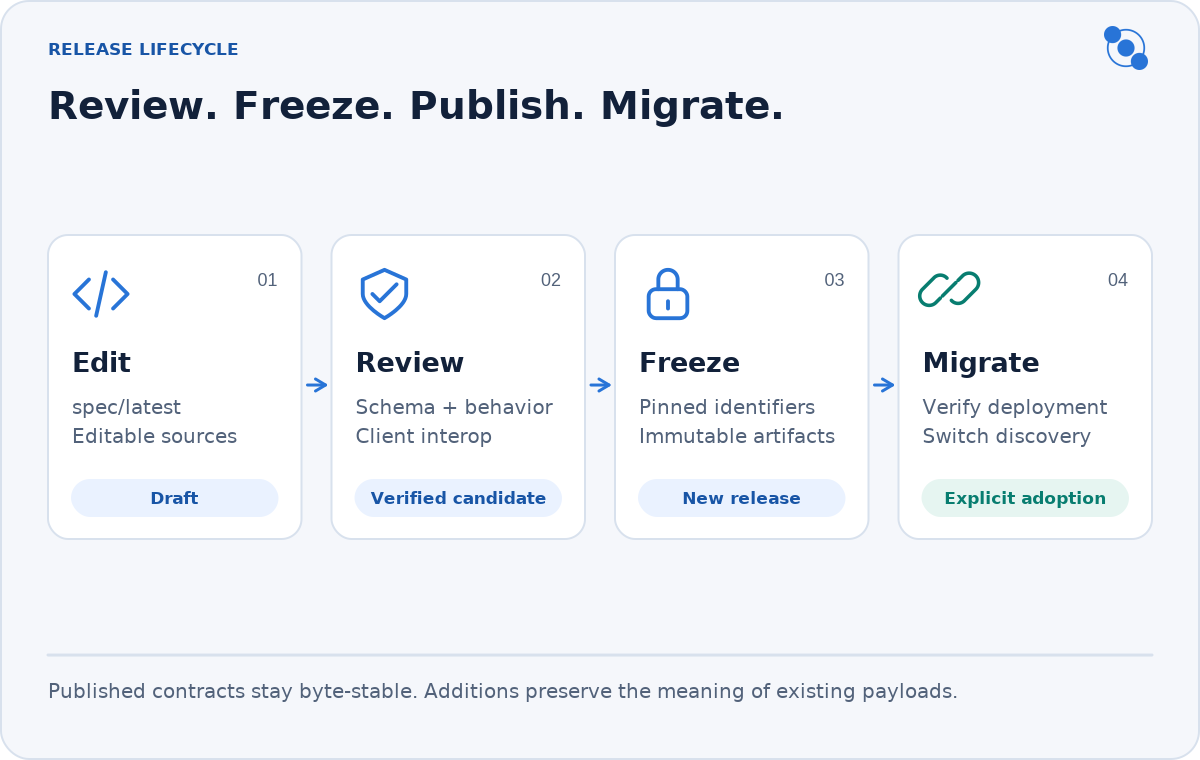
Editable work and stable releases
| Source or URL | Meaning |
|---|---|
spec/latest/, docs/ | Editable specification and documentation |
/docs/latest/ | Editable documentation with an unreleased banner |
spec/v3.2/, /v3.2/, /docs/v3.2/ | Frozen AAP 3.2 contract, artifacts and documentation |
/latest/ | Artifact alias of the stable release named by releases.json |
Draft schema/extension URLs use https://draft.autoagentprotocol.invalid. Release preparation replaces them with immutable production identifiers. Agents pin the selected release rather than relying on a moving /latest/ alias.
SemVer and immutability
AAP normally follows Semantic Versioning. Optional additive behavior can be minor; removed fields, tighter validation, changed required meanings or new mandatory interfaces normally require a major release. The PAP transitions to AAP 2.1 and 3.2 were minor-release exceptions, with required client migrations documented above. AAP 4.0.0 is a normal major release: PAP 1.0 was the major reserved for it. These decisions do not waive compatibility checks for other changes; the structural report remains conservative and does not replace semantic review.
Contract paths contain major/minor only, so the release tool creates MAJOR.MINOR.0 snapshots. Published snapshots are never edited, including their diagrams. Editorial corrections enter the editable source for a later release.
A release freezes schemas, examples, skills, docs/sidebar/images, generated TypeScript/OpenAPI/MCP artifacts, provenance, a compatibility report and SHA-256 integrity. CI and local checks reject changes under previously released paths. Historical artifacts are copied from their snapshots, never regenerated using newer tooling.
Preparing a release
Commit reviewed edits to the working sources, then rehearse:
pnpm release:prepare 4.0.0 --dry-run
After reviewing the compatibility report, run without --dry-run from a clean tree. The command validates and freezes the new contract, generates artifacts, records the source commit/hashes and updates registry/package versions. It does not commit, tag, push, publish npm packages or deploy the site. See RELEASING.md.
A2A version handling
Portable A2A clients send A2A-Version: 1.0 and the exact A2A-Extensions URI. AAP (since 3.0) additionally accepts their omission on a contract-pinned endpoint, using its configured A2A 1.0 interface and AAP contract. Supplied values still take effect: unsupported versions return -32009, and an explicitly empty version means 0.3, not a request for a default. This compatibility extension does not change strict upstream client requirements or permit automatic contract fallback. See request headers.