inventory_search
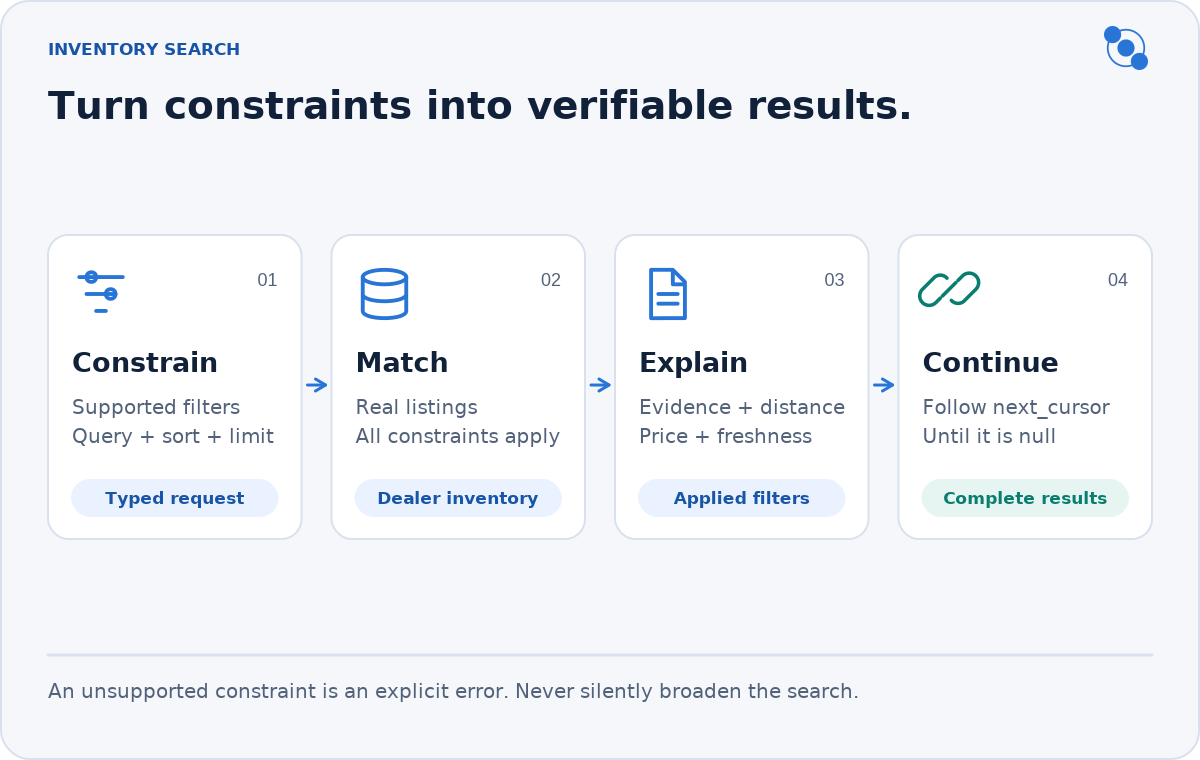
One request shape across MCP, A2A and PAP. Search without sharing customer contact details. Results state what was filtered, what is known about each vehicle, and how to continue.
| MCP tool | AAP request → response |
|---|---|
aap_inventory_search | inventory_search_request → inventory_search_response |
Ask for constraints explicitly
{
  "type": "inventory_search_request",
  "filters": {
    "body": ["suv"],
    "price_max": 35000,
    "status": ["available"],
    "features_all": ["adaptive_cruise_control", "heated_front_seats"],
    "near": { "latitude": 37.7749, "longitude": -122.4194, "radius_mi": 50 }
  },
  "pagination": { "limit": 20 },
  "sort": { "field": "distance_mi", "order": "asc" },
  "privacy": { "anonymous": true }
}
The coordinates above are an illustrative San Francisco origin. A client resolves the user's place name before calling; the server MUST NOT guess a location from an ambiguous string.
| Constraint | Fields | Meaning |
|---|---|---|
| Vehicle | make, model, trim, condition, vehicle_type, body | Arrays of accepted values; sale condition is new, used or cpo. |
| Powertrain | transmission, fuel, driveline, charge_port, dc_fast_charge | The listing must contain the requested value. Both true and false are constraints. |
| Ranges | year_min/max, price_min/max, electric_range_mi_min/max, displacement_cc_min/max, mileage_max | Inclusive bounds. Inverted ranges are invalid. Price and odometer bounds use the effective query context below. |
| Equipment | features_all, features_any | Advertised feature codes with verified, vehicle-specific evidence. |
| Location | near, rooftops | Radius around a point, or exact rooftop names on a dealer-scoped endpoint. |
| Availability | status | available, intransit, pending; no sold or out-of-stock units. |
| Identity | vin, stock | Exact identifiers. |
| Appearance | exterior_color, interior_color | Arrays of accepted color values. |
| Keywords | query | Explicit keyword matching, described below. |
Filter fields combine with AND. Values in an array combine with OR, except features_all, which requires every value. Empty arrays are invalid. Missing listing values never satisfy a constraint. Free-text array values match facet values without case sensitivity; schema enums, feature codes and rooftop names are exact. Providers MUST reject unsupported filters with UNSUPPORTED_FILTER, unsupported ordering with UNSUPPORTED_SORT, and unknown keys or invalid values with SCHEMA_VALIDATION_FAILED. They MUST NOT silently remove, broaden or reinterpret constraints.
Know what this endpoint supports
Read params.skills["inventory_search"].capabilities on the AAP Agent Card extension, or tools/list → the search tool's _meta["autoagentprotocol.org/aap"].capabilities. Both follow inventory-capabilities.schema.json and MUST agree. PAP clients can follow their discovery document's Agent Card link.
The capabilities name the endpoint's scope (dealer or aggregate), supported filters, sort_fields, default_sort, default_limit, max_limit, and support for an offset entry point. An aggregate endpoint MUST reject rooftops: names are not globally unique. Aggregate results MUST include the owning dealer_id and a stable vehicle_id unique within that endpoint. That ID must resolve the same listing through inventory_vehicle; a dealer-local stock number alone is insufficient.
An aggregate endpoint MUST also expose dealer_information, accepting the listing's dealer_id and returning that actual seller's profile before consent.
A deployment advertising feature filters MUST also expose inventory_facets. Its features facet supplies the feature codes, labels and counts; include supported codes with zero matches when necessary to preserve the vocabulary. An unknown code produces UNSUPPORTED_FILTER with its request path and a recovery hint.
Currency and odometer context
currency and mileage_unit are optional top-level request fields, separate from filters. The same contexts apply to inventory_facets.
{
  "type": "inventory_search_request",
  "currency": "CAD",
  "mileage_unit": "km",
  "filters": { "price_max": 40000, "mileage_max": 80000 },
  "sort": { "field": "price", "order": "asc" }
}
The Agent Card and MCP search metadata advertise currencies, default_currency and default_mileage_unit. Omitted capability fields mean currencies: ["USD"], default_currency: "USD" and default_mileage_unit: "mi". A default currency MUST be supported. A Canadian dealer may advertise CAD/km defaults; an aggregate may support both currencies with USD/mi defaults. An omitted request context uses the advertised default. Callers can pass both fields explicitly to avoid relying on deployment defaults.
Services implementing only inventory_facets use the facets-only currency fallback instead of advertising an unimplemented search skill.
- The effective
currencyselects one denomination for the entire matching set, including listings without a price. Compare and sort price fields only within it; never sort CAD and USD amounts as interchangeable numbers or invent an exchange rate. A schema-valid but unsupported currency producesSCHEMA_VALIDATION_FAILEDat/currency. mileage_unitdefines the units ofmileage_max, mileage sorting andmileage_range. Bothmiandkmcontexts are supported. Convert known native readings using exactly 1 mi = 1.609344 km before filtering, sorting and range aggregation. Do not round before comparison. Missing odometers never satisfy a mileage bound and sort last in either direction.- Search results echo the effective context in
data.currencyanddata.mileage_unit; embedded facets carry the same labels. These response fields may be omitted only for the original USD/mi meanings. CAD or km contexts MUST be explicit, including on empty pages. - Each returned
Vehicle.currencyandVehicle.mileage_unitdescribes that vehicle's native numbers. Omitted vehicle labels always mean USD/mi and never inherit request, response, capability or country values. CAD listings MUST labelcurrency: "CAD"; kilometre readings MUST labelmileage_unit: "km".
Currency is not a country selector. Use geography for location; a Canadian vehicle may be priced in USD or have a miles odometer. Fields explicitly ending in _mi, including geographic radius and electric range, always remain miles. Cursor identity includes both effective contexts: changing either while continuing returns INVALID_CURSOR.
Equipment needs evidence
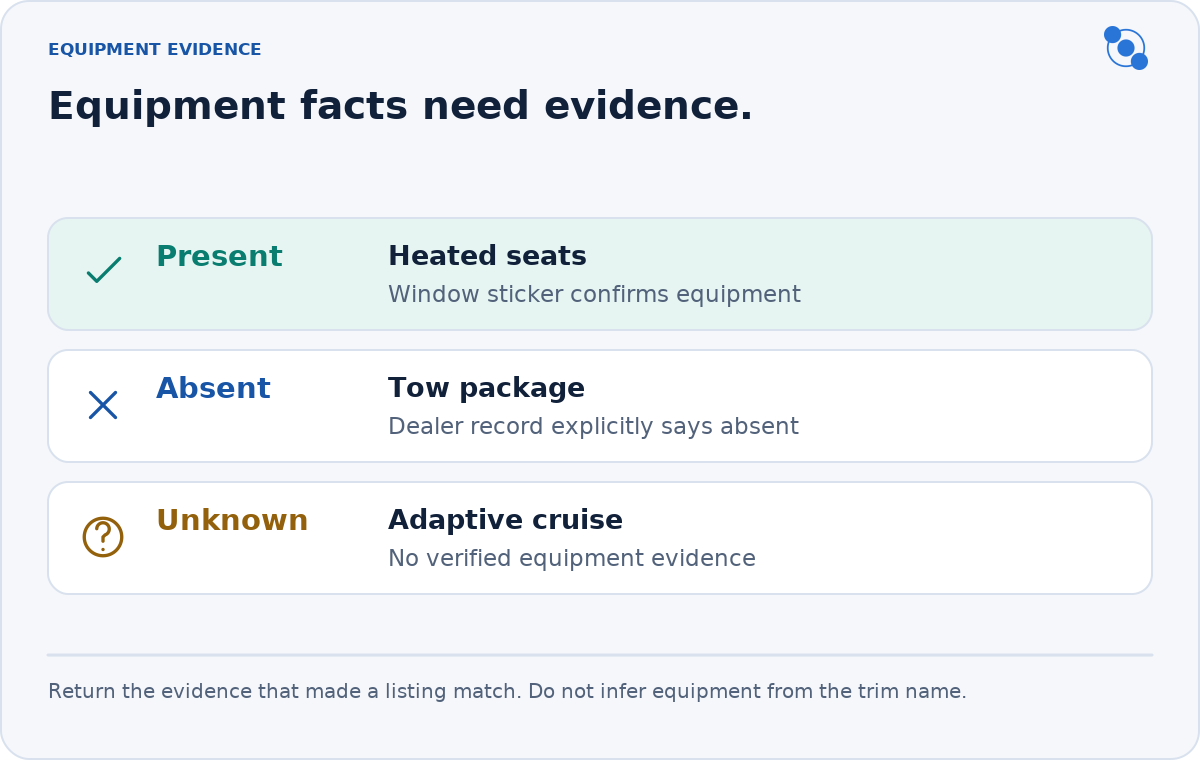
features remains a readable equipment list. feature_evidence records a code, label, status, source and a short source excerpt for a specific vehicle. Only status: "present" satisfies feature filters. Every matching result MUST include evidence for all features_all codes and at least one matching features_any code.
A trim name or a model-year default is insufficient. Missing or unknown evidence does not prove presence or absence. A verified absent claim also needs a source. Clients SHOULD show the evidence when explaining why a vehicle matches.
Distance is to the vehicle's rooftop
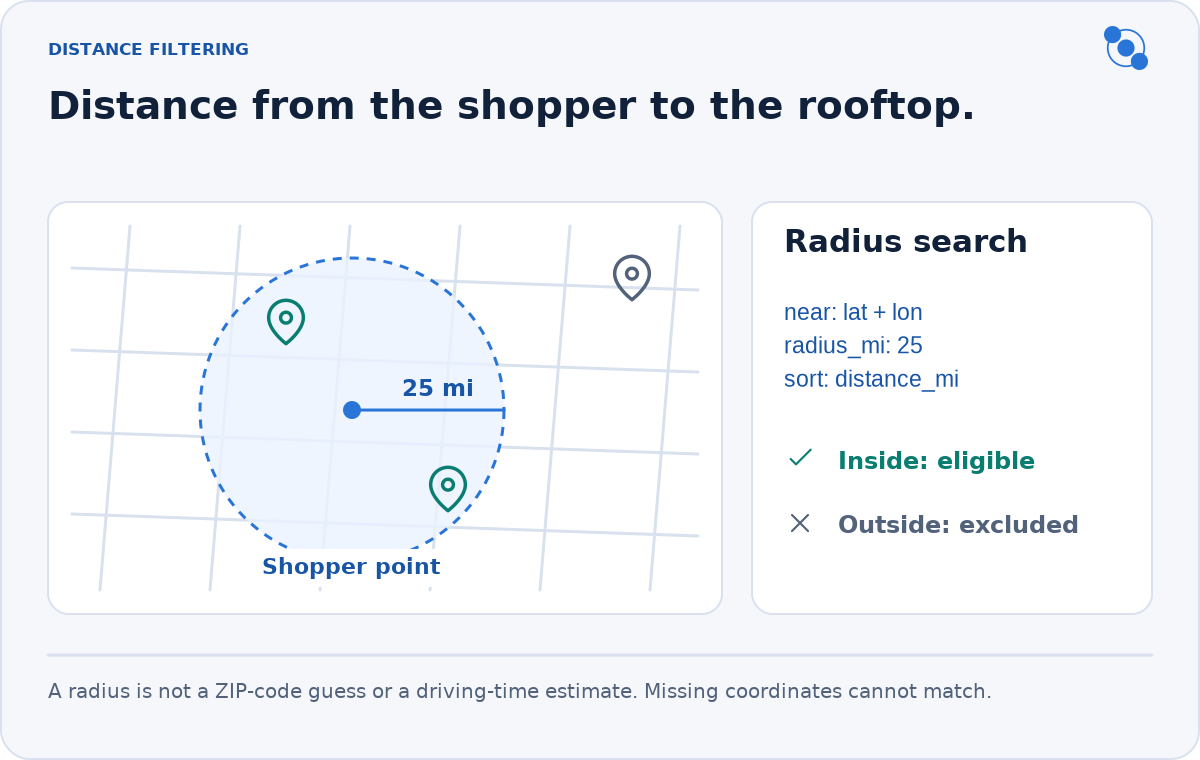
near contains latitude, longitude and radius_mi. Use straight-line distance on a sphere with mean Earth radius 3958.7613 miles and the haversine formula. Coordinates are WGS84 latitude/longitude. Apply the inclusive radius using the unrounded distance; report distance_mi with precision of 0.001 miles or better. JSON numbers need no trailing zeros. This is not driving distance or a delivery promise.
Each result MUST include distance_mi when near is present. Listings without known physical rooftop coordinates do not match. sort.field: "distance_mi" requires near; a deployment default sort cannot depend on a missing origin.
Keywords do not invent filters
Trim query, split on whitespace, and match each token case-insensitively as a substring in at least one of make, model, trim, vin, stock or features. All tokens must match somewhere in those fields. Quotes and operators have no special meaning. An all-whitespace query is invalid.
For “hybrid SUV under $35k,” send fuel, body and price_max. Do not rely on the string "hybrid SUV under 35k" to create them. The response echoes the effective query in applied_filters and lists its actual query_terms.
Read a result without guessing
{
  "type": "inventory_search_response",
  "data": {
    "total": 1,
    "limit": 20,
    "next_cursor": null,
    "applied_filters": { "price_max": 35000 },
    "sort": { "field": "price", "order": "asc" },
    "vehicles": [{
      "dealer_id": "demo-dealer",
      "vehicle_id": "vehicle-1042",
      "year": 2024,
      "make": "Example Motors",
      "model": "Tourer",
      "condition": "used",
      "status": "available",
      "price": 32995,
      "updated_at": "2026-10-24T10:00:00Z"
    }]
  }
}
This compact response illustrates a price-only request. The complete feature-and-radius request and matching response include evidence and distance.
| Result field | Contract |
|---|---|
applied_filters | Every effective constraint, including any documented defaults. No hidden relaxation. |
sort | Effective field and direction. Missing values sort last in either direction. |
total | Exact count across all pages, or null when unavailable. Never a capped count or estimate. |
limit | Effective page size, from 1 through the advertised maximum, at most 100. |
next_cursor | Opaque next-page token; null only when the matching set is exhausted. |
vehicles | Current listings with status, updated_at and at least one of vin, vehicle_id or stock. |
facets | Optional counts and ranges across the full matching set, before pagination. |
price includes mandatory dealer charges and excludes government-required consumer charges. Any fees are already included. An omitted price is unknown: do not reconstruct it from list_price and fees. See pricing.
New listings may carry rebates. They never affect price filters, price sorting or price_range, which use price alone; an unconditional rebate is already inside price and a conditional one never is. See rebates and the new-vehicle search example, where one listing carries rebates and the other does not.
available, intransit and pending are different states. A result is not a reservation. updated_at reflects the source's last relevant update; servers MUST NOT invent a fresh timestamp merely because an agent requested the listing.
Continue through the full inventory
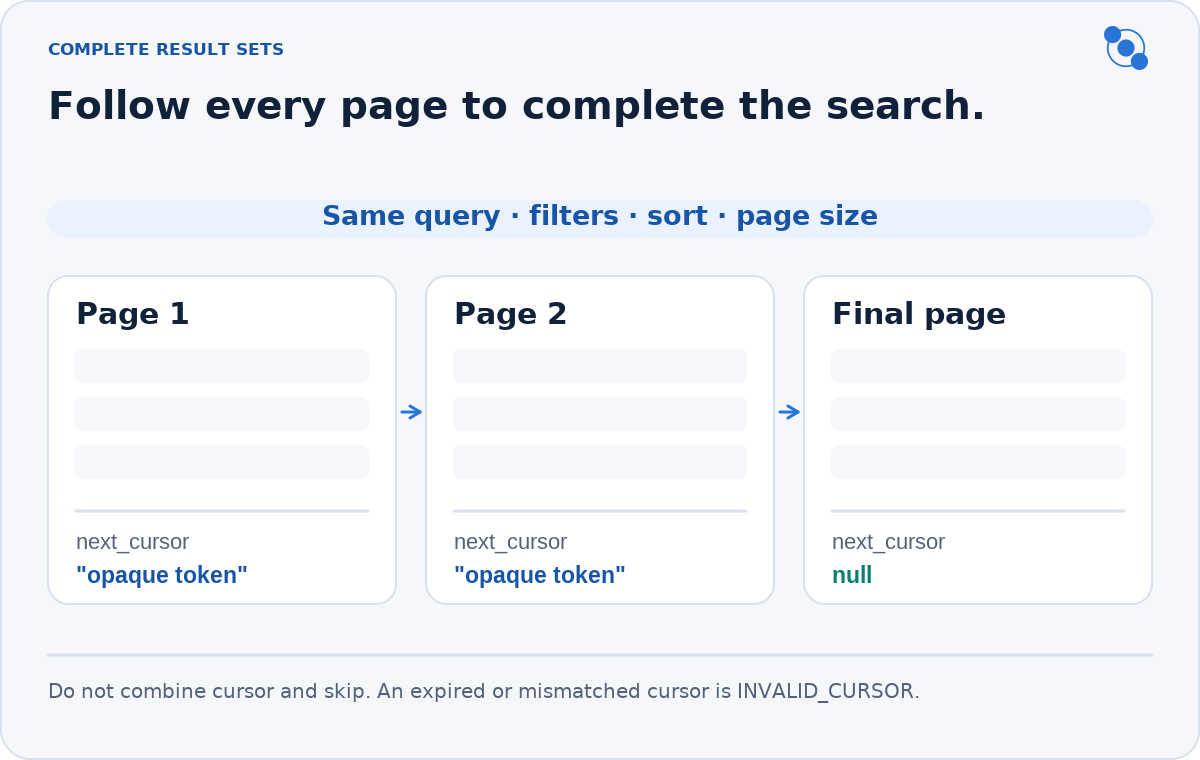
For the first page, omit cursor and skip. Pass the returned next_cursor in pagination.cursor for the next page, keeping effective filters, sort and limit unchanged. If the first request omitted defaults, carry the returned applied_filters, sort and limit forward explicitly. Stop only when next_cursor is null. A page-size limit MUST NOT become a limit on the entire traversable matching set.
- Cursor and
skipare mutually exclusive. A deployment may acceptskipas an advertised entry point; its response still supplies cursor continuation. Ifoffsetis false, a suppliedskipreturnsSCHEMA_VALIDATION_FAILEDat/pagination/skip, with a hint to start without an offset. A limit above the advertisedmax_limitalso returnsSCHEMA_VALIDATION_FAILED; it is never silently clamped. - Bind cursors to the endpoint tenant, authorization scope, normalized filters, sort and page size. Do not put customer information in a cursor. Verify scope on every request; a cursor is not authorization.
- Use a stable identifier (dealer + vehicle for aggregate scope) to break sort ties, and preserve ordering for the cursor's lifetime. Document cursor expiry. An expired, altered or mismatched cursor returns
INVALID_CURSORwith a hint to restart the search. - Concurrent changes may remove listings. Do not return stale or unavailable vehicles merely to fill a snapshot page. An empty page with a non-null cursor can occur; clients may continue. Clients SHOULD detect repeated cursors and bound retries.
privacy.anonymous: truemeans no customer contact information is attached. It does not disable server authentication or make a PAP session unidentifiable.
Cars, motorcycles and other inventory
The same contract covers car, motorcycle, trailer, rv and other; omitted vehicle_type means car. Use body and displacement for motorcycles, and electric range, battery and charging fields for EVs of any vehicle type. Populate only relevant fields. See inventory_vehicle for the shared vehicle shape.