Automotive, ready for agents
Auto Agent Protocol gives AI agents a shared language for automotive retail. Discover a dealer, search actual inventory, inspect evidence and pricing, then send a lead with the buyer's permission.
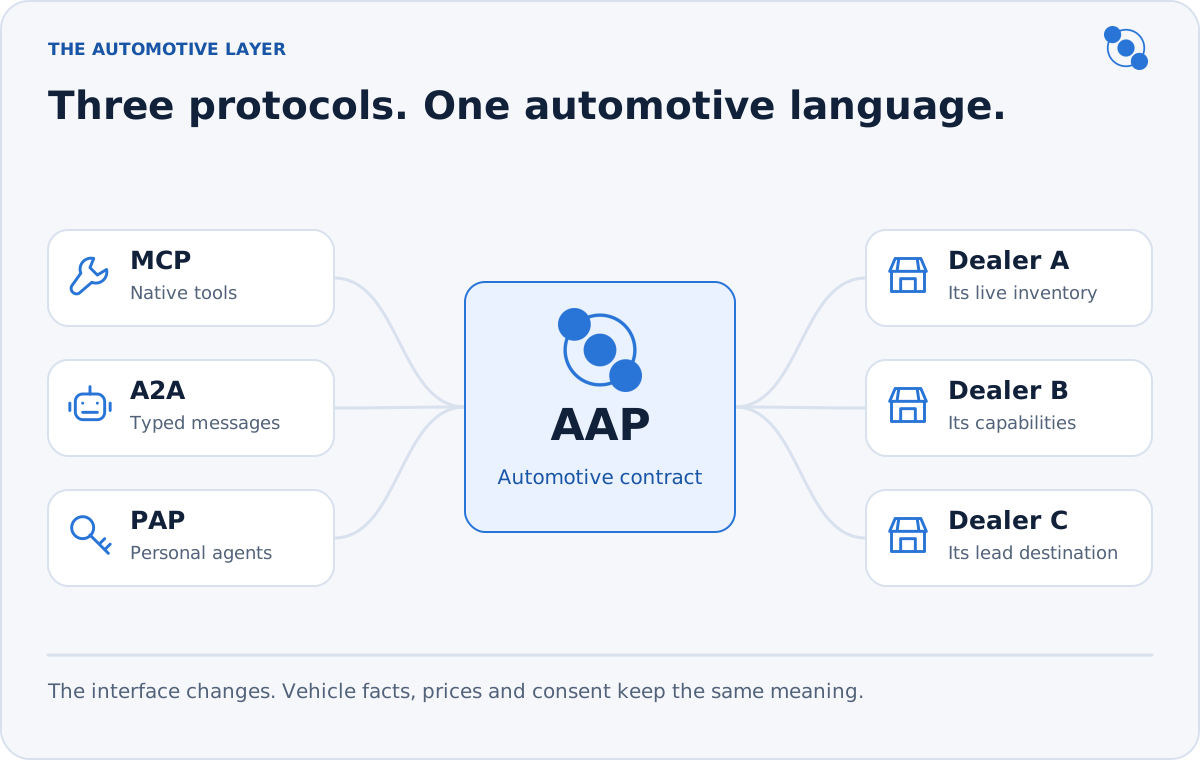
AAP 3.1 defines three native interfaces. Each carries the same typed request and response; none requires an extra hop through another protocol.
| Interface | How the agent calls | Baseline |
|---|---|---|
| MCP | Discover and call automotive tools | Streamable HTTP, 2026-07-28 + 2025-11-25 compatibility |
| A2A | SendMessage with an automotive DataPart | A2A 1.0, JSON-RPC 2.0 |
| PAP | Native OpenAPI operation with Session + DPoP | Personal Agent Protocol draft 0.3 |
A full AAP 3.1 dealer deployment implements all three with the same skill subset and business behavior. A client needs only its chosen interface. A partial implementation can describe the binding it supports, but cannot claim the full deployment profile. Conformance defines the exact boundary.
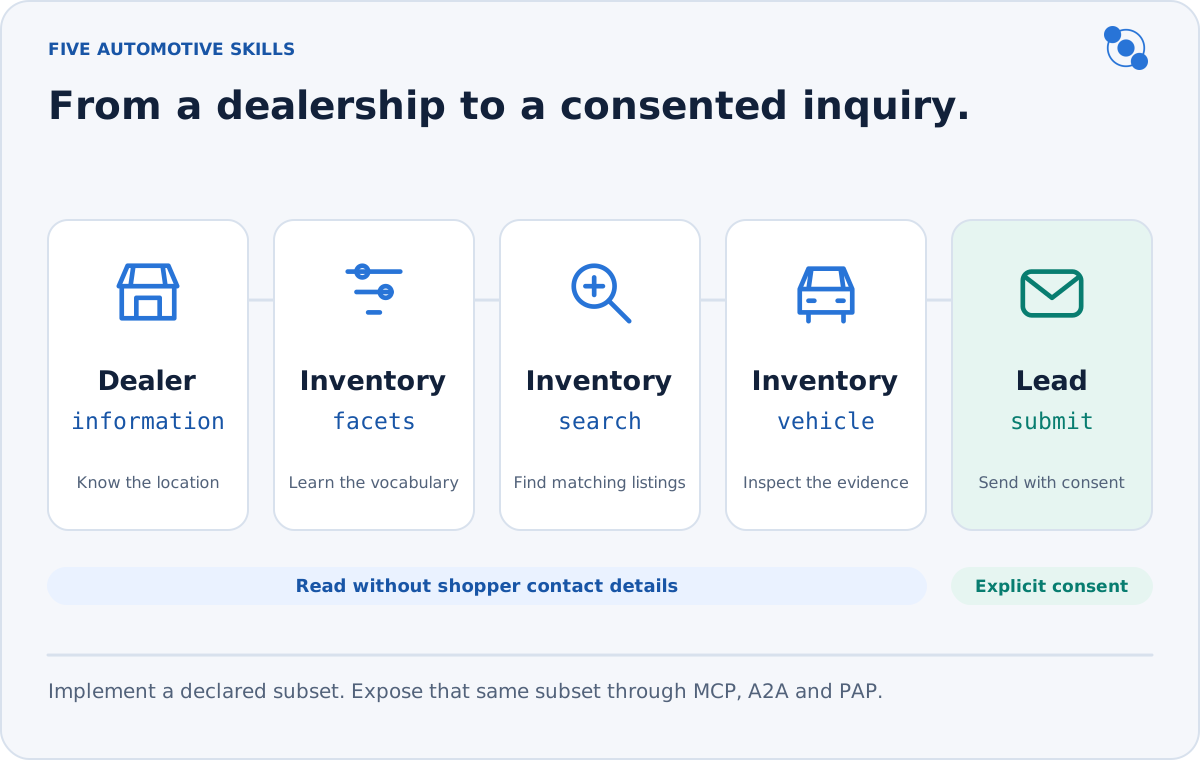
Five skills. One shopping journey.
| Skill | Answer |
|---|---|
dealer.information | Who is this dealer, and where are its locations? |
inventory.facets | Which filters and feature codes are useful here? |
inventory.search | Which vehicles meet every supported constraint? |
inventory.vehicle | What is known about this specific listing? |
lead.submit | Can the dealer receive this explicitly authorized inquiry? |
Declare one or more implemented skills. Search with feature filters also requires facets for its feature vocabulary. For a complete shopping experience, implement all five. The same vehicle model covers cars, EVs, motorcycles, RVs and trailers; an omitted vehicle_type means car.
Automotive meaning, shared everywhere
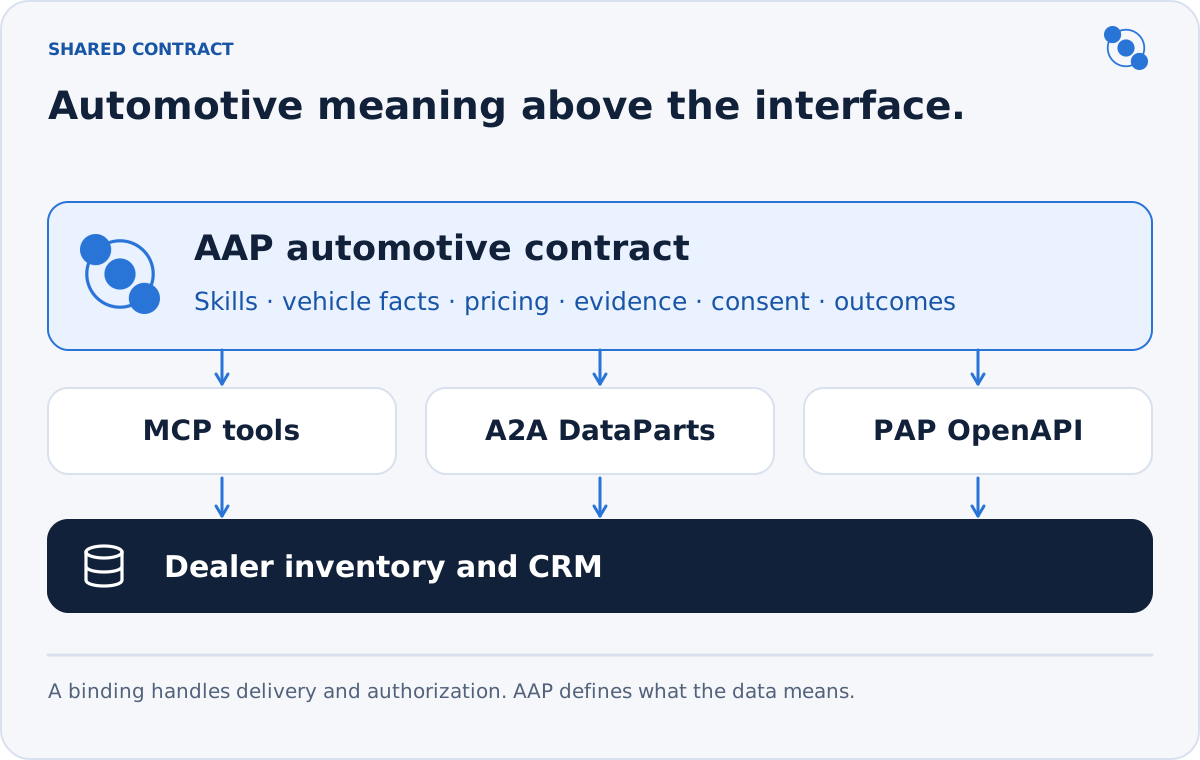
- Search: explicit capabilities, verified features, radius/distance semantics and complete cursor pagination.
- Truthful listings: availability, freshness, identifiers and evidence; missing data remains unknown.
- Clear pricing: one authoritative advertised
price; mandatory dealer charges are included, only government-required consumer charges are separate. - Explicit units: native USD/CAD prices and mi/km odometers; single-currency searches and exact odometer comparisons. Omitted labels preserve USD/mi.
- Controlled contact: explicit channel consent, mandatory retry keys and truthful appointment outcomes.
AAP covers discovery, research and dealer contact. Payments, financing approval, transaction quotes, reservations and trade-in valuations are outside this release.
Start on the dealer's domain
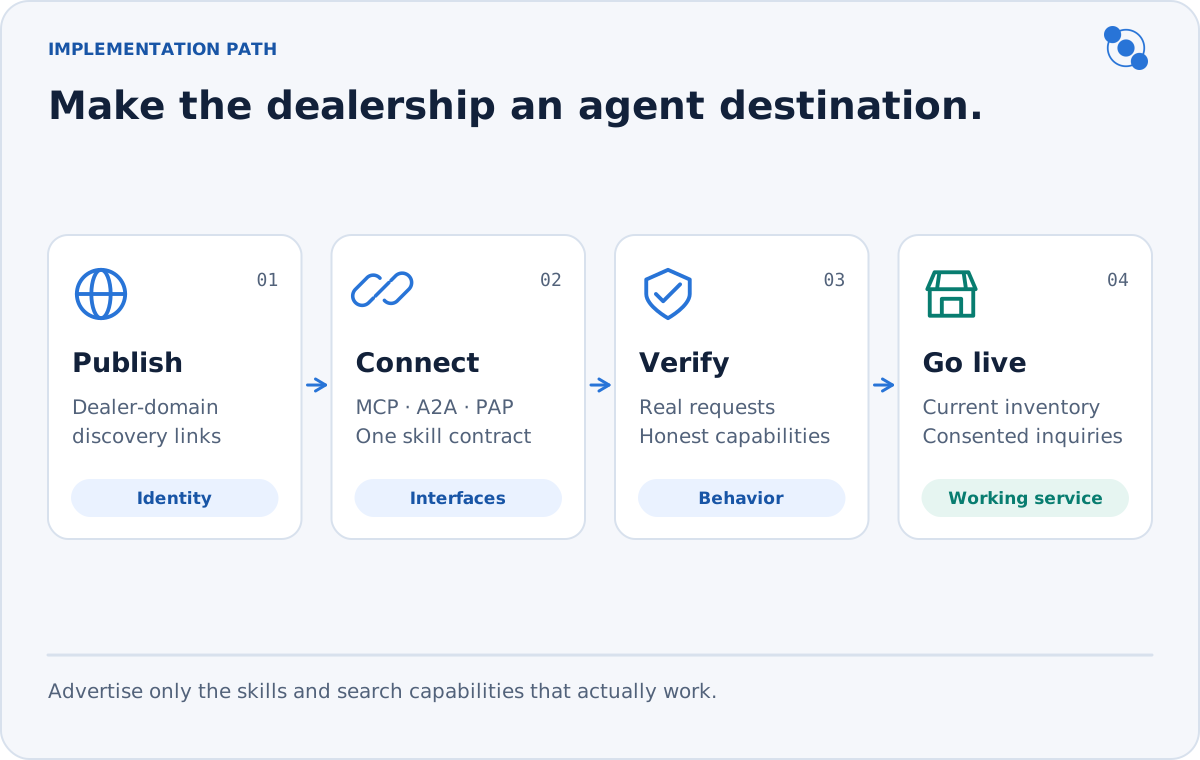
Publish /.well-known/agent-card.json, /.well-known/poppy.json and /llms.txt on the dealer's HTTPS website. They link the actual MCP endpoint, A2A interface and deployment-specific PAP OpenAPI. Services can run on a provider's tenant infrastructure.
An agent follows an explicit endpoint and its access requirements. It does not have to guess a URL or scrape a search form. Discovery improves access; it does not guarantee every assistant will automatically use a protocol.
The selected automotive contract is identified by:
https://autoagentprotocol.org/extensions/aap/v3.1
For a quick implementation path, read discovery, choose the MCP, A2A or PAP client guide, and validate against the schemas. Existing operators should start with the v3 migration checklist.