Discovery
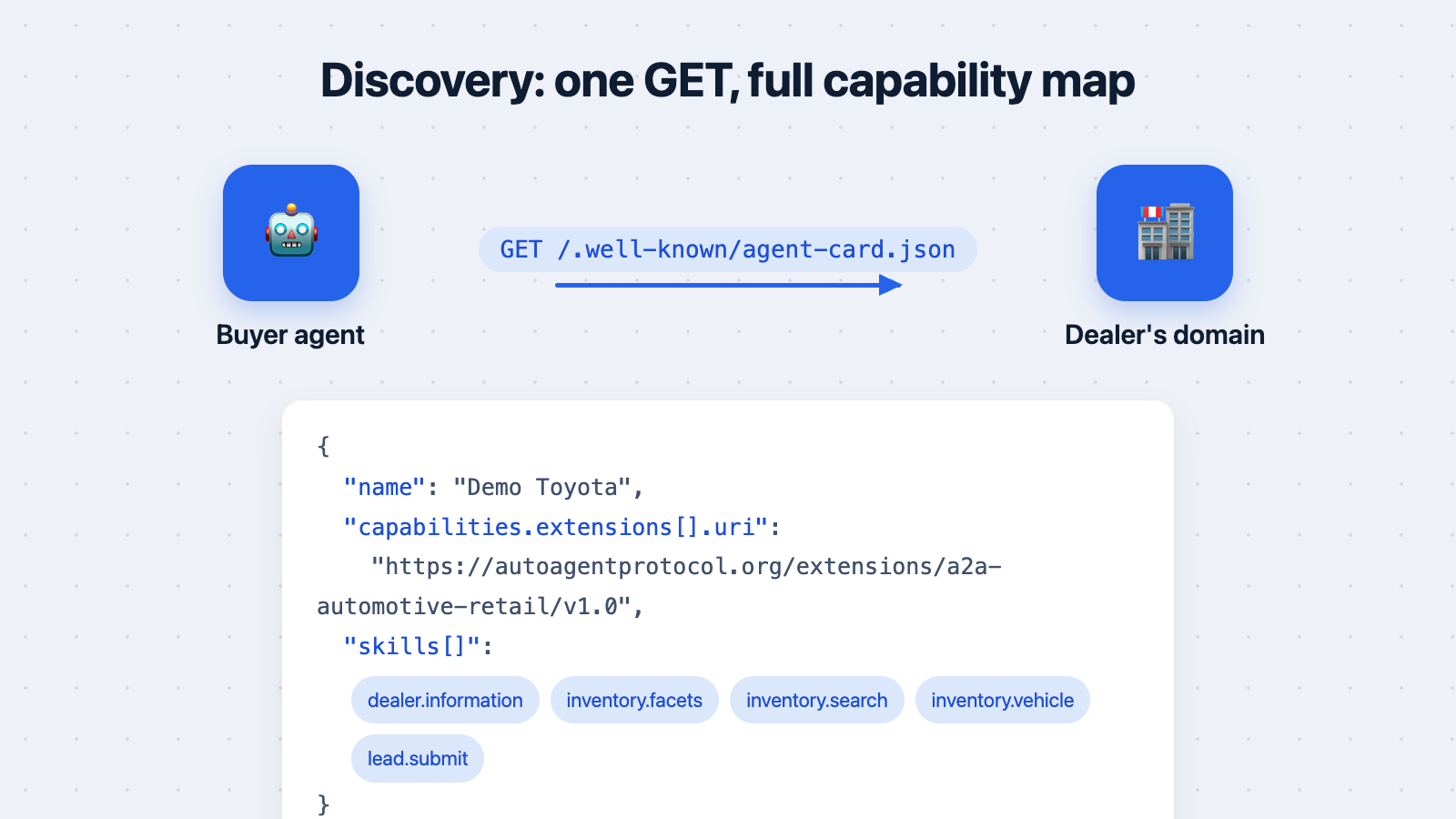
Every AAP-compliant dealer agent publishes an A2A v1.0 agent card at the well-known URL on its own domain:
GET https://{dealer-domain}/.well-known/agent-card.json
The card MUST declare the AAP extension and list the AAP skills the agent implements (one or more from the vocabulary of five). The buyer agent uses the card to confirm AAP compliance, discover which skills are actually available, and select a protocol binding before calling any skill.
Required AAP additions to the A2A agent card
The AgentCard structure itself is defined by A2A — AAP does not redefine it. AAP only narrows it: an AAP-compliant agent card MUST satisfy all of:
-
capabilities.extensions[]contains an entry whoseuriequals:https://autoagentprotocol.org/extensions/a2a-automotive-retail/v1.0 -
skills[]contains one entry per AAP skill the agent implements (one or more). Buyer agents discover capability fromskills[], not from the AAP extension URI alone. AAP RECOMMENDS that an agent expose at leastinventory.search+lead.submitfor a meaningful shopping experience, but no single skill is individually required. -
supportedInterfaces[]includes an entry whoseprotocolBindingisJSONRPC(REQUIRED on every AAP agent card). An additional entry withprotocolBindingHTTP+JSONMAY be added (OPTIONAL). gRPC is out of scope for AAP v1.0.
A buyer agent that does not find a matching extension URI MUST treat the agent as a generic A2A agent, not as an AAP dealer agent.
Authentication
AAP v1.0 agents are public by default — the simplest setup needs no authentication. AAP defines no auth of its own. A dealer that wants to protect its endpoint uses A2A's native securitySchemes / securityRequirements on the agent card (e.g. HTTP bearer), and buyer agents obtain credentials out of band, exactly as A2A specifies. Auth is therefore an A2A/transport concern, out of scope for the v1.0 profile beyond what A2A already provides.
Full example agent card
This is the smallest card that satisfies the three requirements above — a public dealer agent on one binding. Copy it, change the name, the supportedInterfaces[].url, and params.id, and keep only the skills[] you actually implement. A copy-pasteable copy is published at /v1.0/examples/agent-card.example.json.
{
  "name": "Demo Toyota",
  "description": "Auto Agent Protocol dealer agent for Demo Toyota — browse inventory and submit consented leads over A2A.",
  "version": "1.0.0",
  "provider": {
    "organization": "Lumika AI",
    "url": "https://lumika.ai"
  },
  "supportedInterfaces": [
    {
      "url": "https://demo-toyota.example.com/a2a",
      "protocolBinding": "JSONRPC",
      "protocolVersion": "1.0"
    }
  ],
  "capabilities": {
    "extensions": [
      {
        "uri": "https://autoagentprotocol.org/extensions/a2a-automotive-retail/v1.0",
        "description": "Auto Agent Protocol v1.0 — A2A Automotive Retail Profile.",
        "required": true,
        "params": {
          "id": "0192f3c0-1a2b-7c3d-8e4f-5a6b7c8d9e0f"
        }
      }
    ]
  },
  "defaultInputModes": ["application/json"],
  "defaultOutputModes": ["application/json"],
  "skills": [
    {
      "id": "dealer.information",
      "name": "Dealer Information",
      "description": "Return the dealership profile: group name, welcome message, and rooftops with address, hours, contacts, and capabilities.",
      "tags": ["dealer", "dealership", "profile", "hours", "contact", "locations", "automotive"]
    },
    {
      "id": "inventory.facets",
      "name": "Inventory Facets",
      "description": "Return aggregated facets (makes, models, years, conditions, price/mileage ranges, statuses) over the dealer's inventory.",
      "tags": ["inventory", "facets", "aggregation", "filters", "automotive"]
    },
    {
      "id": "inventory.search",
      "name": "Inventory Search",
      "description": "Search the dealer's vehicle inventory by make, model, year, condition, price, mileage, body, fuel, drivetrain, VIN, or stock.",
      "tags": ["inventory", "vehicles", "search", "cars", "automotive"]
    },
    {
      "id": "inventory.vehicle",
      "name": "Vehicle Detail",
      "description": "Return full detail for a specific vehicle by VIN, stock number, or vehicle_id.",
      "tags": ["inventory", "vehicle", "vin", "stock", "detail", "automotive"]
    },
    {
      "id": "lead.submit",
      "name": "Submit Lead",
      "description": "Submit a consented lead with optional vehicle of interest, trade-in, and appointment.",
      "tags": ["lead", "contact", "consent", "sales", "appointment", "automotive"]
    }
  ]
}
provider names who operates the agent. The AAP extension's params.id is a unique identifier (UUID v7 recommended) the dealer regenerates whenever the card changes — onboarding tools cache it to cheaply detect changes. Both params and any AAP-specific data live inside the extension entry, which is the only A2A-sanctioned place for it.
Each skill carries the A2A-required tags (keywords clients/LLMs use to categorize and rank skills). Everything else is optional A2A surface a dealer MAY add to the same card — documentationUrl, an extra supportedInterfaces entry (e.g. HTTP+JSON), per-skill examples / inputModes, or securitySchemes + securityRequirements for auth. Note that the optional A2A surface beyond SendMessage (streaming, tasks, push notification configs, extended agent card) is out of scope for AAP v1.0 — dealer agents do not need to implement it and buyer agents MUST NOT require it. The AgentCard shape is A2A's; see the A2A spec.
What a buyer agent does next
Once the card is fetched and validated:
- Read
skills[]from the card to learn which AAP skills the agent implements. The request/response JSON Schema for each skill is defined by the AAP spec itself (this docs site), version-pinned by the extension URI. - Pick a binding from
supportedInterfaces[]. AJSONRPCentry is always present on an AAP card;HTTP+JSONmay also be offered. Both accept the same AAPDataParts; choose whichever the buyer agent already speaks. - Invoke skills via standard A2A
SendMessage(JSON-RPC binding or REST binding) — the only A2A operation AAP uses: requestMessagein, responseMessageout. If the card declares A2AsecuritySchemes, obtain credentials out of band first.