AAP as an A2A profile
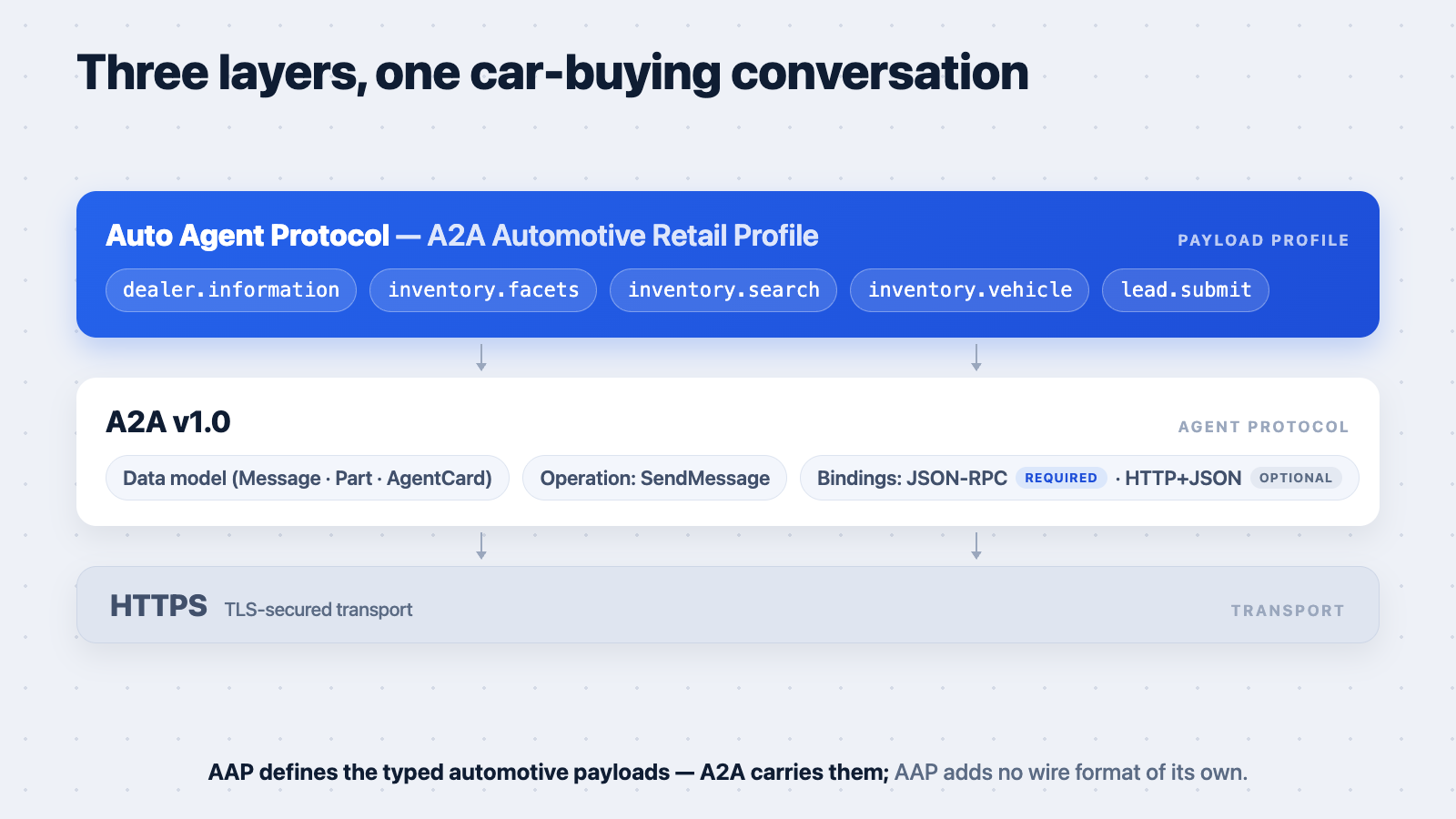
The Auto Agent Protocol is a strict profile of A2A v1.0. It does not redefine discovery, message envelopes, the task model, or transport. It only constrains the shape of one specific A2A construct: typed DataParts carried inside Message.parts[].
The three layers of A2A
A2A is structured in three layers. AAP sits as a profile that constrains layer 1 (data model).
A2A clients and servers can mix and match: any abstract operation can be called over any binding, with the same data model.
Where AAP fits
AAP is a layer 1 profile. It defines:
- Standard skill vocabulary. Five canonical
skills[].idvalues an AAP-compliant agent card draws from:dealer.information,inventory.facets,inventory.search,inventory.vehicle,lead.submit. An agent declares the subset it actually implements (one or more); none is individually mandatory. AAP RECOMMENDS at leastinventory.search+lead.submitfor an end-to-end shopping flow. - Typed
DataPartpayloads. For each skill, an exact request and response JSON Schema. Each payload includes atypefield whose value is<scope>.<thing>.requestor<scope>.<thing>.response(e.g.inventory.search.request). The AAP version is announced once via the agent-card extension URI; it is not repeated on the wire. - An extension URI.
https://autoagentprotocol.org/extensions/a2a-automotive-retail/v1.0, declared incapabilities.extensions[]of the agent card.
AAP does NOT redefine layer 2 (abstract operations) or layer 3 (protocol bindings) — it deliberately uses a minimal slice of each. AAP uses exactly one A2A operation: SendMessage (the message-only pattern — request Message in, response Message out), which maps to POST {base}/message:send on the HTTP+JSON binding. The optional A2A surface (SendStreamingMessage, the tasks Get/List/Cancel/Subscribe operations, push notification configs, GetExtendedAgentCard) is out of scope for AAP v1.0 — dealer agents do not need to implement it, and buyer agents MUST NOT require it. On bindings: a JSON-RPC 2.0 interface is REQUIRED on every AAP agent card; an HTTP+JSON interface MAY be added (OPTIONAL); gRPC is out of scope for AAP v1.0.
The typed DataPart pattern
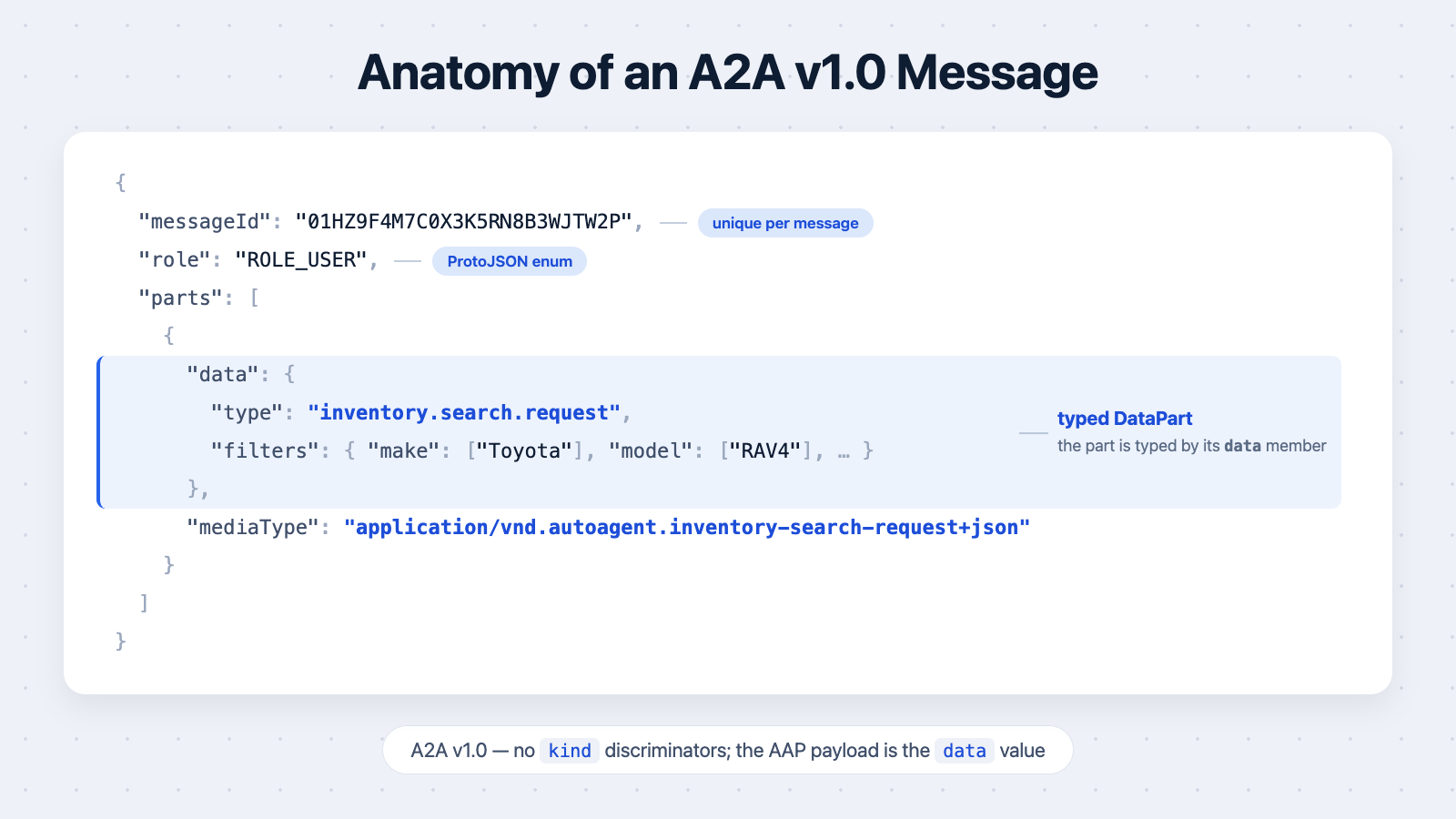
A2A messages are composed of one or more parts. Each part identifies its kind by the member it carries — a part with a text member is a TextPart, with a file member is a FilePart, with a data member is a DataPart. AAP only uses DataParts — it never relies on free-text natural-language parsing for protocol semantics.
A DataPart looks like this:
{
  "data": {
    "type": "inventory.search.request",
    "filters": { "make": ["Honda"] },
    "pagination": { "skip": 0, "limit": 20 }
  },
  "mediaType": "application/vnd.autoagent.inventory-search-request+json"
}
The type field is the AAP-typed identifier (e.g. inventory.search.request). Every AAP request and response carries a type matching the regex ^[a-z_]+(\.[a-z_]+){1,2}$. This lets a buyer agent or middleware validate the payload against the right schema without inspecting the surrounding A2A envelope. The mediaType field on the part advertises the AAP media type so generic A2A middleware can route or filter parts without parsing the inner data.
AAP rides on A2A v1.0, whose single canonical wire format is the ProtoJSON form: the method is SendMessage, Role is the enum name "ROLE_USER" (buyer agent) / "ROLE_AGENT" (dealer response), and a Part has no kind discriminator (it is typed by the member it carries — AAP uses the data member). The Message has no kind discriminator either. A compliant AAP agent MUST emit and accept this form so any A2A v1.0 client and the published A2A SDKs (a2a-js, a2a-python) can parse its replies. Every Message carries a unique messageId.
Concrete example: inventory.search
A full A2A Message carrying an AAP request:
{
  "messageId": "01HZ9Q2V5L8F1U3ABV6K1ETBDEX",
  "role": "ROLE_USER",
  "parts": [
    {
      "data": {
        "type": "inventory.search.request",
        "filters": {
          "make": ["Honda"],
          "condition": ["used", "cpo"],
          "year_min": 2020,
          "price_max": 30000
        },
        "pagination": { "skip": 0, "limit": 20 },
        "sort": { "field": "price", "order": "asc" },
        "privacy": { "anonymous": true }
      },
      "mediaType": "application/vnd.autoagent.inventory-search-request+json"
    }
  ]
}
The dealer agent replies with an A2A Message containing the AAP response:
{
  "messageId": "01HZ9Q2W9SH5ZB6DUA0J1K2L3M",
  "role": "ROLE_AGENT",
  "parts": [
    {
      "data": {
        "type": "inventory.search.response",
        "data": {
          "total": 1,
          "skip": 0,
          "limit": 20,
          "vehicles": [
            {
              "dealer_id": "dealer_demo_toyota",
              "vin": "1HGCY2F57RA000001",
              "stock": "T12345",
              "year": 2022,
              "make": "Honda",
              "model": "Civic",
              "trim": "EX",
              "condition": "cpo",
              "status": "available",
              "list_price": 24990,
              "price": 26780,
              "inventory_date": "2026-04-12",
              "updated_at": "2026-04-30T10:15:00Z"
            }
          ]
        }
      },
      "mediaType": "application/vnd.autoagent.inventory-search-response+json"
    }
  ]
}
The outer envelope around this Message differs by binding (JSON-RPC 2.0 vs. HTTP+JSON), but the Message itself — and the AAP DataPart.data — is identical in both cases. See JSON-RPC binding and REST binding for full envelope examples.
Why typed DataParts instead of natural-language parts
An AI agent could in principle stuff a search query into a TextPart and let the dealer's LLM parse it. AAP does not allow that for protocol calls because:
- Buyer agents need deterministic schemas to plan and validate.
- Dealer CRMs need structured data to write to ADF/XML and downstream lead pipes.
- Pricing and consent are regulated; ambiguous natural language increases compliance risk.
- Validation tooling (Ajv, ajv-formats, OpenAPI clients) only works on structured payloads.
A buyer agent MAY include free-text TextParts in the same Message for human-readable context. AAP defines no semantics for them — only the typed DataPart is normative.
Discovery and bindings: the rest of the profile
AAP layers one more piece on top of the base A2A surface:
| Piece | Where it lives | Purpose |
|---|---|---|
| Agent card with AAP extension | /.well-known/agent-card.json | A2A discovery; declares the AAP extension URI and lists the subset of AAP skills the agent implements. |
| Binding sections | A2A Sections 9 and 11 | How AAP DataParts ride inside JSON-RPC 2.0 (REQUIRED on every AAP agent card) and HTTP+JSON (OPTIONAL) envelopes. |
See:
- Discovery for the agent card.
- JSON-RPC binding and REST binding for the wire format of each binding.