A2A profile
AAP uses A2A's message-only pattern. A typed automotive request goes in; a typed automotive response comes back. Inventory calls do not require a Task, Artifact or streaming lifecycle.
The baseline is A2A 1.0, with the canonical protobuf definitions. Cards and headers use major/minor 1.0; patch numbers do not select the automotive contract.
What AAP adds
| A2A surface | AAP requirement |
|---|---|
| Agent Card | The actual AAP skill subset and one required, version-pinned AAP extension |
Extension params | Automotive schema URLs, search capabilities and MCP/PAP/llms links |
SendMessage request | First part is the typed AAP request with its vendor mediaType |
| Direct response Message | First part is the matching typed AAP response, with a nonempty contextId |
| Errors | Standard A2A detail objects, plus a typed AAP skill error when applicable |
The required extension URI for this contract is:
https://autoagentprotocol.org/extensions/aap/v3.1
Portable A2A clients activate that exact URI with A2A-Extensions. A contract-pinned AAP endpoint also accepts omission of A2A-Version and A2A-Extensions, selecting its configured A2A 1.0 interface and exact AAP contract before dispatch. Supplied conflicting values still fail before a skill executes. This AAP compatibility behavior extends strict upstream header handling; it does not change the required automotive semantics or allow version fallback.
Typed data, standard envelope
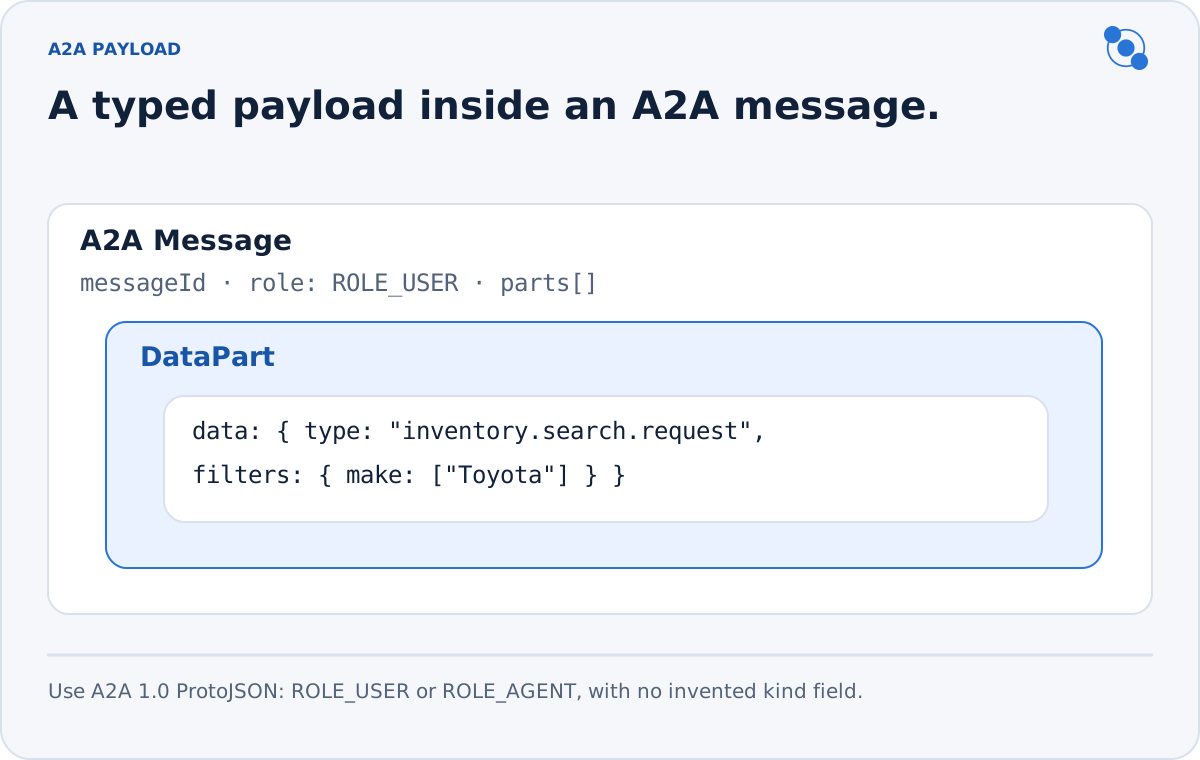
{
  "data": {
    "type": "inventory.search.request",
    "filters": { "make": ["Honda"], "status": ["available"] },
    "pagination": { "limit": 20 }
  },
  "mediaType": "application/vnd.autoagent.inventory-search-request+json"
}
The AAP request is the same object used as MCP arguments or a PAP JSON body. Its type selects the skill; the surrounding transport does not change filter, pricing or consent semantics.
AAP uses JSON-RPC SendMessage, ROLE_USER / ROLE_AGENT, and A2A 1.0 ProtoJSON member discriminators. There is no kind field on Message or Part. Each Message has a unique messageId; every server response also includes contextId, preserving the authorized interaction context or creating one for an initial request.
The first request/response part MUST contain the matching AAP DataPart. Free-text parts have no AAP protocol semantics and MUST NOT supply filters, consent or other business instructions. Do not dispatch a skill by parsing conversational prose.
The deliberately small A2A surface
The required A2A binding is JSON-RPC 2.0. Optional A2A streaming, tasks, push notifications and extended cards are outside AAP's required operation set. Clients MUST NOT depend on them. Servers MUST advertise only capabilities they really serve and return the proper A2A error for an unsupported operation.
A2A's removed HTTP+JSON binding in earlier AAP releases is distinct from the current native PAP OpenAPI interface. MCP is a separate first-class binding; it is not an invented A2A transport name.
For complete headers, a copyable exchange and numeric errors, see the JSON-RPC binding. For truthful capability publication, see discovery. For the same automotive contract through the other interfaces, see MCP and PAP.