inventory.facets
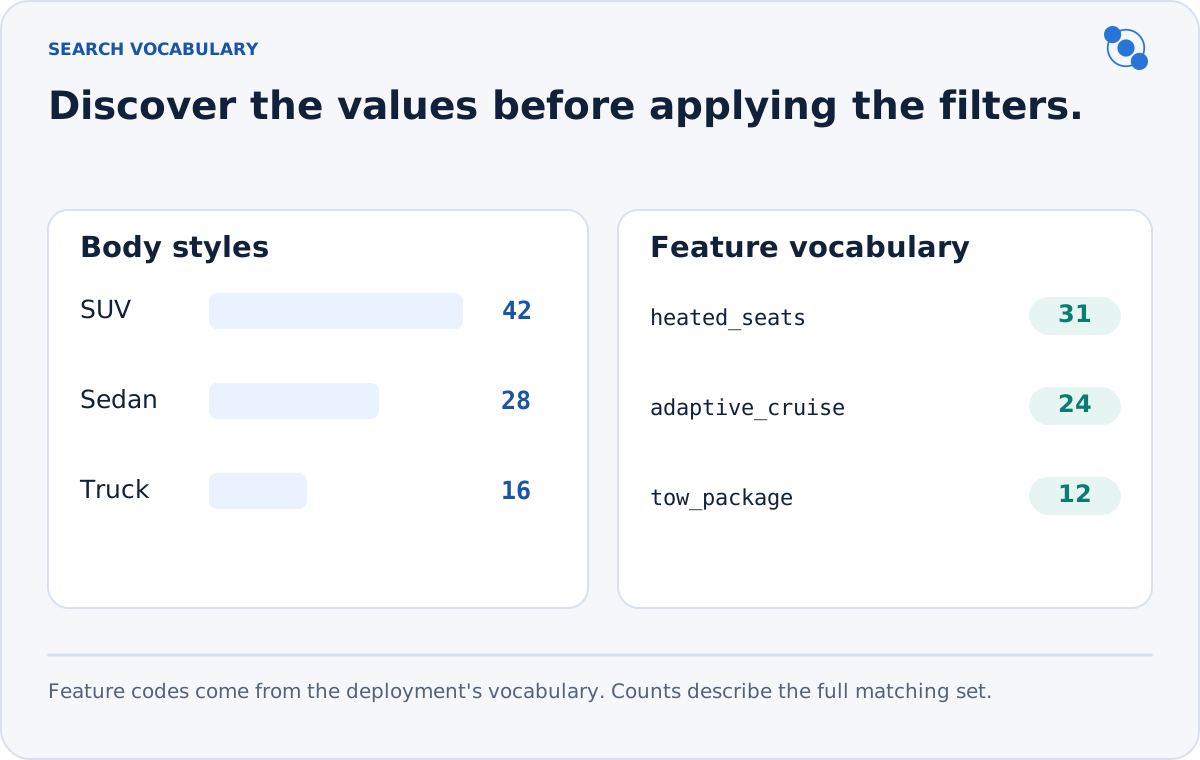
Ask what can be searched before guessing a filter value. Facets expose counts, numeric ranges and the deployment's supported feature codes.
| MCP tool | Shared request → response |
|---|---|
aap_inventory_facets | inventory.facets.request → inventory.facets.response |
The same typed payload works through MCP, A2A and PAP. It needs no customer information or contact consent.
Scope the inventory
{
  "type": "inventory.facets.request",
  "filters": { "condition": ["used"], "status": ["available"] }
}
Omit filters for the entire visible inventory. Otherwise, apply the search filter semantics before aggregating. Counts cover the full matching set, not one page or a capped sample.
When search is implemented, facets use its advertised filter capabilities and the same visibility. A facets-only endpoint accepts unfiltered requests and MUST reject supplied filters with UNSUPPORTED_FILTER; it cannot advertise search capabilities it does not implement.
Currency and odometer context
Top-level currency and mileage_unit select the same query contexts as search. When inventory.search is implemented, facets MUST use its advertised supported currencies and defaults.
When inventory.search is not implemented, inventory.facets MUST accept both USD and CAD, and both mi and km. Omitted request fields mean USD and mi. This fallback needs no search capability declaration and does not imply that inventory exists in both currencies: a currency with no matching inventory returns empty facets. A Canadian facets-only service is queried explicitly as follows, without filters:
{
  "type": "inventory.facets.request",
  "currency": "CAD",
  "mileage_unit": "km"
}
Apply this fallback consistently across A2A, MCP and PAP. It does not change the USD/mi meaning of existing unlabelled requests or permit unsupported filters.
Read counts and ranges
{
  "type": "inventory.facets.response",
  "data": {
    "makes": [{ "value": "Honda", "count": 8 }, { "value": "Toyota", "count": 12 }],
    "conditions": [{ "value": "used", "count": 20 }],
    "price_range": { "min": 18995, "max": 34995 },
    "features": [
      { "code": "heated_front_seats", "label": "Heated front seats", "count": 11 },
      { "code": "adaptive_cruise_control", "label": "Adaptive cruise control", "count": 0 }
    ]
  }
}
| Facet group | Examples |
|---|---|
| Identity and condition | makes, models, trims, years, conditions, statuses |
| Vehicle and location | vehicle_types, bodies, rooftops, exterior_colors, interior_colors |
| Powertrain | fuels, transmissions, drivelines, charge_ports, dc_fast_charge |
| Numeric ranges | price_range, mileage_range, year_range, displacement_cc_range, electric_range_mi_range |
| Equipment vocabulary | features: stable code, readable label and verified-present count |
Term entries use {value, count}; values are strings, integers or booleans as appropriate. Counts are nonnegative exact counts. dc_fast_charge uses actual booleans. Range fields use {min, max} with min <= max and the source field's units.
Only known authoritative prices in the effective query currency contribute to price_range; omit it when none are known. Missing facets mean unavailable data. Empty/zero buckets are allowed when meaningful; do not invent an observed value.
Return the effective labels in data.currency and data.mileage_unit; omission means USD/mi, never an inherited Canadian default. All counts and ranges come from the same currency-scoped matching set. mileage_range contains exact converted bounds in the query unit and may be fractional; do not aggregate raw mi and km numbers together. electric_range_mi_range remains miles. Facets embedded in a search response MUST use that search's effective contexts, including when empty. Vehicle odometers retain their own native units independently of the facet mileage range.
Feature codes have stable meaning
A deployment supporting features_all or features_any MUST implement this skill and publish its full supported feature vocabulary in features. Include supported codes with zero matches so an empty result is distinguishable from an unsupported code. Filtering may change counts, but not a code's meaning.
Count only vehicle-specific evidence with status: "present". Unknown or absent equipment does not contribute. Feature codes are unique within the vocabulary and use lowercase snake_case. A model's usual equipment or a trim label is not evidence for a particular vehicle.
Clients discover a code here, submit it to search, then inspect the returned evidence. An unadvertised code returns UNSUPPORTED_FILTER; it must not quietly become a keyword query.
See the full facet example, motorcycle example and schema.