MCP binding
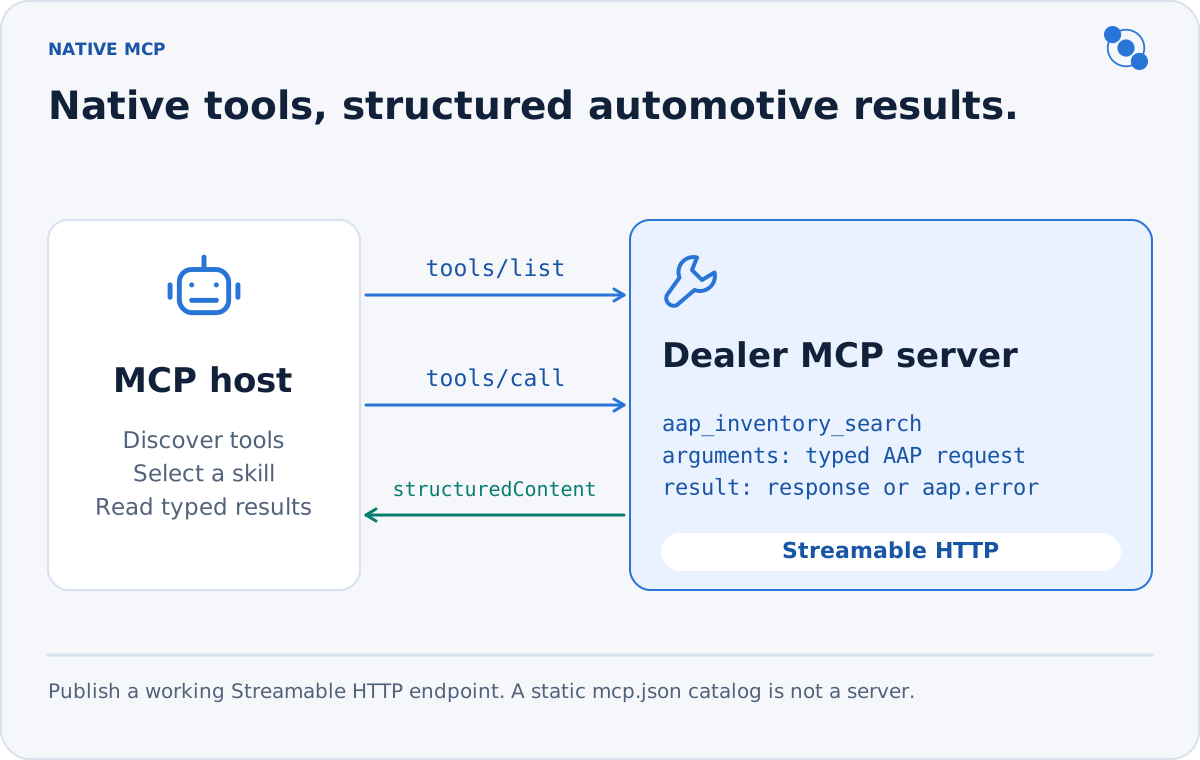
MCP is a first-class AAP interface. A server can call its inventory and lead services directly. An A2A hop is optional. All bindings share the same automotive payloads, supported skill subset, inventory scope, consent checks and idempotency store. Verified caller scope remains part of duplicate detection.
Protocol baseline
An AAP 3.0 MCP endpoint MUST implement Streamable HTTP for MCP 2026-07-28 and 2025-11-25. Advertise both actual revisions in discovery; additional revisions are optional. AAP's 3.0.0 release number is separate from these MCP protocol dates and from a server's software version.
| MCP 2026-07-28 | MCP 2025-11-25 compatibility | |
|---|---|---|
| Start | Optional client call to mandatory server/discover | initialize, then notifications/initialized |
| Request metadata | Protocol version and client capabilities required; client info recommended, optional | Version, capabilities and client info supplied during initialization |
| HTTP metadata | Standard clients send MCP-Protocol-Version, Mcp-Method, and Mcp-Name for tool calls; AAP accepts their omission when the body supplies the values | Negotiated MCP-Protocol-Version; may be omitted when this client's validated session supplies it |
| Completed results | resultType: "complete" | No resultType field required |
| Protocol sessions | None | Optional Mcp-Session-Id |
The current binding follows the 2026-07-28 specification, pinned for review to upstream commit dae694f. The compatibility path follows the 2025-11-25 lifecycle and transport. Optional upstream features are required only when advertised.
Under the current per-request metadata rules, clients MUST send io.modelcontextprotocol/protocolVersion and io.modelcontextprotocol/clientCapabilities (an empty object is sufficient when no optional capabilities apply). io.modelcontextprotocol/clientInfo is recommended but MAY be omitted. Servers MUST NOT reject an otherwise valid request solely because this software-identification field is absent, or use it as authenticated identity. This optionality does not change the legacy initialization fields.
Publish a reachable endpoint
Publish a public HTTPS MCP URL on the dealership's own discovery surfaces. It may point to a platform-hosted tenant endpoint, for example https://api.provider.example/aap/3.0.0/demo-toyota/mcp.
- Agent Card:
capabilities.extensions[]→ the AAP entry'sparams.mcp. - Poppy:
extensions["autoagentprotocol.org/aap"].mcpfor a public link; a nativeapisentry only when PAP session support is implemented. /llms.txt: a Markdown link to the exact endpoint, its access requirements and the AAP contract version.
Do not guess /mcp or invent a universal well-known MCP path. Discovery files MUST identify the same dealership, AAP contract and implemented skill subset. See discovery.
The endpoint MUST accept POST with Content-Type: application/json. Standard MCP clients send Accept: application/json, text/event-stream and handle either JSON or request-scoped SSE responses. AAP endpoints MUST also serve synchronous operations as JSON when Accept is absent, is */*, or accepts JSON without SSE. Do not reject such a request solely for omitting SSE from Accept; honor explicit media exclusions and return 406 if no supported response type is acceptable. Validate a supplied Origin against the deployment's allowed origins; reject invalid origins with HTTP 403. A missing browser Origin header is not, by itself, evidence of an unauthorized server-side client.
Discover and list tools
For the current revision:
POST /aap/3.0.0/demo-toyota/mcp HTTP/1.1
Host: api.provider.example
Content-Type: application/json
Accept: application/json, text/event-stream
MCP-Protocol-Version: 2026-07-28
Mcp-Method: server/discover
{
  "jsonrpc": "2.0",
  "id": "discover-1",
  "method": "server/discover",
  "params": {
    "_meta": {
      "io.modelcontextprotocol/protocolVersion": "2026-07-28",
      "io.modelcontextprotocol/clientCapabilities": {}
    }
  }
}
The result declares supportedVersions, capabilities.tools, and server identity under _meta["io.modelcontextprotocol/serverInfo"]. Both server/discover and tools/list results MUST include ttlMs (a nonnegative integer) and cacheScope (public or private). Use private when visibility depends on authorization, and never share those cached results between authorization contexts. Use ttlMs: 0 when the result should be immediately stale. The server MUST implement this method; clients may proceed directly to another method with the same required request metadata.
This minimal discovery request omits optional client software identification. Then call tools/list, keeping the version/capability metadata and changing Mcp-Method to tools/list. Follow MCP nextCursor until the entire tool list is retrieved. This cursor is distinct from an inventory result's next_cursor.
| AAP skill | MCP tool | Side effect |
|---|---|---|
dealer.information | aap_dealer_information | Read |
inventory.facets | aap_inventory_facets | Read |
inventory.search | aap_inventory_search | Read |
inventory.vehicle | aap_inventory_vehicle | Read |
lead.submit | aap_lead_submit | Consented dealer contact |
The release's mcp.json is a reference tool catalog, not a live server or a JSON-RPC response. A deployment MUST expose only implemented tools, in a deterministic order. Its inventory search tool MUST add actual capabilities under _meta["autoagentprotocol.org/aap"], following inventory-capabilities.schema.json. That object MUST match the linked Agent Card.
Complete schemas, standard hints
Every tool MUST expose:
- An object
inputSchemathat validates the complete typed AAP request, includingtype. - An object
outputSchemaaccepting either the matching typed response oraap.error. - Self-contained JSON Schema 2020-12: referenced definitions are included under
$defs; no remote fetch is needed to validate a call. - Standard
annotationsfor read-only, destructive, idempotent and open-world behavior. AAP metadata belongs in namespaced_meta, not custom annotation keys. - A meaningful description and AAP metadata containing the release version, skill ID, request/response types and canonical schema URLs.
Read tools use readOnlyHint: true. lead.submit uses readOnlyHint: false, destructiveHint: false, and conservatively idempotentHint: false: its required key protects retries for at least 24 hours, not indefinitely. Include the actual retention window in the tool description. Every tool uses openWorldHint: true. These are descriptive hints; authorization and consent remain enforced by the server.
Call the shared contract
Set Mcp-Method: tools/call and Mcp-Name: aap_inventory_search, alongside the headers above:
{
  "jsonrpc": "2.0",
  "id": "search-1",
  "method": "tools/call",
  "params": {
    "_meta": {
      "io.modelcontextprotocol/protocolVersion": "2026-07-28",
      "io.modelcontextprotocol/clientInfo": { "name": "example-buyer", "version": "1.0.0" },
      "io.modelcontextprotocol/clientCapabilities": {}
    },
    "name": "aap_inventory_search",
    "arguments": {
      "type": "inventory.search.request",
      "filters": { "price_max": 35000, "status": ["available"] },
      "pagination": { "limit": 20 },
      "sort": { "field": "price", "order": "asc" },
      "privacy": { "anonymous": true }
    }
  }
}
The server MUST validate arguments, authorize the operation, execute the shared skill, and validate the response before returning it. The tool name and payload type MUST agree.
A successful current result contains resultType: "complete", isError: false, the typed AAP response in structuredContent, and its serialized JSON in a text content block. The two representations MUST agree. Clients may use either without losing vehicle fields, evidence, pagination or fee semantics. The compatibility result carries the same content without requiring resultType.
Errors that an agent can act on
| Failure | Response |
|---|---|
| Unknown tool or malformed JSON-RPC | MCP protocol error; do not pretend a skill succeeded. |
| Invalid arguments to a known tool, unsupported filters, expired cursor, unavailable vehicle, missing consent | Completed tool result with isError: true; typed aap.error in structuredContent and matching serialized text. |
| Invalid or missing authorization | HTTP 401 with MCP authorization discovery challenge; no skill execution. |
| Insufficient scope | HTTP 403 with the applicable OAuth challenge; no skill execution. |
| HTTP-level throttling | HTTP 429 and Retry-After. |
| Skill-level quota | aap.error / RATE_LIMITED, isError: true, and details.retry_after_ms. |
The output schema's success/error union keeps structured failures valid. isError MUST agree with the payload: true for aap.error, false for a successful skill response. Include request paths and a concrete correction in details; never include credentials, customer values or internal stack traces.
Supplied metadata headers that conflict with the body return HTTP 400 with HeaderMismatch (-32020). The AAP ingress rules below allow omission of redundant headers. An unsupported or unresolvable protocol date returns HTTP 400 with UnsupportedProtocolVersionError (-32022) and supported versions. Required current body metadata still applies. Correct the request instead of interpreting these errors as a signal to drop into an older protocol.
Host schema compatibility
MCP permits JSON Schema 2020-12 composition and conditionals. Some Claude Code builds have been reported to drop tools with these keywords at the input schema root, or to receive an Anthropic API error: current report, earlier API error. This is a host limitation, not an invalid MCP contract, and does not establish failure in every Claude product or Instinct.
The generated catalog places root input constraints under dependentSchemas.type. Every AAP request already requires its type discriminator, so those constraints still validate the whole request object whenever it can be valid. The arguments, property descriptions, examples and accepted/rejected payloads stay the same; no wrapper, alternate skill name or second automotive schema is introduced. The generator refuses this transformation if the required discriminator is absent. Servers MUST retain complete canonical request validation, including consent, identifiers and geography.
Repository checks compare the generated and canonical validators on valid and malformed requests and exercise both pinned official MCP clients. These are not a Claude-host certification. Before advertising a supported host, verify that all implemented tools appear and that search, vehicle detail and consented lead calls reach the server. If a host still rejects dependentSchemas, $defs or other standard keywords, use a client supporting the complete schema (the pinned official clients are covered), or a separately tested host adapter that preserves the arguments and canonical server validation. Report the unsupported host/build explicitly; never silently remove tools or weaken the automotive contract.
Existing clients
For 2025-11-25, accept initialize with protocolVersion, clientInfo and capabilities; return that supported version, serverInfo and capabilities.tools. Accept notifications/initialized with HTTP 202 and no body. Subsequent requests send the negotiated protocol header, or may omit it when the server can recover the version from this client's validated session. A stateless request with no version information must supply the header. Keep tool arguments, schemas and AAP results identical to the current binding.
A legacy server may issue an MCP session ID. It is transport state, never a replacement for authorization or a PAP Session Token. If issued, enforce its lifecycle under the legacy specification. The current 2026-07-28 path does not create protocol sessions. Do not require legacy initialization or a session ID on a current request.
Use the upstream HTTP compatibility rules when supporting both client generations. Do not retry a consented write on a different binding with a new idempotency key after an uncertain result.
Keep the client requirements small
Public MCP reads need no A2A activation headers, PAP Session, DPoP proof or customer sign-in. Require authorization only when the endpoint advertises it. Validate Origin when supplied; non-browser clients need not invent it. For legacy clients, prefer stateless operation without issuing Mcp-Session-Id unless a deployment actually needs transport sessions. Modern MCP has no protocol session ID.
The modern HTTP rules require mirror headers from conforming MCP clients. AAP adds explicit compatibility ingress so those redundant copies do not block a request whose body already supplies the same information:
| Header | AAP behavior when absent | Behavior when supplied |
|---|---|---|
MCP-Protocol-Version | Use the current request's params._meta["io.modelcontextprotocol/protocolVersion"], or this client's negotiated legacy session version | Must agree with the body or negotiated context and select a supported revision |
Mcp-Method | Derive from JSON-RPC method | Must match method |
Mcp-Name on tools/call | Derive from params.name | Decode standard Base64 sentinel encoding when used, then require an exact match |
Accept | Return JSON for synchronous AAP operations | JSON-only is accepted; respect explicit media exclusions |
AAP servers MUST accept these omissions whenever the listed source unambiguously supplies the value. Normalize metadata before routing or policies that use it, then run the same envelope, schema, authorization and tenant checks. Never overwrite a supplied conflict, infer a version from another client's session, or treat absent credentials as a public grant. Keep current body version/capability metadata required; do not guess a protocol version when neither the body, header nor the client's negotiated context provides one.
These omission rules are an AAP compatibility extension, not the strict upstream MCP wire requirements. Portable MCP clients should continue sending the standard headers, as the examples do. An adapter to a strict MCP implementation fills the omitted copies before forwarding. AAP adds no custom header or x-mcp-header parameter mirroring requirement. Modern mirror requirements never apply to a valid legacy request. The reference normalization helpers and HTTP contract tests cover both accepted omissions and rejected conflicts; deployed endpoints must implement and verify this behavior too.
Public reads and PAP sessions
Public inventory reads SHOULD work without customer sign-in or personal information. An operator may require MCP OAuth credentials; it MUST disclose that requirement and publish protected resource metadata rather than an undocumented API-key prerequisite.
A public MCP link in the AAP Poppy extension does not claim native PAP authorization. Advertising apis: [{"type":"mcp", ...}] in poppy.json additionally requires the PAP MCP rules: resource-bound Session Tokens, protected resource metadata, authorization-server discovery, and scope enforcement. Under PAP 0.3, new MCP servers SHOULD support DPoP. For an existing MCP server without DPoP, the client first obtains a DPoP Session Token and then uses RFC 8693 token exchange with a fresh DPoP proof at the token endpoint. Only that exchange returns a Bearer Session Token, restricted to the exact MCP resource URL. The issuer advertises the token-exchange grant; omitting the proof is never a Bearer shortcut.
PAP clients MUST send their Session Token to a native PAP MCP API. Generic MCP clients use standard MCP OAuth. A token issued for MCP MUST NOT be forwarded to an A2A or OpenAPI endpoint, or to another tenant. An adapter authenticates to its downstream service according to that service's own audience and policy.
lead.submit always requires explicit contact consent and a stable idempotency key. MCP tool selection, OAuth consent, a PAP session or an agent's source_agent label cannot substitute for the buyer's contact consent.
Implement once; verify each binding
Route every binding to the same schema validators and automotive operations. A direct MCP implementation is sufficient; an A2A adapter must additionally set the downstream A2A-Version: 1.0 and exact A2A-Extensions URI. Never send those activation headers as a substitute for MCP metadata.
Record correlation ID, actual binding, MCP revision, AAP version, skill, outcome code and latency. Exclude raw arguments, customer data, tokens and proofs. Verify modern and legacy tool discovery, every implemented skill, schema errors, consent rejection, duplicate suppression, tenant isolation and throttling before publication. See conformance.