dealer.information
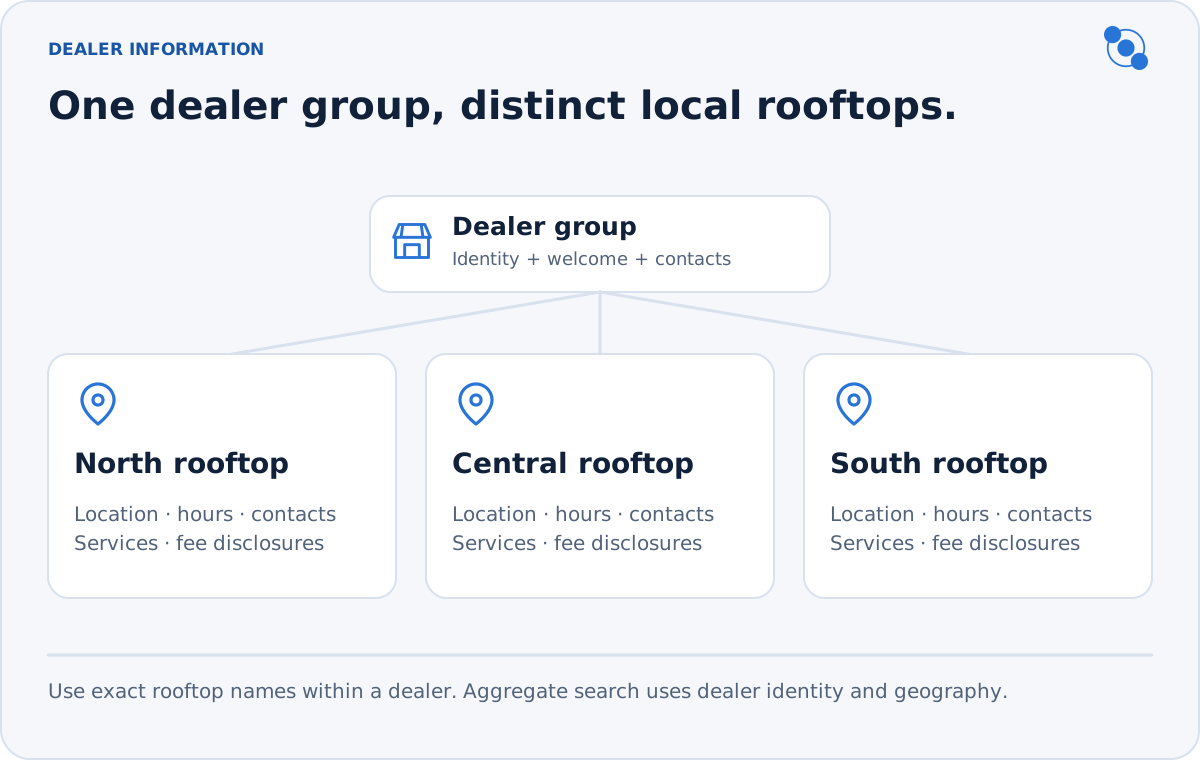
Learn who the dealer is and where to go. One dealer group can have several physical locations, called rooftops.
| MCP tool | Shared request → response |
|---|---|
aap_dealer_information | dealer.information.request → dealer.information.response |
Use the typed request as MCP arguments, an A2A DataPart or a PAP OpenAPI body. No customer information or contact consent is needed; transport authentication still applies.
Request
{ "type": "dealer.information.request" }
Omit dealer_id for the endpoint's default profile. Unknown request properties are invalid.
Resolve a seller from aggregate inventory
An endpoint advertising scope: "aggregate" MUST expose this skill through every binding. Before requesting permission to contact a seller, resolve the listing's opaque dealer_id on that same endpoint:
{ "type": "dealer.information.request", "dealer_id": "d-7" }
{
  "type": "dealer.information.response",
  "data": {
    "dealer_id": "d-7",
    "name": "Demo Toyota",
    "rooftops": [{
      "name": "Demo Toyota San Francisco",
      "website": "https://demo-toyota.example.com"
    }]
  }
}
For a selected profile, data.dealer_id MUST equal the requested identifier. data.name and rooftops MUST identify only the actual receiving dealership. An unknown or inaccessible identifier returns DEALER_NOT_FOUND; never substitute the marketplace's profile. Clients MUST stop on a mismatched or unresolved identity and MUST NOT infer the recipient from a rooftop name. The seller ID remains stable within this endpoint and MUST NOT be reassigned to another business.
An ordinary dealer-scoped endpoint needs no additional lookup before consent: its discovery already identifies the dealer. The existing parameterless request remains valid. If it accepts a selector, it follows the same exact-match rule.
Response
{
  "type": "dealer.information.response",
  "data": {
    "name": "Demo Auto Group",
    "rooftops": [{
      "name": "Demo Toyota San Francisco",
      "website": "https://demo-toyota.example.com",
      "geo": { "latitude": 37.789, "longitude": -122.394 },
      "timezone": "America/Los_Angeles",
      "phones": [{ "name": "Sales", "value": "+14155550100" }],
      "capabilities": ["sales", "service", "trade_in"]
    }]
  }
}
data.name and at least one rooftop are required. Every rooftop needs name; the other details are optional. Omission means unknown, not closed or unavailable.
| Rooftop fields | Meaning |
|---|---|
name, legal_name, website | Public identity, optional legal name and website |
address, geo | Physical location; latitude/longitude use WGS84 coordinates |
emails, phones | Labeled contact values such as Sales or Service |
schedules, timezone | Named weekly hours such as sales, service or parts in rooftop local time; a day is {open, close} or null when closed |
capabilities | Service tags such as sales, service, trade_in, delivery or motorcycle_sales |
fees | Optional default fee schedule for the publisher; never an extra charge for the buyer to add |
Rooftop names MUST be unique within a dealer-scoped endpoint and match the exact values used by Vehicle.rooftop and filters.rooftops. Aggregate search does not accept ambiguous rooftop-name filters. An aggregate operator must retain owning dealer identity on listings.
A displayed 09:00 is interpreted in the rooftop's timezone, not the buyer's timezone. If the timezone or hours are absent, do not infer them. Keep cached profile data consistent with current operations.
Department schedules
A rooftop can publish separate schedules for sales, service and parts. Use name: "parts" for parts department hours, with the same weekly value structure used by sales and service. Each department can have different opening and closing times, interpreted in the rooftop's timezone.
Schedule names are free-text labels, so other department names are allowed. Schedules remain optional. Advertising the parts capability does not require a parts schedule or establish its hours. The full response example below includes a separate parts schedule.
Fees belong to the listing price
Rooftop fees are publisher defaults and discovery metadata. A publisher may use them to construct a complete effective vehicle fee snapshot. Buyers MUST NOT join them onto a vehicle, add them to price, or treat a missing schedule as zero fees.
A vehicle's optional fees is a complete replacement breakdown, already included in authoritative price. See pricing.
The full example includes two rooftops and complete schedules. The schema defines every field.