Why automotive needs AAP
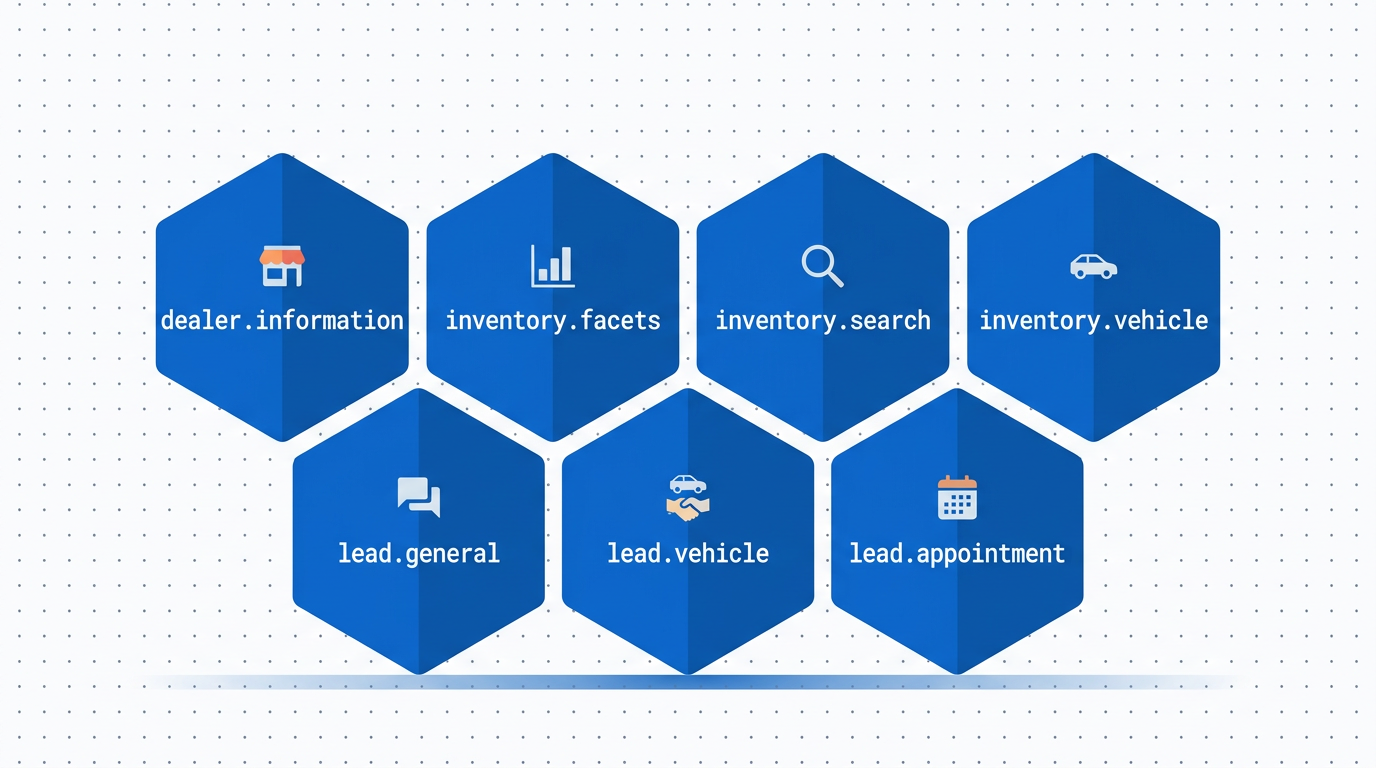
Automotive retail has unusual constraints that no general-purpose agent protocol addresses end-to-end:
- Inventory is mixed (new + used + certified + in-transit) and mutates daily. A car listed at 9am can be sold by 11am.
- Pricing is regulated. The FTC's CARS Rule and 2026 enforcement actions require advertised prices to reflect the final out-the-door amount, including all required fees and add-ons.
- Customer contact data is regulated. TCPA, CAN-SPAM, and state laws require explicit, scoped consent before a dealer can call, text, or email.
- Lead handoff is legacy-bound. Dealer CRMs ingest ADF/XML (Auto-lead Data Format) leads that have been the de-facto standard for two decades.
A protocol for AI agents talking to dealerships has to handle all four. AAP does. Generic agent protocols do not.
How AAP relates to neighboring protocols
| Protocol | What it standardizes | What it does NOT cover for automotive |
|---|---|---|
| A2A (Agent2Agent) | Generic agent discovery, message envelope, JSON-RPC + HTTP+JSON bindings, task model, push notifications | Automotive vocabulary (vehicles, VIN, pricing semantics, ADF compatibility, dealership consent rules) |
| ACP (Agentic Commerce Protocol) | E-commerce checkout (cart, payment, fulfillment) between agents and merchants | Pre-purchase research, leads, appointments, dealership-specific data — vehicles are rarely bought through agentic checkout |
| MCP (Model Context Protocol) | Tool layer between an LLM client and one host application (filesystem, DB, API) | A peer-to-peer protocol between agents; MCP is host-to-tool, not agent-to-business |
| ADF/XML | Legacy lead format dealer CRMs ingest today | A read API (no inventory queries), no agent discovery, no consent records, no appointment booking |
AAP does not replace any of these. It complements them.
- AAP IS an A2A profile. Every AAP message is an A2A
DataPart. A buyer agent that already speaks A2A can call an AAP dealer agent without learning a new transport. - AAP COMPLEMENTS ACP. ACP is built around payment + checkout. Vehicles are typically not transacted that way — the dealer's lead system, financing, F&I, and trade-in conversation happen out of band. AAP covers the lead step that precedes (or replaces) checkout.
- AAP COMPLEMENTS MCP. A buyer agent's host LLM can expose AAP skills as MCP tools. The MCP compatibility page shows the one-to-one mapping.
- AAP MAPS TO ADF. Every
lead.vehiclerequest can be losslessly converted to an ADF/XML payload so a dealer's existing CRM accepts it without changes. See the ADF mapping page.
What AAP adds that A2A alone does not
A2A standardizes how agents exchange messages, not what is in them. Two A2A-compliant dealer agents could each invent their own inventory_search skill with different field names, different filter semantics, different pricing fields, and a buyer agent would have to special-case each one.
AAP fixes the field names, types, and required behavior:
- Seven canonical skills every dealer agent MUST implement.
- Strict typed
DataParts(<scope>.<thing>.request,<scope>.<thing>.response) so a buyer agent can validate before sending. - Four explicit pricing fields (
msrp,list_price,offered_price,price) wherepriceis the FTC-final out-the-door amount — see Pricing and FTC compliance. ConsentGrantstructure required when a lead carries customer contact info, with explicitallowed_channelsandscope.- Free-text vehicle
status(so each dealer keeps its own inventory vocabulary like "In Stock", "In Transit", "Pending", "Sold") combined with a hard MUST that known-sold vehicles are not returned as available — see behavior rules. - A machine-readable contract manifest at
/.well-known/auto-agent-contract.jsonso an LLM-driven buyer agent can plan calls deterministically — see the contract manifest.
First automotive-specific A2A profile
AAP v0.1 is the first published A2A profile written specifically for the automotive retail vertical. Its goal is narrow: a buyer agent should be able to talk to any compliant dealer agent — Toyota, Honda, an independent used-car lot, a CDK/Reynolds-backed group — through identical typed messages, with consent, pricing, and ADF compatibility built in from day one.