# `inventory.facets`
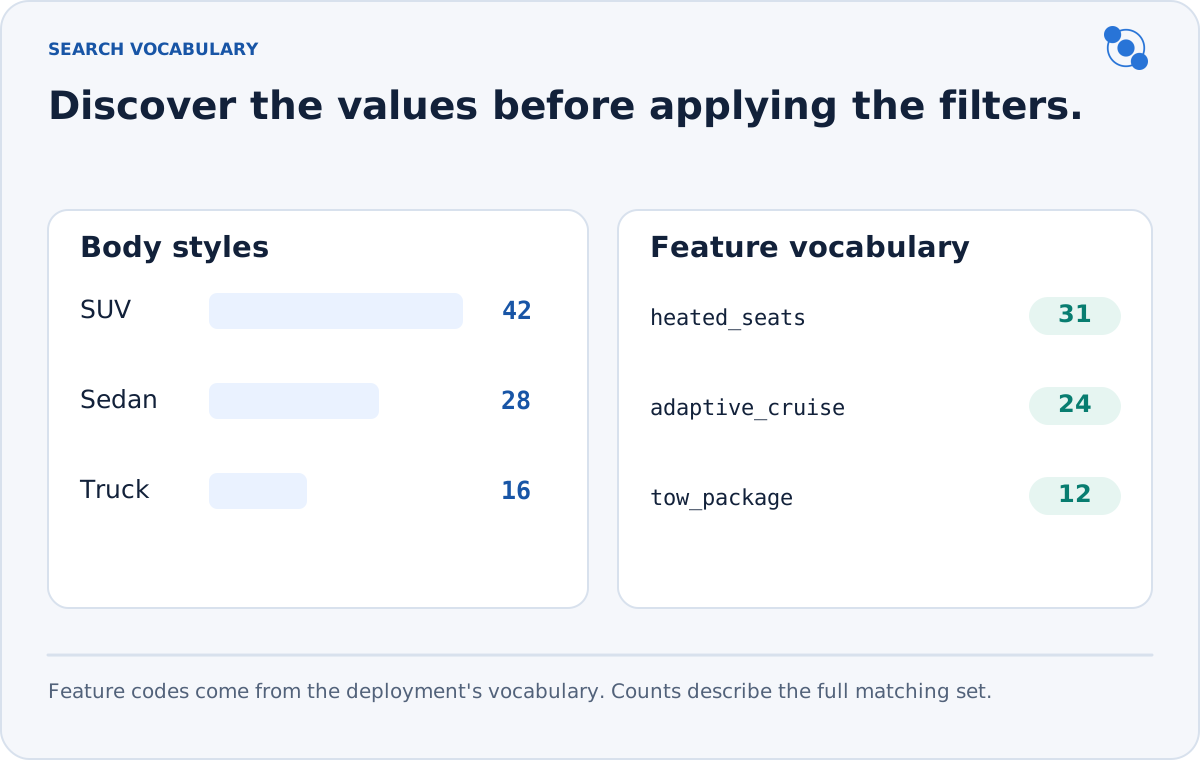
**Ask what can be searched before guessing a filter value.** Facets expose counts, numeric ranges and the deployment's supported feature codes.
| MCP tool | Shared request → response |
|---|---|
| `aap_inventory_facets` | `inventory.facets.request` → `inventory.facets.response` |
The same typed payload works through MCP, A2A and PAP. It needs no customer information or contact consent.
## Scope the inventory
```json
{
"type": "inventory.facets.request",
"filters": { "condition": ["used"], "status": ["available"] }
}
```
Omit `filters` for the entire visible inventory. Otherwise, apply the [search filter semantics](https://autoagentprotocol.org/docs/v3.0/skills/inventory-search.md) before aggregating. Counts cover the **full matching set**, not one page or a capped sample.
When search is implemented, facets use its advertised filter capabilities and the same visibility. A facets-only endpoint accepts unfiltered requests and MUST reject supplied filters with `UNSUPPORTED_FILTER`; it cannot advertise search capabilities it does not implement.
## Read counts and ranges
```json
{
"type": "inventory.facets.response",
"data": {
"makes": [{ "value": "Honda", "count": 8 }, { "value": "Toyota", "count": 12 }],
"conditions": [{ "value": "used", "count": 20 }],
"price_range": { "min": 18995, "max": 34995 },
"features": [
{ "code": "heated_front_seats", "label": "Heated front seats", "count": 11 },
{ "code": "adaptive_cruise_control", "label": "Adaptive cruise control", "count": 0 }
]
}
}
```
| Facet group | Examples |
|---|---|
| Identity and condition | makes, models, trims, years, conditions, statuses |
| Vehicle and location | vehicle_types, bodies, rooftops, exterior_colors, interior_colors |
| Powertrain | fuels, transmissions, drivelines, charge_ports, dc_fast_charge |
| Numeric ranges | price_range, mileage_range, year_range, displacement_cc_range, electric_range_mi_range |
| Equipment vocabulary | features: stable code, readable label and verified-present count |
Term entries use `{value, count}`; values are strings, integers or booleans as appropriate. Counts are nonnegative exact counts. `dc_fast_charge` uses actual booleans. Range fields use `{min, max}` with `min <= max` and the source field's units.
Only known authoritative prices contribute to `price_range`; omit it when none are known. Missing facets mean unavailable data. Empty/zero buckets are allowed when meaningful; do not invent an observed value.
## Feature codes have stable meaning
A deployment supporting `features_all` or `features_any` MUST implement this skill and publish its full supported feature vocabulary in `features`. Include supported codes with zero matches so an empty result is distinguishable from an unsupported code. Filtering may change counts, but not a code's meaning.
Count only vehicle-specific evidence with `status: "present"`. Unknown or absent equipment does not contribute. Feature codes are unique within the vocabulary and use lowercase snake_case. A model's usual equipment or a trim label is not evidence for a particular vehicle.
Clients discover a code here, submit it to search, then inspect the returned evidence. An unadvertised code returns `UNSUPPORTED_FILTER`; it must not quietly become a keyword query.
See the [full facet example](https://autoagentprotocol.org/v3.0/examples/inventory-facets-response.example.json), [motorcycle example](https://autoagentprotocol.org/v3.0/examples/inventory-facets-response.motorcycle.example.json) and [schema](https://autoagentprotocol.org/v3.0/schemas/facets.schema.json).